 Otto
OttoStop Double Booking: 3 Safe Ways Teams Can Automate Scheduling Emails
Stop Double Booking: 3 Safe Ways Teams Can Automate Scheduling Emails

Yes, professionals can automate scheduling from email using three practical approaches: native scheduled send plus calendar invites, automation-platform workflows, or an integrated AI assistant that coordinates email and calendar with approval controls. Individuals usually start with native tools, operations and marketing teams lean on automation platforms, and founders or chiefs of staff get the most value from an integrated AI approach that holds context across every tool.
TL;DR:
- Native scheduled send is best for solo professionals with infrequent, time-sensitive emails needing minimal automation setup.
- Automation platforms work well for teams with high-volume, repeatable scheduling flows like onboarding or reminders.
- Integrated AI assistants are ideal for founders and operators managing multiple tools and needing context-aware scheduling and follow-up.
- Key features for reliable automation include human approval, two-way calendar sync, explicit time zone handling, and audit logs to prevent mistakes and double bookings.
- Starting with native scheduled send is recommended, then upgrading to integrated AI solutions for complex, multi-tool context management.
Table of Contents
- Three ways to automate scheduling from email
- Features that separate reliable scheduling automation from risky automation
- How to set up scheduled send in Gmail and Outlook
- Using automation platforms to extend scheduling beyond the inbox
- Why unified context changes what automation can actually do
- Three ready-to-build workflows for scheduling automation
- Pitfalls to avoid when automating scheduling emails
- How to choose the right automation approach for your team
- What I’d actually do if I were setting this up today
- Otto: one system for scheduling, follow-ups, and everything you’ve promised
- FAQ
- Sources
Three ways to automate scheduling from email
Each approach solves a different problem, and most professionals end up combining two of them rather than picking just one.
Native scheduled send with calendar invites is the simplest option. You write an email, tell Gmail or Outlook when to send it, and attach a calendar invite manually. It automates timing but nothing else: you still read replies, check availability, and send the invite yourself.
Automation platforms like Zapier or SendGrid connect triggers to actions. A reply containing “yes” can fire a booking link, a new lead can enter a reminder sequence, and a missed response can trigger a follow-up email, all without you touching the inbox. The trade-off is setup time and the risk of messy edge cases if your trigger conditions are too loose.
Integrated AI assistants read your email and calendar together, draft responses to scheduling requests, and propose invites based on what you have actually said in meetings and messages, not just what is in your inbox. The best versions require your explicit approval before anything goes out.
- Native scheduling suits solo professionals who send a handful of time-sensitive emails a week.
- Automation platforms suit teams running repeatable flows like onboarding, webinar reminders, or sales follow-ups.
- Integrated AI assistants suit founders and operators juggling commitments across many tools who need one place that remembers everything.
The right starting point depends less on budget and more on how much context your scheduling actually requires. A single recurring reminder needs none. A shifting client relationship with promises made over calls, email threads, and meetings needs a lot.
Features that separate reliable scheduling automation from risky automation
Before adopting any tool, check for behaviors that prevent the two most common failures: sending something you did not mean to send, and double-booking a meeting because two systems disagreed about your calendar.
- Human-in-the-loop approval. The system should draft and wait, not send and notify. Industry guidance increasingly favors approval-first architectures for AI scheduling agents specifically to avoid unauthorized commitments.
- Two-way calendar sync with conflict detection. A tool that only reads your calendar, rather than writing to it in real time, will eventually schedule over something.
- Explicit time zone handling. Scheduled-send timestamps and calendar invites need to agree on whose time zone they use, especially across distributed teams.
- Visible storage for scheduled messages. You need to know where a pending email lives and how to cancel it before it sends.
- Recurring scheduling and reminder support, so a weekly check-in or a payment reminder does not require manual re-creation every cycle.
- Shared mailbox permissions, including clear “send as” versus “send on behalf of” behavior for delegated accounts.
- A defined integration surface, whether that is the Gmail API, Microsoft Graph, or basic IMAP/SMTP access, so you know what the tool can actually see and touch.
Pro Tip: Before automating anything, confirm where your provider stores a scheduled-but-unsent email. If you cannot find it in under 30 seconds, you will not catch a mistake before it goes out.
How to set up scheduled send in Gmail and Outlook
Native scheduled send is the fastest way to start, and it works differently depending on your provider.
In Gmail:
- Compose your email, then click the dropdown arrow next to the Send button and choose Schedule send.
- Pick a suggested time or set a custom date and time.
- Scheduled emails appear in a dedicated Scheduled folder, where you can open, edit, or cancel them before they go out.
- Gmail sends based on the time zone set in your account, and messages may go out a few minutes later than scheduled.
- You can schedule up to 100 emails at a time, which matters if you run frequent outreach batches.
In Outlook:
- The new Outlook offers a Schedule send option directly in the compose window, similar to Gmail’s flow.
- Classic Outlook uses a Delay Delivery setting under message options, and you can also build a rule that defers messages, though rules-based deferment tops out at 120 minutes.
- Viva Insights adds schedule-send suggestions that recommend times inside a recipient’s working hours, and admins can turn this feature on or off at the tenant level. These suggestions only work properly once conflicting delay rules are turned off.
- Scheduled messages sit in Drafts on the web version and in Sent Items on Windows until they actually go out.
- Shared mailboxes add a wrinkle: scheduling permissions and “send as” rights need to be checked separately from your personal account settings.
- IMAP and POP accounts cannot use scheduled send in some Outlook clients, and distribution lists can behave unpredictably with delayed rules.
To verify a scheduled send worked, open the relevant folder (Scheduled in Gmail, Drafts or Sent Items in Outlook), confirm the timestamp, and test the cancel or edit function on a low-stakes email before relying on it for anything client-facing.
Using automation platforms to extend scheduling beyond the inbox
Automation platforms turn scheduling into an event-driven system: something happens, conditions get checked, and an action fires.
- Define the trigger. A reply containing specific keywords, a form submission, or a new row in a spreadsheet can all kick off a scheduling flow.
- Add conditions. Check that the lead matches your target criteria, or that a certain amount of time has passed, before taking action.
- Set the action. Send a booking link, create a calendar event, or enqueue a reminder sequence.
- Build in exit criteria. Automation services let you create a series with entry and exit rules, and skipping the exit rule is how people end up annoying leads who already booked.
A typical flow looks like this: a prospect replies “interested,” which triggers a booking link; if they do not respond within three days, a reminder goes out; once they book, the automation stops, because the exit criteria removed them from the sequence. Reminder-focused automations follow the same pattern, often starting from a calendar-based or schedule trigger rather than a reply.
Operationally, watch for rate limits on your sending platform, IP reputation if you are sending at volume, proper unsubscribe handling for anything that resembles a campaign, and a test environment so you are not debugging live on real prospects. Practitioner experience suggests starting with one narrow automation, proving it has a low error rate, and only then expanding to more complex flows.
Automation platforms make the most sense when your scheduling need is repeatable and high-volume. If every scheduling conversation is genuinely different, with its own context and history, you are better served by something that understands that context rather than a workflow that treats every reply the same way.
Why unified context changes what automation can actually do
Most scheduling tools are clever inside one box and blind everywhere else. An email assistant can draft a reply but has no idea what you promised on a call. A notetaker captures a meeting but never sees the email thread that followed it. The person using these tools ends up being the integration layer, manually carrying context from one tool to the next.
An AI chief of staff built around one shared memory removes that job. When email, calendar, meetings, and commitments live in the same system, a promise made out loud in a call can turn into a scheduled follow-up without anyone copying it over by hand. That is the structural difference between a tool that schedules and a system that actually tracks what you owe people.
Nothing is ever sent or finalized without explicit approval. The system drafts, you decide.
This matters most for founders and chiefs of staff, whose commitments rarely live in one place. A promise made in a Monday call, referenced in a Wednesday email, and due on Friday needs something that was present for all three moments. Capturing that promise automatically, and surfacing it as a drafted follow-up rather than a buried to-do, saves the kind of manual tracking that otherwise falls through when someone’s week gets busy.
The practical payoff is less about any single automated email and more about never having to ask “wait, did I already follow up on this?” The approval step keeps control with the person doing the work, while the shared memory means nothing has to be re-explained to a separate tool each time.

Three ready-to-build workflows for scheduling automation
These recipes work regardless of which platform you choose, as long as it supports the approval step.
- Quick scheduling from a reply. Parse the incoming email for proposed times or availability language, generate a draft calendar invite based on what it finds, and hold it for your approval before sending. This replaces the manual back-and-forth of “does Tuesday work” threads.
- Booking link plus reminders. Generate a booking page link, send it in response to an inquiry, and queue automated reminders if the recipient has not booked within a set window. Build in exit criteria so the reminders stop the moment a booking happens, which is the step most flows skip and later regret.
- Promise capture and follow-up. Detect a commitment made in an email or meeting (“I’ll send the proposal by Friday”), create a scheduled task and reminder tied to that date, and notify the owner if it is at risk of slipping.
Pro Tip: Test each recipe on yourself for a week before rolling it out to a team. You will catch the edge cases, like a reply that mentions a date but isn’t actually proposing a meeting time, before they become someone else’s problem.
Before deploying any of these, confirm your connector checklist: calendar read and write access, email read access (and send access only through an approval step), and a logging mechanism so you can see what the automation did and when. Run each recipe against a handful of real but low-stakes threads first.
Pitfalls to avoid when automating scheduling emails
The failure modes are predictable, and most have a straightforward fix.
- Accidental commitments: require explicit confirmation before any email sends or calendar event gets created, rather than letting a workflow act on inferred intent alone.
- Shared mailbox mistakes: check “send as” permissions before enabling any automation on a delegated or shared account.
- Overly broad access: use least-privilege API tokens scoped to only what the workflow needs, and review those scopes periodically.
- Deliverability damage: sending at volume without warming up an IP or testing on a staging domain risks landing future emails in spam.
- No rollback plan: test every new workflow in a staging environment or on a small recipient list before pointing it at real clients.
In production, the most common failures come from mismatched time zone metadata between calendar events and scheduled-send settings. Verifying scheduled sends against the recipient’s actual time zone catches most of these before they cause a missed meeting.
Audit logs matter here too. If a workflow sent something it should not have, you need to be able to trace exactly which trigger fired and why, not just know that it happened.
How to choose the right automation approach for your team
Match the approach to your actual constraints, not to whatever tool is trending.
- Team size and volume: a solo consultant rarely needs an automation platform; a 20-person sales team usually does.
- Context needs: if scheduling depends on what was said in a call or promised in a prior thread, a tool confined to the inbox will miss it.
- Compliance and privacy: shared mailboxes, client data, and audit requirements narrow your options fast.
- Control preferences: decide up front whether you want full automation or a draft-and-approve model, because retrofitting approval into a write-only automation is harder than building it in from the start.
Ask any vendor or your IT team: which APIs does it support (Gmail API, Microsoft Graph, IMAP/SMTP), what does the approval flow actually look like, are there audit logs, does it support SSO and SCIM for team deployments, and how does it handle shared mailboxes.
| Criterion | What to check |
|---|---|
| Approval model | Draft-and-approve versus automatic send |
| Integration surface | Gmail API, Microsoft Graph, IMAP/SMTP support |
| Calendar behavior | Two-way sync and conflict detection |
| Audit trail | Logs showing what was sent, drafted, or canceled |
| Shared mailbox support | Explicit “send as” permission handling |
Treat a vendor’s refusal to explain its approval flow, or the absence of any audit log, as a red flag regardless of how polished the interface looks. Budget conversations should include implementation time, since a platform with more integrations usually takes longer to configure correctly.
For calendar-heavy setups specifically, a guide to Google Calendar integration options walks through the trade-offs between sync methods, which is worth a read before committing to one connector over another.
What I’d actually do if I were setting this up today
Start with native scheduled send. It costs nothing, takes five minutes to learn, and covers most individual needs without any setup risk. Only move to an automation platform once you have a repeatable flow, like onboarding reminders or booking confirmations, that happens often enough to justify the build time.
Reach for an integrated AI assistant when your scheduling problem is really a context problem: promises scattered across calls, emails, and meetings that nobody is reliably tracking. That is a different job than sending a reminder on time.
Measure success by what actually changes: hours saved per week, fewer manual follow-ups, and a lower no-show rate on booked meetings. If none of those move, the automation isn’t solving your actual problem.
— Eddie
Otto: one system for scheduling, follow-ups, and everything you’ve promised
We built Otto around a different idea: scheduling only works when the system remembers what you said in the meeting, promised in the email, and still owe someone next week. Otto reads your email and calendar together, drafts the follow-up or invite, and waits for your approval before anything goes out.
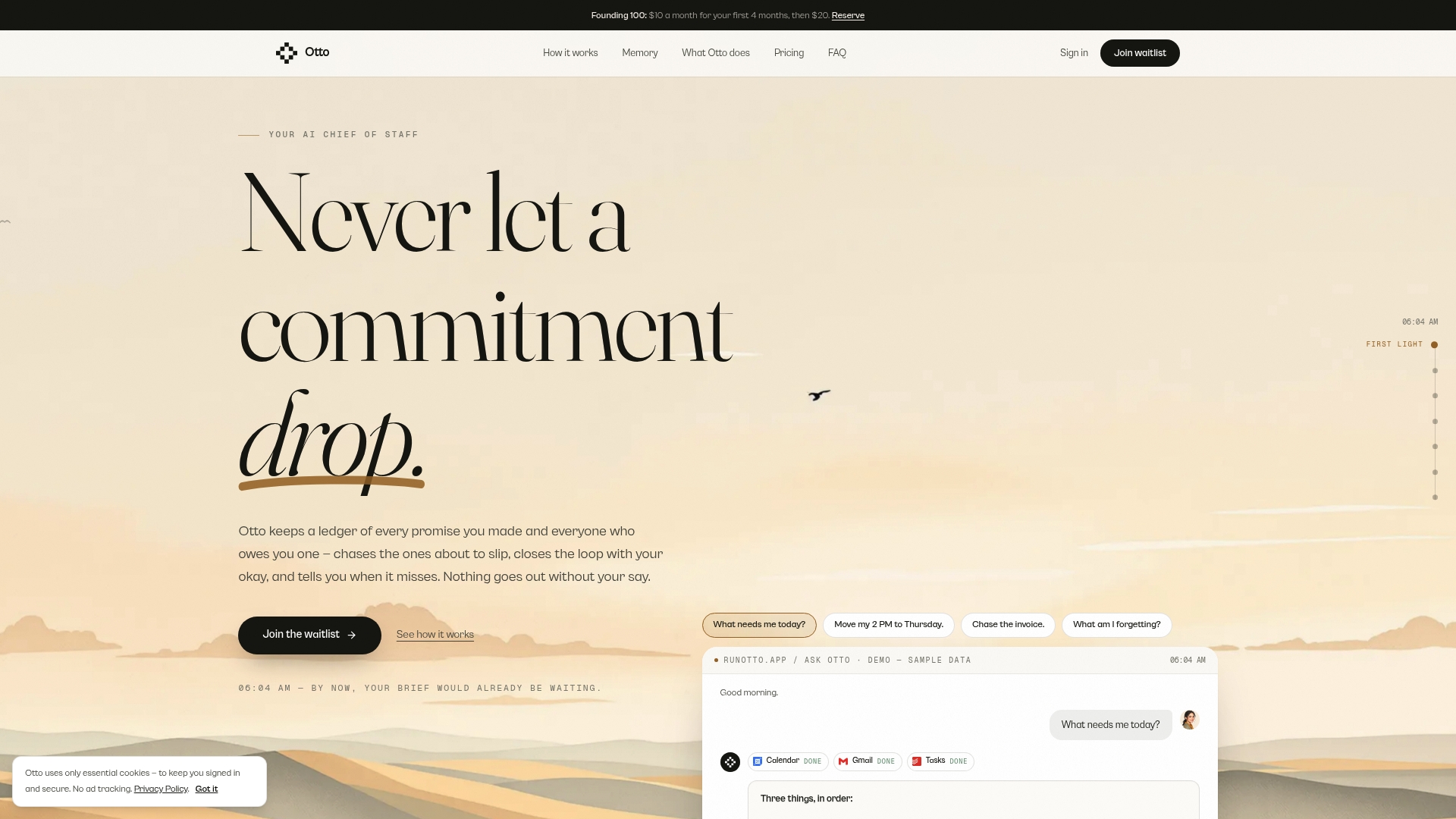
This fits founders, chiefs of staff, and operations leads juggling commitments across a dozen tools who are tired of being the one holding all the context in their head. We offer Free and paid subscription plans with varying levels of usage and integration depth.
- Free: get started with core scheduling and follow-up tracking at no cost.
- Upgraded: more volume and deeper integration coverage.
- Max: full access for teams running the most commitments across tools.
Check plan details and start on the Otto landing page.
FAQ
Does Outlook offer a scheduling tool?
Yes, Outlook supports Schedule send directly in the new Outlook compose window, along with a classic Delay Delivery option and rules-based deferment. Viva Insights also suggests send times that fall within a recipient’s working hours.
Do scheduled emails show that they were scheduled?
Scheduled emails typically sit in a visible folder, such as Gmail’s Scheduled folder or Outlook’s Drafts and Sent Items, so you can confirm a message is pending before it sends. Gmail specifically lets you open, edit, or cancel a scheduled message from that folder.
Is there a way to automate sending emails?
Yes, through native scheduled send for simple timing, automation platforms like Zapier or SendGrid for trigger-based flows, or an integrated AI assistant that drafts emails based on calendar and commitment context. Entry and exit criteria matter most once you move beyond simple scheduled send.
What is the best email automation tool?
The right choice depends on your actual need: native scheduling for occasional time-sensitive sends, an automation platform for repeatable high-volume flows, or an integrated assistant like Otto when scheduling depends on context scattered across email, calendar, and meetings. Otto specifically requires your approval before anything sends, which suits anyone wary of write-only automation.
How do I avoid sending an email by mistake with automation?
Require an explicit approval step before any automated workflow sends a message or creates a calendar event, rather than letting the system act on inferred intent. Checking where scheduled messages are stored and testing the cancel function regularly also catches mistakes before they go out.