 Otto
OttoSet Automatic Email Reminders in Under Five Minutes for Busy Teams
Set Automatic Email Reminders in Under Five Minutes for Busy Teams

The quickest route is a smart-address inbox service (email a task to something like tomorrow@fut.io and it comes back on schedule), Gmail’s built-in Schedule Send or Outlook’s recurring message rules, or, for client appointments, your booking software’s automated reminder toggle. Pick the smart address for a one-off follow-up, Gmail/Outlook for anything recurring inside your own inbox, and appointment software when clients need to reschedule from the reminder itself.
TL;DR:
- Smart-address services are ideal for quick, one-off reminders but do not preserve conversation context for ongoing follow-ups.
- Built-in Gmail and Outlook scheduling features are more reliable for recurring internal reminders, with minimal setup time.
- Automated reminders from booking platforms are best for client appointments, as they include reschedule links and timing options.
- Connecting forms and CRMs to email requires careful setup to avoid errors, volume limits, and deliverability issues, especially with personal accounts.
- A unified system like Otto can centralize and automate reminders tied to actual commitments, reducing scattered effort and duplicate messages.
Table of Contents
- What Are the Main Ways to Set Up Automatic Email Reminders?
- How Do You Set Up Reminder Emails in Gmail, Outlook, and Smart-Address Tools?
- Will Automatic Reminder Emails Get Flagged as Spam?
- How Do You Set Recurring Reminders and What Should They Say?
- How Do You Connect Forms, CRMs, and Spreadsheets to Auto-Send Reminders?
- Which Reminder Method Actually Fits Your Team?
- Otto Keeps Reminders Tied to What You Actually Promised
- Sources
What Are the Main Ways to Set Up Automatic Email Reminders?
Every method trades speed for control. Inbox-first smart-address services are the fastest: you address an email to a service like nudge@followupthen.com, write a subject, and it lands back in your inbox at the time you named. No account setup, no new app, and the original thread stays intact because you are literally forwarding it forward in time.
Built-in Gmail and Outlook features sit one notch up in reliability. You are not depending on a third party staying online. Outlook’s recurring rules and add-ins, and Gmail’s Schedule Send, work inside the client you already trust, and Microsoft’s own community troubleshooting threads cover the exact menu paths when something breaks.
Calendar-based reminders work best for anything tied to a date rather than a task. Appointment and booking platforms go further still, sending automated reminders with built-in reschedule links, which matters when a client needs to act on the email rather than just read it.
Automation platforms like Zapier or Power Automate are the heaviest option, and the right one once you outgrow manual triggers.
- Sales follow-ups and one-off nudges: smart-address services, fastest to set up
- Recurring internal task reminders: Gmail/Outlook native scheduling
- Client appointments: booking software with automated reminders and reschedule links
- Form-based triggers (someone submits a request): automation platforms connected to your email provider
The trade-off to watch is context. A forwarded thread keeps history; a fresh reminder email from a booking tool does not, so you rebuild context every time a client replies.
How Do You Set Up Reminder Emails in Gmail, Outlook, and Smart-Address Tools?
Each method takes under five minutes once you know the pattern.
- Smart-address method. Compose a new email, put the smart address in the To field (something like
3days@service.comor a natural-language string such as “next Monday 9am”), and BCC yourself if you want the reminder to stay private and out of a shared thread. Use ISO-style dates when the service supports them (“2026-03-12”) to avoid ambiguity between US and international date formats. - Gmail. Compose your reminder, click the dropdown arrow next to Send, and choose “Schedule send.” For anything recurring, most people either resend the same draft weekly or connect a lightweight add-in, since Gmail has no native recurring-send button.
- Outlook. Use the Follow Up flag with a reminder time, or build a rule that fires a templated message on a schedule. Outlook’s own community answers walk through the add-in options when the built-in rules engine falls short.
- Appointment software. Turn on automated reminders in settings, set the lead time (24 hours before is standard, 48 for anything requiring prep), and confirm the reschedule link actually resolves before you go live.
Test every setup with a reminder to yourself first. Send it, wait for delivery, then check formatting and links before you trust it with a client’s inbox.
Pro Tip: Set your first automatic reminder five minutes ahead of the current time, not a day out. You will know within minutes whether the setup actually works instead of finding out tomorrow that it didn’t.
Will Automatic Reminder Emails Get Flagged as Spam?
They can, especially when you send from a personal account at volume or stuff the body with unnecessary personal details. Remote’s automation guidance recommends including only the minimum information needed and confirming your provider actually permits automated sends before you rely on them.
Personal Gmail accounts have a daily sending limit that restricts the volume of emails you can send to keep usage manageable; this limit is important to consider before connecting a form or CRM for automated emails.
Before switching anything on, run through this:
- Verify the sender address is authenticated (SPF/DKIM set up if you’re sending from a custom domain)
- Strip out anything sensitive from the reminder body, name and detail only what’s needed
- Send a test to a Gmail, Outlook, and Yahoo address and check all three inboxes, not just spam folders
- Keep an eye on send logs if your platform provides them, silent failures are more common than bounced ones
A quick number worth knowing: personal Gmail’s rough 500-message daily ceiling is the point where most small teams need to move to a dedicated sending tool rather than a personal inbox.
How Do You Set Recurring Reminders and What Should They Say?
Recurrence works differently depending on the tool. Smart-address services usually parse phrases like “every Monday” or “every 14 days” directly in the subject or address. Native scheduling in Gmail and Outlook has no true recurrence button, so most people either duplicate a scheduled draft or use a rule tied to a calendar trigger.
Three templates cover most professional use cases:
- Appointment reminder: “Hi [Name], this confirms your appointment on [Date] at [Time]. Reply to this email or use [Reschedule Link] if that no longer works.”
- Post-meeting follow-up: “Following up on our call about [Topic] — you mentioned sending [Item] by [Date]. Let me know if that timeline still works.”
- Periodic task check-in: “Quick check on [Task]: any blockers since we last touched this on [Last Date]?”
Keep the original thread attached for follow-ups where history matters, and use a short standalone summary for anything recurring, like a weekly check-in, where dragging the whole thread along just adds clutter.
How Do You Connect Forms, CRMs, and Spreadsheets to Auto-Send Reminders?
The standard pattern is trigger, then action: a form submission, a spreadsheet due date, or a CRM stage change fires an automation platform, which sends the email. FormAssembly’s documentation draws a useful line here: notifications go to your internal team, auto-responders go to the person who filled out the form, and auto-responders need a validated email field plus a verified sender address before they’ll fire.
FormHug’s notification docs describe the mechanism plainly: each notification is a rule, trigger happens, email sends, and connecting Gmail through OAuth lets the system send from your own address rather than a generic one.
Watch for three failure points as you build these:
- Field mapping errors (the automation pulls the wrong column or an empty cell)
- OAuth consent expiring silently, which stops sends without an obvious error
- Provider-specific sender rules that block automated mail from a personal account past a certain volume
Pro Tip: Route anything past a few hundred sends a month through a transactional SMTP provider instead of a personal inbox. It’s the difference between a reminder system that works quietly and one you have to babysit. A marketing automation checklist is worth reviewing before you wire up your first multi-step workflow.
Which Reminder Method Actually Fits Your Team?
Solo operators and very small teams should start with inbox-first smart addresses. They’re free, take sixty seconds to set up, and don’t require touching a settings menu you’ll forget about in six months.
Once you’re sending reminders that clients act on, like rescheduling an appointment, move to purpose-built software such as recurring maintenance or booking platforms, which handle that back-and-forth cleanly.
Where I see people get stuck is the middle ground: five or six tools, each holding half a conversation, and no single place that remembers what was promised in a meeting versus what’s sitting in an inbox. That’s a coordination problem, not a reminder problem, and it’s where a unified system like Otto earns its place instead of another point solution.
— Eddie
Otto Keeps Reminders Tied to What You Actually Promised
A unified assistant is the difference between a reminder that says “follow up with Sarah” and one that already knows you promised her a proposal by Friday because it heard that on the call. Such a system reads email and calendar and listens in meetings, holding every commitment in one shared memory instead of scattering it across a notetaker, an inbox rule, and a sticky note.
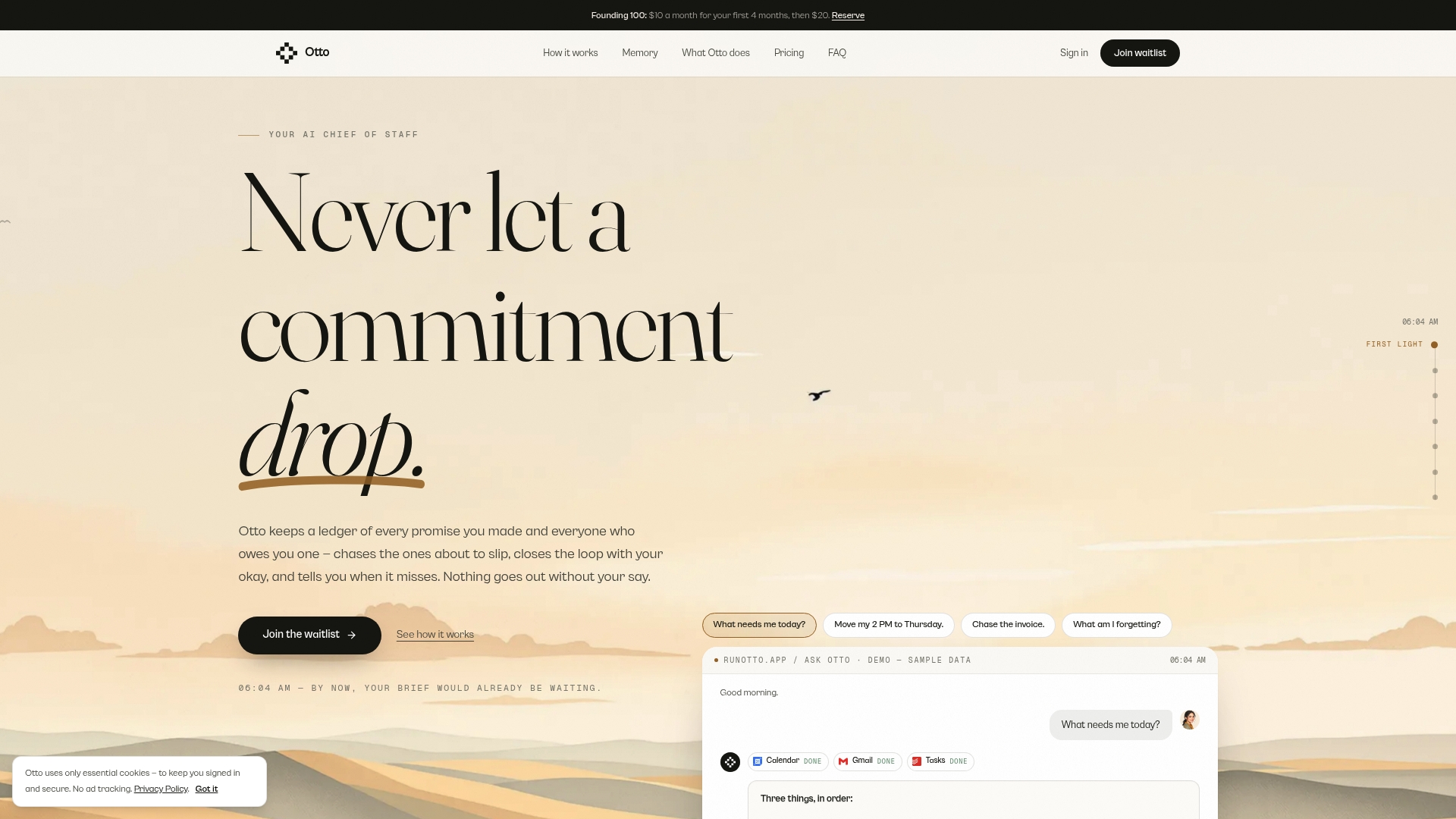
That single memory is what stops duplicate reminders. Most setups fire a nudge from your calendar and another from your inbox for the same task, and you end up doing the reconciling. This type of system chases each commitment until it’s closed and drafts the follow-up for your approval. Nothing goes out without your sign off.
If your reminders are scattered across three tools and you’re tired of being the one holding the connections together, start with Otto and see what a single shared memory does to your morning task list.