 Otto
OttoOne Rule to Fix Calendar and Task Sync for Busy Professionals
One Rule to Fix Calendar and Task Sync for Busy Professionals

A dated task shows up on your calendar. An undated one usually sits in a separate list, invisible until you open the app, or it fires a default reminder instead of taking a calendar slot. The single rule that fixes most sync frustration: give any task you want to see on your calendar an explicit date and time. From there, pick one app as the source of truth, run a test task before trusting the system, and reach for middleware or an AI assistant only once native sync hits a real limit.
TL;DR:
- Tasks without a specified date usually do not appear on your calendar, while tasks with a date and time will be projected as events or reminders.
- Using different accounts for tasks and calendar apps can cause items to go missing due to OAuth mismatch; consistent sign-in is essential.
- Recurring tasks only show a limited window of upcoming instances, so older or far-future items may seem absent but are simply outside the display range.
- Middleware is necessary if you need conditional syncing, custom fields, or integration across multiple ecosystems like Google, Microsoft, and external databases.
- Setting explicit dates and times, turning on the calendar’s task layer, and testing with one or two tasks help establish a reliable sync from the start.
Table of Contents
- How task-to-calendar synchronization actually works
- Google Tasks and Google Calendar: what actually shows up
- Outlook and Microsoft To Do: how the two systems connect
- When native sync isn’t enough: middleware and advanced tools
- A checklist for setting up reliable sync
- Fixing missing or incorrect sync
- Why one shared memory beats another point-to-point sync
- Setting expectations before you automate
- Try Otto if you’re tired of being the sync layer
- Where to check the details yourself
- Sources
- FAQ
How task-to-calendar synchronization actually works
Tasks and calendar events are built differently, even when an app blends them on screen. An event has a fixed start and end time and represents a commitment on the clock. A task is an item on a list, sometimes with a due date, sometimes without one, and the app decides whether and how to project it onto your calendar grid.
That projection follows rules, not guesswork. A task with only a date usually gets slotted as an all-day item or a default-time reminder. A task with a specific time behaves more like an event and notifies you at that exact moment. This is why two tasks that look identical in a list can behave completely differently once they hit the calendar.
Sync also comes in two shapes. One-way sync copies data in a single direction, so edits made on the receiving side often do not travel back and can create duplicates. Two-way sync tries to keep both sides identical, but only one system can really be canonical, meaning the original record of truth, or conflicting edits start overwriting each other.
Underneath all of it sits authentication. Most sync depends on OAuth account linking between apps, and a mismatch (signing in to Calendar with one account and Tasks with another) is the most common reason items go missing.
- Dated tasks generally appear on the calendar; undated tasks usually stay list-only.
- One-way sync creates copies; two-way sync needs one clear canonical source.
- OAuth linking must use the same account across every connected app.
- Default notification times vary by platform and by whether a task has a time attached.
Google Tasks and Google Calendar: what actually shows up
Google Tasks needs a date before it will appear anywhere on the Google Calendar grid. Once it has one, the notification behavior depends on whether you added a specific time: a time-specific task notifies you at that exact time, while a date-only task defaults to a 9:00 AM local notification. That default has caught out plenty of people who assumed a task due “Friday” would nudge them at a useful moment during the day.
Recurring tasks add another wrinkle. Google Calendar only displays a limited window of upcoming instances at a time rather than the entire future series, and new instances populate as older ones pass. If you edit a repeating task, do it from Calendar’s task panel to make sure the change applies to the instance you expect.
- Open Google Calendar and confirm the Tasks layer is checked in the side panel.
- Add a due date (and time, if you want a precise reminder) to any task you want visible.
- Click into the task from the calendar to edit it directly, rather than switching to the separate Tasks app.
- Create one test task with a time and one with only a date to confirm the notification difference.
Pro Tip: Set a specific time on anything time-sensitive. Date-only tasks will otherwise ping you at 9:00 AM regardless of when the work is actually due.
One more thing worth planning around: Google Keep reminders are migrating into Google Tasks, and Tasks carries its own cap on total items, so a large import from another system deserves a staged rollout rather than a single bulk upload.
Outlook and Microsoft To Do: how the two systems connect
Microsoft To Do and Outlook Tasks share the same underlying storage: when you sign into both with the same account, tasks stored on Exchange Online appear in both apps. Dragging a task from My Day onto your Outlook calendar blocks time for it, but the original task and the new calendar event often remain two separate objects rather than one synced item, so completing one does not automatically close the other.
Feature parity is the second thing to watch. Microsoft To Do does not mirror every field that Outlook Tasks supports: start and end dates, multiple priority levels, and categories can exist on the Exchange record without ever displaying in the To Do interface. That mismatch is a common reason a task looks incomplete or a category tag seems to vanish, when in fact the data is stored, just not surfaced.
- Sign into Outlook and To Do with the identical account to avoid split task lists.
- Treat a dragged calendar block as a separate item and check off the original task manually.
- Expect some categories, colors, or date ranges to exist on Exchange but not show in To Do.
- Test canonical editing by changing a task in Outlook first, then confirming it updates in To Do.
When native sync isn’t enough: middleware and advanced tools
Native sync between two apps handles the basics well: one task list, one calendar, one account. Trouble starts once you’re running multiple ecosystems, need conditional logic (like only syncing tasks tagged “urgent”), or want database fields like project and estimated duration to survive the trip from a tool like Notion into calendar events. That’s the point where middleware built for field-level mapping starts to earn its cost over a free native connector.
Before adopting one, check a few things: does it support mapping custom fields rather than just title and date, what’s the webhook latency and rate limit under real usage, and does it offer granular OAuth scopes so you’re not handing over blanket account access. On the security side, ask where data is stored at rest, whether audit logs exist, and whether it supports enterprise single sign-on if you’re deploying it across a team.
- Multiple ecosystems (Google plus Microsoft plus a database tool) usually justify middleware.
- Conditional sync (tags, priority, custom fields) is rarely available in native connectors.
- Granular OAuth scopes and audit logs matter more once several tools touch the same data.
- An AI assistant that reads inbox, calendar, and meeting notes directly can replace several point-to-point syncs.
Pro Tip: Before paying for middleware, map out exactly which fields you need to survive the sync. Most sync headaches trace back to one missing field, not a missing platform.
A checklist for setting up reliable sync
Getting sync right the first time beats debugging it later. Run through this order:
- Confirm you’re signed into every connected app with the same account and that OAuth grants are active.
- Pick one canonical source per item type (tasks live in one app, events in another) so edits have a clear home.
- Add explicit dates and times to anything you need visible on the calendar, not just in a list.
- Turn on the task layer in your calendar’s view settings.
- Create one or two test tasks, one dated and one timed, and confirm both notification and visibility behave as expected.
- If you’re adding middleware, map a handful of test fields and run a small pilot before connecting your full workload.
Fixing missing or incorrect sync
Most sync problems trace back to one of four causes. Start with the task itself: does it have a date, and if you expect a calendar slot rather than a list entry, does it also have a time? Next, check the calendar’s task layer setting, since a hidden layer makes correctly synced tasks look missing.
Time zone mismatches are another frequent culprit, particularly when a task was created on one device’s local time and the calendar account defaults to another. If a task appears twice, look for two integrations both writing to the calendar and designate one as canonical, turning the other read-only. Finally, remember that recurring tasks only show a limited window of instances at a time. An older or far-future occurrence that seems to have vanished is often just outside that window, not actually deleted.
- Check the task has a date/time and the calendar’s task layer is turned on.
- Compare the task’s time zone to the calendar account’s default time zone.
- Look for duplicate entries from more than one integration writing to the same calendar.
- Remember that repeating tasks show only a rolling window of instances, not the full series.
Why one shared memory beats another point-to-point sync
Some AI assistants keep email, calendar, and meetings in one shared memory instead of syncing separate apps. They listen in meetings, read inbox and calendar, and capture commitments made in either into a single ledger they track until closed. A promise made out loud on a call can become a tracked item proposed as a scheduled task or a calendar block, without re-typing it into a separate to-do app.
These tools may draft actions and scheduling suggestions but never send or finalize anything without explicit approval, so automation stays reviewable rather than autonomous.

Setting expectations before you automate
I’d rather start calendar-first for anything time-bound and task-first for open-ended work, since forcing every task onto the calendar just adds noise. Founders, chiefs of staff, and operators juggling several tools tend to benefit most from an integrated assistant. Whatever you choose, grant OAuth scopes gradually and pilot with a small task list first.
— Eddie
Try Otto if you’re tired of being the sync layer
This assistant skips the calendar-versus-task-app question by keeping one shared memory of email, calendar, and meetings, so a commitment made in either place becomes a tracked item without manual copying.
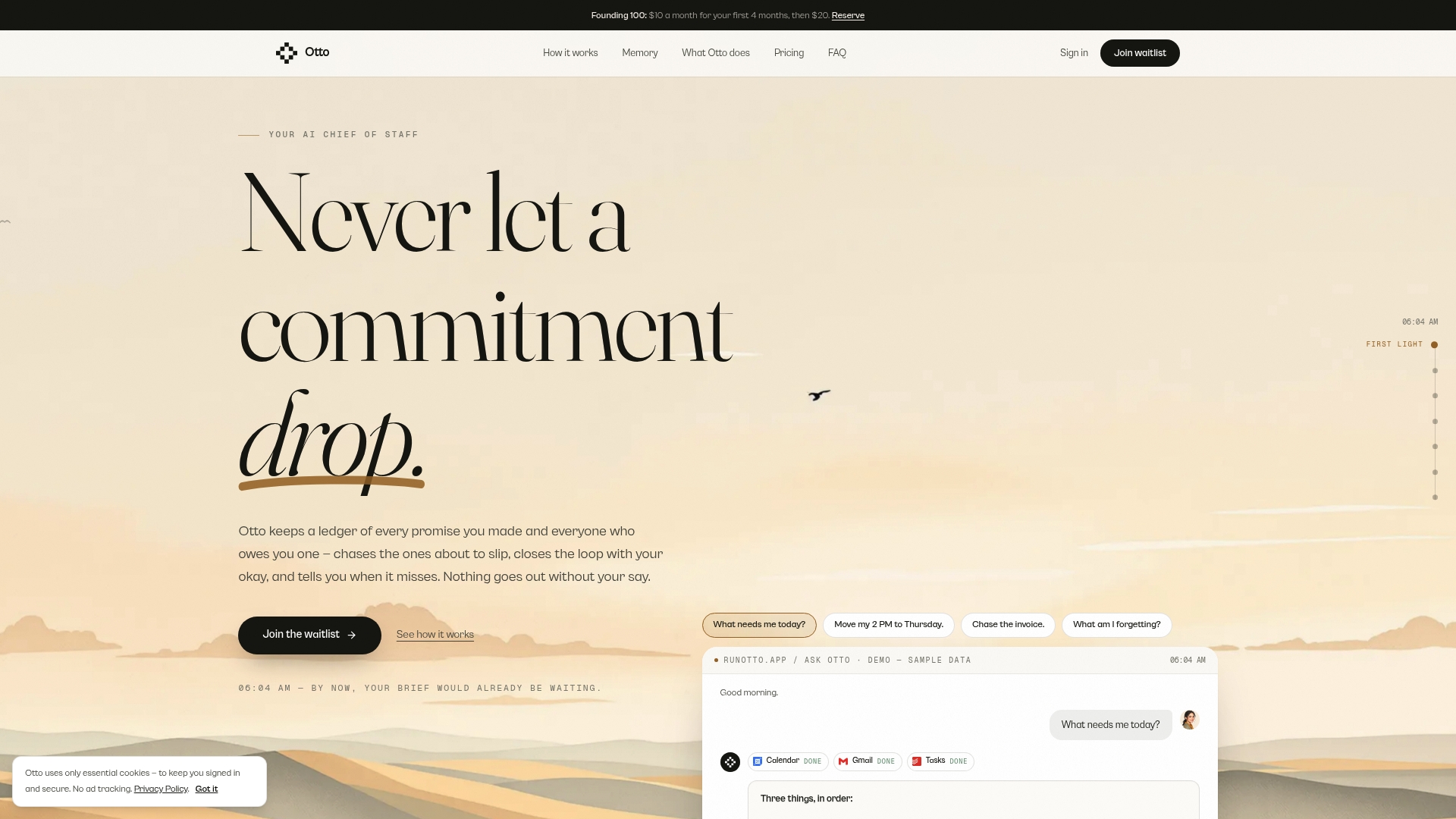
A trial shows three things directly: how it captures a promise from a meeting or email thread, how it proposes a scheduling slot for that commitment, and how nothing goes out or gets finalized until you approve it. Plans start with a Free tier, with Upgraded and Max available as usage grows, all listed on the Otto landing page.
- See a real commitment get captured from an email or meeting automatically.
- Review a scheduling proposal before anything hits your calendar.
- Approve or edit every outbound action yourself, every time.
Where to check the details yourself
For exact platform behavior, see Google’s Tasks help, Microsoft’s To Do support, and the Nomora sync checklist for a hands-on setup example.
Sources
- Set start times and import reminders in Google Workspace updates (2019)
- Create and manage tasks in Google Calendar - Google Tasks Help
- Drag a task to your calendar with To Do in Outlook
FAQ
How do I sync tasks with my calendar in Outlook?
Sign into Outlook and Microsoft To Do with the same account, since tasks stored on Exchange Online then appear in both apps automatically. From My Day in Outlook, you can drag a task onto the calendar to block time for it, though the task and the new event often stay separate objects.
Can I sync Google Tasks with Apple Calendar?
Google Tasks does not have a direct native sync into Apple Calendar, so most people rely on a middleware tool or a shared calendar subscription to bridge the two. Checking the specific connector’s field mapping matters here, since custom middleware typically handles cross-ecosystem sync better than a one-off workaround.
What task apps can sync with Google Calendar?
Google Tasks syncs natively with Google Calendar once a task has a date, appearing directly on the calendar grid per Google’s own Tasks documentation. Other task apps, including database-style tools, generally need middleware or an integrated assistant like Otto to map their fields into calendar events.
How do I sync Google Tasks with my calendar?
Add a due date to the task, since Google Tasks only appears on the calendar once it has one, and add a specific time if you want a precise reminder instead of the default 9:00 AM notification. Then confirm the Tasks layer is turned on in Google Calendar’s side panel so the item is visible.