 Otto
OttoCut Overhead in 4–8 Weeks: Modular Calendar Automation & AI for Teams
Cut Overhead in 4–8 Weeks: Modular Calendar Automation & AI for Teams

Start by choosing a single canonical calendar and enabling a lightweight orchestration layer that enforces a small set of rules, then pilot it with one team before expanding. That means connecting your primary calendar source, writing two or three automations that handle common scheduling friction, and testing with real meetings for a few weeks before rolling out further.
TL;DR:
- Native automations are suitable for small teams with light scheduling needs but lack advanced logic and cross-platform support.
- Using a single canonical calendar as the source of truth and testing one small automation at a time greatly improves reliability.
- Expect potential sync issues from API rate limits, platform-specific constraints, and declining support for cross-platform calendar syncing after October 2026.
- Building modular, role-based rules with preview and conflict-resolution defaults helps ensure long-term calendar automation stability.
- AI orchestration can reduce scheduling complexity further but should be started cautiously with limited permissions and human oversight.
Table of Contents
- What Are the Main Approaches to Calendar Automation for Teams?
- How to Set Up Calendar Automation Step by Step
- Common Integrations and the Compatibility Gotchas to Watch For
- Design Patterns That Make Calendar Automation Reliable
- What AI Orchestration Adds to Team Scheduling
- A Pilot Checklist for Rolling Out Calendar Automation
- Getting Your Team to Actually Use Calendar Automation
- How to Measure Whether Calendar Automation Is Working
- Fixing the Most Common Calendar Automation Problems
- What Teams Get Wrong About Calendar Automation
- Why We Built Otto Around One Shared Memory
- FAQ
- Sources
What Are the Main Approaches to Calendar Automation for Teams?
Teams generally pick from four approaches to calendar automation, and the right one depends on team size, meeting complexity, and how much control you want over the logic.
- Native platform automations: built into Google Calendar or Outlook, these handle basics like recurring events and simple reminders with no extra cost or setup, but they offer limited logic and almost no cross-platform reach.
- Integration and workflow platforms: tools like Zapier or Make connect calendars to other apps and let you build conditional rules, offering more flexibility at the cost of ongoing maintenance.
- Dedicated scheduling tools: booking links and group-scheduling apps solve the “find a time” problem well but rarely touch the rest of a team’s workflow.
- AI orchestration layers: software that reads calendars, email, and meeting context together to prioritize, draft, and negotiate scheduling decisions, offering the most coverage but requiring the most trust and oversight.
Small teams with light scheduling needs usually do fine with native automations. Operations-heavy teams running dozens of weekly meetings, room bookings, and external calls tend to outgrow them fast and move toward workflow platforms or AI orchestration, trading some simplicity for coverage and speed.
How to Set Up Calendar Automation Step by Step
Setting up calendar automation works best as a short, testable sequence rather than a single big rollout. Follow these steps in order:
- Audit existing calendars. List every calendar each team member uses (personal, shared, resource, scheduling tool) and flag duplicates or conflicting sources of truth.
- Choose your canonical calendar. Pick the one calendar system that will act as the source of record (commonly Google Calendar or Outlook) and treat every other tool as a consumer of it, not a second source.
- Set up permissions and connections. Grant OAuth or API access scoped to calendar read/write only, never full account access, and record which app holds which scope.
- Map event fields. Define how title, description, attendee roles (organizer, must-attend, optional), room or resource bindings, and time zone fields translate across connected tools.
- Build one small automation first. Start with a single rule, such as auto-blocking PTO or auto-declining double-bookings, rather than a full rule library.
- Test with a sample group. Run the automation with five to ten real events for one or two weeks and log every unexpected outcome.
- Define rollback and acceptance criteria. Decide in advance what “working” looks like (for example, zero missed syncs over a week) and how to disable the automation instantly if it misfires.
- Expand gradually. Add the next rule only after the first one has run cleanly through a full business cycle.
Pro Tip: Keep your first automation boring. A rule that blocks PTO correctly every time beats a clever one that occasionally double-books a conference room.
Testing matters more than design here. A rule that looks correct in a spec document can still fail against real calendar quirks like recurring events with exceptions or attendees in different time zones, so the acceptance criteria you set before launch are what catch those failures early.
Common Integrations and the Compatibility Gotchas to Watch For
Most team calendar automation runs through a small set of integration patterns: webhooks that fire on calendar changes, vendor add-ons (like the Teams Meeting add-on for Google Workspace), and API polling where webhooks aren’t available. Google Calendar, Microsoft Outlook and Teams, and standalone schedulers each expose slightly different event objects, which is where sync problems usually start.
- Google Calendar: strong webhook support, but API rate limits can throttle high-frequency automations.
- Microsoft Teams and Outlook: deep native integration, but cross-platform sync has known limits (see below).
- Standalone schedulers (booking links, group polls): easy to connect but often don’t write back role or resource data to the canonical calendar.
The most consequential gotcha for 2026 planning: Microsoft has announced that calendar syncing between Google Workspace and Microsoft Teams will no longer be supported starting October 2026, and recommends admins notify affected users, retrieve account-matching information in advance, and switch to the Teams Meeting add-on for Google Workspace before the cutoff.
Permission models deserve the same attention as integrations. Broad calendar scopes expose attendee lists, meeting titles, and sometimes notes to every connected tool, so a preview-before-execute step, where an automation shows you what it’s about to do before it does it, is worth the extra friction it adds.
Design Patterns That Make Calendar Automation Reliable
The teams that keep calendar automation working long-term tend to follow a few consistent patterns rather than building one all-purpose system.
- Build many small calendar objects instead of one monolith. Enterprise automation guidance recommends composing scheduling logic from several small calendar objects with few events each, rather than one large, complex calendar, because smaller objects are easier to test, reuse, and debug.
- Use role-based rules. Separate logic for organizers, must-attend participants, optional attendees, and bound resources (rooms, equipment) instead of one rule that treats every attendee the same way.
- Default to preview, not auto-send. Any automation that creates, moves, or cancels a meeting should show a preview before it executes, with a human approval step for anything touching external attendees.
- Set conflict-resolution defaults. Decide in advance whether double-bookings get auto-declined, flagged, or left for manual review, so the system doesn’t guess.
- Monitor continuously. Log every sync attempt, alert on failures, and periodically sweep for phantom room bookings that never got released.
Pro Tip: Treat each automation rule as its own small object with one job. A pile of small, well-tested rules is easier to fix than one large rule set that quietly breaks when a single edge case changes.
This modular approach also makes it far easier to roll back a single misbehaving rule without disabling the whole system.
What AI Orchestration Adds to Team Scheduling
AI orchestration goes further than rule-based automation by reasoning about context, not just executing fixed logic. Instead of a static rule (“always book the next open slot”), an AI layer can weigh priority, attendee preferences, and room availability together, and in some setups negotiate directly with other people’s scheduling agents.
- Adaptive slot selection: dynamically narrows down candidate times instead of presenting a fixed list.
- Prioritization: weighs meeting importance against existing commitments rather than treating every request equally.
- Agent-to-agent negotiation: emerging coordination prototypes let scheduling agents negotiate availability on each person’s behalf and present a preview before any event is created.
- Resource coordination: ties room and equipment booking into the same decision instead of handling it as a separate step.
Controlled research on this approach is encouraging. Togedule, an adaptive AI scheduling tool tested in controlled experiments, reduced the mental load reported by attendees and helped organizers reach decisions faster and with less back-and-forth communication than shared calendars or email-based scheduling.
Adaptive scheduling that narrows a dynamic candidate pool, rather than presenting every possible slot, measurably reduced the communication needed to reach consensus and sped up organizer decisions.
The safe way to adopt any of this: start with read-only or preview-before-execute modes, scope agent permissions to meeting metadata rather than full calendar content, and keep a human approval step on anything irreversible. A practical primer on getting started with scheduling tasks using an AI assistant covers the basics well if your team is new to the idea.
A Pilot Checklist for Rolling Out Calendar Automation
A good pilot runs for four to eight weeks with a clear owner, a small test group, and metrics you can actually measure: fewer scheduling email threads, fewer double-booked rooms, and minutes saved per organizer each week.
Assign roles before you start: an admin to manage permissions, an operations lead to own the rule set, two or three testers from a real team, and someone from security or IT to sign off on scopes.
- Weeks 1 to 2: audit calendars, connect the canonical source, configure permissions, build one automation.
- Weeks 3 to 4: run the pilot with testers, log every failure and false positive.
- Weeks 5 to 6: adjust rules based on feedback, add a second automation if the first is stable.
- Weeks 7 to 8: review metrics against acceptance criteria and decide go or no-go for a wider rollout.
| Metric | What to track | Target signal |
|---|---|---|
| Scheduling email threads | Count per week before and during pilot | Noticeable drop by week 6 |
| Meeting conflicts | Double-bookings flagged or caught | Trending toward zero |
| Time to finalize a meeting | Hours from request to confirmed slot | Faster than baseline |
Getting Your Team to Actually Use Calendar Automation
The best automation fails quietly if nobody trusts it enough to rely on it. Training should start with a short walkthrough showing exactly what each rule does and, just as important, what it does not do, so people don’t assume coverage that isn’t there.
Give the pilot group a single point of contact for questions and a visible log of every automated action for the first few weeks. Seeing that a tool correctly blocked PTO or declined a conflicting invite ten times in a row builds trust faster than any explanation does.
Resistance usually comes from two places: fear of losing control over your own calendar, and past experience with automation that silently broke something. Address both directly. Let people opt out of any automation that touches their personal calendar, and be transparent when something goes wrong instead of quietly patching it.
Keep documentation short. A one-page reference showing what’s automated, who owns it, and how to flag a problem works better than a long policy document nobody reads. Revisit adoption after the pilot ends. Usage tends to drop off if nobody checks in, so a brief follow-up at thirty and sixty days helps catch rules that quietly stopped being useful or started causing friction.

How to Measure Whether Calendar Automation Is Working
Measuring calendar automation starts with the same metrics you set during the pilot: the number of scheduling email threads per week, the rate of meeting conflicts, and the average time to finalize a group meeting. Track these weekly rather than waiting for a quarterly review, since small regressions are easier to catch and fix early.
A no-show or phantom-booking rate for shared rooms is worth tracking separately. Rooms that stay reserved after a meeting is canceled or moved waste physical space and quietly erode trust in the system.
Optimization is mostly about removing rules that aren’t pulling their weight. If a rule hasn’t caught a real conflict in a month, it may be redundant or miscalibrated. Pair quantitative metrics with a short, recurring check-in: ask the pilot group whether the automation is saving them time or creating new work. A rule that technically reduces email threads but adds confusion isn’t actually a win.
Treat the first full business cycle (a month, typically) as your baseline. Comparing week-over-week numbers against that baseline, rather than against a vague sense of “better,” keeps the evaluation honest.
Fixing the Most Common Calendar Automation Problems
Most calendar automation failures trace back to a handful of recurring causes.
Sync delays or missed updates usually come from API rate limits or webhook failures. Check your logs first; if a webhook silently stopped firing, events can drift out of sync for hours before anyone notices.
Double-bookings often happen when two systems both think they’re the canonical source. Revisit your source-of-truth decision if conflicts keep appearing after rules were supposed to prevent them.
Time zone errors are common with distributed teams, especially around daylight saving transitions. Confirm that every connected tool reads time zone data from the event itself, not from a default account setting.
Phantom room bookings happen when a meeting is canceled in one calendar but the resource booking isn’t released in another. A periodic sweep that cross-checks room bookings against live meetings catches this before it compounds.
Over-broad permissions sometimes surface as a privacy complaint rather than a technical bug. If attendees notice an automation referencing details it shouldn’t have access to, tighten the scope immediately rather than patching around it.
When in doubt, roll back to the last known-good rule set and reintroduce changes one at a time. Debugging a single new rule is far easier than untangling several at once.

What Teams Get Wrong About Calendar Automation
Simplicity wins early, and most teams ignore that. The urge to automate everything at once, PTO, room booking, meeting prioritization, and follow-ups, all in the first sprint, is the single biggest reason pilots stall. Pick one automation that removes real cognitive load, like auto-declining double-bookings, and prove it works before touching anything else.
The second common mistake is skipping observability. A rule that silently fails for two weeks before anyone notices does more damage than no automation at all, because people stop trusting the system and quietly route around it.
If your team’s real problem is that scheduling context lives in five different tools and nobody remembers what was promised to whom, a narrow calendar fix won’t solve it. That’s a case for a unified approach, like Otto, that treats calendar, email, and meeting commitments as one connected record instead of five separate ones.
— Eddie
Why We Built Otto Around One Shared Memory
Calendar automation solves the scheduling half of the problem. The other half is everything a meeting produces: the promise you made out loud, the follow-up email nobody sent, the commitment that lived only in someone’s notes. We built Otto to close that gap by keeping email, calendar, meetings, and commitments in one shared memory, so nothing has to be re-explained between tools.
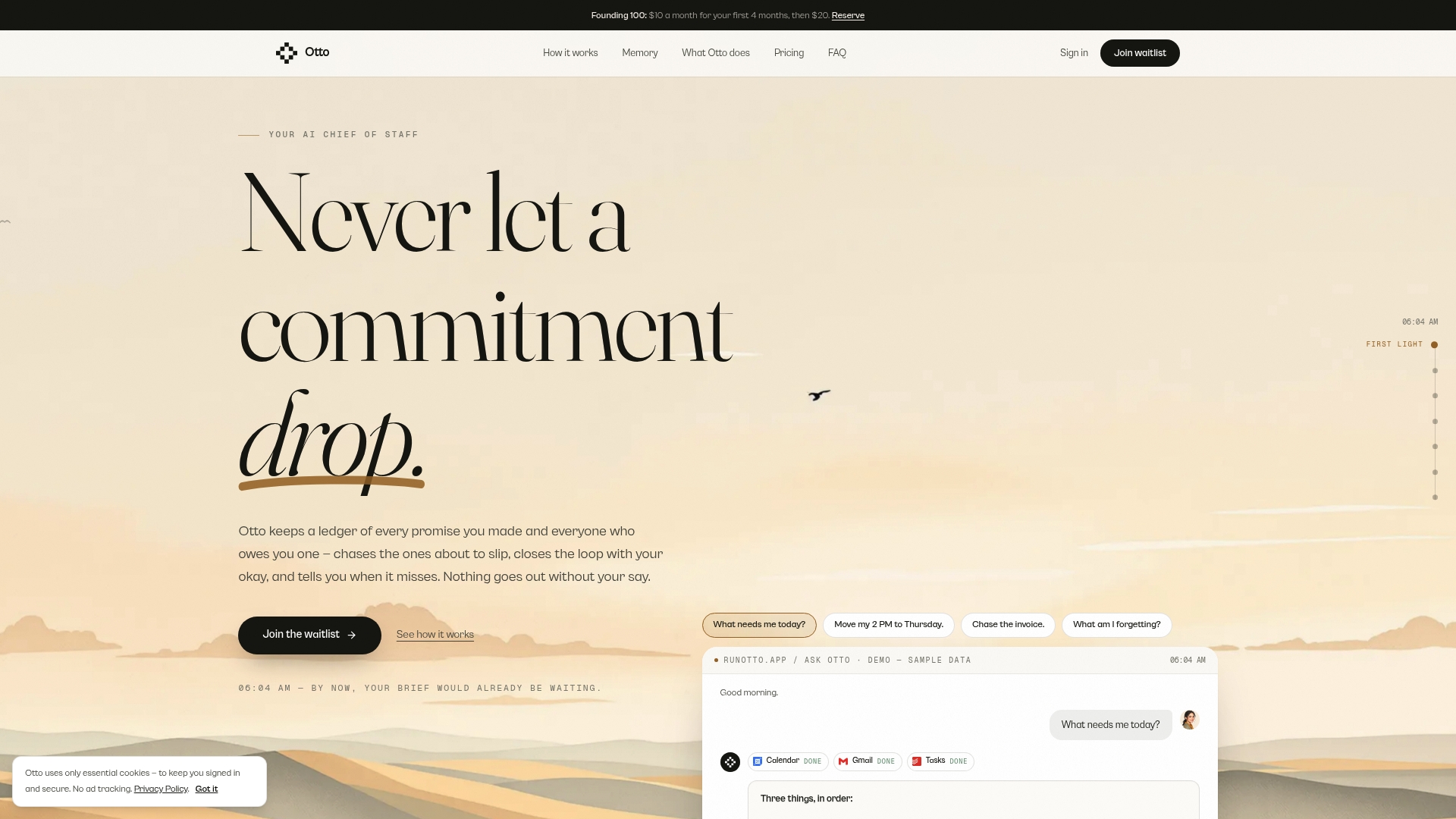
Otto listens in meetings, reads your inbox and calendar, and captures every promise made across any of them into a single ledger it keeps chasing until it’s closed. Nothing goes out without your approval first. We offer a Free plan at $0 per month, with Upgraded and Max plans available as your needs grow. Start with the Otto free plan and see what one shared memory does for your week.
FAQ
What is the best way to set up a team calendar?
Start by choosing one canonical calendar as the source of truth, then connect other tools as consumers of it rather than competing sources. Audit existing calendars first, map attendee roles and resource bindings, and test with a small group before expanding to the full team.
What is the best free scheduling tool for teams?
Native options built into Google Calendar and Outlook handle basic team scheduling at no cost, including recurring events and simple availability checks. For more complex needs like AI-assisted prioritization, Otto’s Free plan offers calendar and email integration at $0 per month.
Which calendar app is best for Microsoft Teams?
Outlook and Microsoft Teams integrate natively and are generally the most reliable pairing for Teams-based scheduling. Note that Microsoft Teams will stop supporting direct calendar sync with Google Workspace starting October 2026, so mixed-platform teams should plan for the Teams Meeting add-on instead.
How can I create an interactive calendar?
An interactive calendar typically combines a shared calendar backend with a booking or scheduling layer that lets people request or confirm times directly. Tools that scan email threads to suggest meeting times, such as AI meeting schedule extensions, can add an interactive layer on top of a standard calendar.