 Otto
OttoOne Week Commitment Tracking for Project Teams: Prove Promises
One Week Commitment Tracking for Project Teams: Prove Promises

Commitment tracking is the practice of capturing every promise made in a meeting, email, or chat message, along with who owns it and when it is due, so nothing depends on memory. The biggest win is visibility: instead of guessing who dropped what, a manager can see, in one place, exactly what was pledged, what shipped, and what slipped. Teams that do this well spend less time chasing status and more time acting on it.
TL;DR:
- Commitments should have a clear owner, deadline, and source like an email or meeting record to ensure they are properly tracked and verified.
- Percent Plan Complete (PPC) is the standard metric, but small weekly samples can cause large swings, so it must be interpreted in context.
- Recording reasons for overdue or canceled commitments helps identify systemic issues such as dependency delays or scope changes, especially when reviewed monthly.
- Connecting conversations from meetings, emails, and chats to commitments reduces missed promises by automatically detecting and creating tracked promises.
- A one-week pilot focusing on capturing, reconciling, and reviewing commitments can validate if the system improves follow-through before wider implementation.
Table of Contents
- What Metrics Actually Show Whether Commitments Get Kept?
- How Do You Record a Commitment So It Actually Sticks?
- What Status Should Every Commitment Carry?
- Why Do Commitments Slip, and How Do You Track the Reasons?
- How Does Connecting Meetings, Email, and Chat Cut Down Missed Promises?
- What Does a One-Week Commitment Tracking Pilot Look Like?
- The Real Divide Isn’t Tracking Tasks. It’s Tracking Promises
- An AI Chief of Staff That Actually Closes the Loop
- Where to Go for Deeper Technical Detail
- Sources
- FAQ
What Metrics Actually Show Whether Commitments Get Kept?
The standard yardstick is Percent Plan Complete (PPC): the share of commitments finished on time out of everything committed for that period. Touchplan’s approach to weekly commitment tracking uses PPC alongside color-coded pins marking work as on-time, late, or early, plus a “Next Period” column that rolls unfinished items forward with a documented reason.
A few variations matter depending on team size and cadence:
- PPC = on-time completed commitments ÷ total commitments made, for the period.
- Completion rate ignores timing and just measures whether the item closed at all, useful for spotting scope problems separate from scheduling ones.
- On-time rate isolates punctuality among only the completed items, which flags a team that finishes work but consistently runs late.
Weekly windows suit fast-moving teams where commitments turn over quickly; monthly windows fit larger programs where a single sprint’s noise would distort the number. Watch out for small-sample swings. A team with few commitments per week can experience large swings in their PPC on a single missed item, so read short-term drops in context before treating them as a trend.
How Do You Record a Commitment So It Actually Sticks?
A commitment only becomes trackable once it has a name, a date, and a source. Vague entries like “follow up with finance” are where tracking systems quietly fail, because nobody can later prove what was actually agreed.
- Owner. One named person, never a team or department. Shared ownership is how commitments go unfinished without anyone feeling responsible.
- Deadline. A specific date, not “soon” or “next sprint.” If the deadline is fuzzy, the commitment isn’t finished being negotiated yet.
- Receipt or source. A link back to the exact email, meeting timestamp, or message where the promise was made. Actioner’s approach stores this receipt with every commitment so it can be reconciled later without a debate about who said what.
- Short description. One sentence, written the moment the promise is made, not reconstructed from memory afterward.
Capturing in the moment beats backfilling from notes days later, because details erode fast. A simple acceptance line (“Confirmed, I’ll have this by Thursday”) or a calendar focus block tied to the deadline gives you a lightweight way to confirm the owner actually agreed, rather than assuming they did.
What Status Should Every Commitment Carry?
Commitments move through a small set of states, and most tracking failures come from skipping or misusing them. Agent Friday’s open-source tracker defines the lifecycle as:
- Active — accepted, not yet due.
- Completed — delivered, ideally with evidence attached.
- Overdue — past the deadline with no delivery.
- Cancelled — no longer needed, with a reason logged.
- Snoozed — deadline renegotiated, new date attached.
The trap most systems fall into is marking something “completed” because someone said it was done, rather than checking it happened. Reconciliation against objective evidence, like a merged pull request, a signed ticket, an uploaded file, or a confirmation email, closes that gap and cuts the manual status updates managers otherwise chase down one by one. Some items genuinely need a human eye (a client relationship promise has no ticket to check), so reserve manual verification for cases where no system-of-record trail exists.
On a dashboard, show owner, deadline, status, and receipt link side by side. In a weekly review, scan for anything sitting in “active” past its deadline before the system even flags it overdue. That’s usually where trouble starts.
Pro Tip: Set a rule that nothing moves to “completed” without a receipt attached. It takes five extra seconds per item and eliminates most of the false positives that make dashboards look better than reality.
Why Do Commitments Slip, and How Do You Track the Reasons?
A missed deadline without a logged reason teaches you nothing. Require a variance reason at the moment a commitment flips to overdue, cancelled, or snoozed, chosen from a short fixed list rather than a free-text box nobody fills in carefully.
A workable taxonomy:
- Staffing — the owner got pulled onto something else.
- Supplier or vendor delay — a third party missed their own deadline.
- Dependency — blocked on another unfinished commitment.
- Scope change — the ask changed mid-stream.
- Unclear owner — nobody actually agreed to it in the first place.
Run these categories through a monthly review, not a weekly one. Weekly variance is mostly noise. Monthly patterns are signal. If “dependency” shows up on a third of your overdue items, your problem isn’t individual accountability, it’s sequencing, and that changes how you plan the next quarter rather than who gets a reminder email.
How Does Connecting Meetings, Email, and Chat Cut Down Missed Promises?
The commitments that vanish are almost never the ones written in a project plan. They’re the ones said out loud in a meeting, buried in a Slack thread, or tossed off at the end of an email that never made it onto anyone’s list. Structured task tools only catch what someone deliberately typed into them, which misses most of how people actually make promises to each other.
In-situ capture, listening where the conversation happens rather than relying on someone to log it afterward, is what closes that gap. A workable flow looks like this:
- A promise gets made in a meeting or message.
- The system detects it and creates a commitment with the receipt attached automatically.
- A follow-up nudge gets drafted when the deadline nears, but a person reviews it before anything goes out.
That last step matters as much as the detection itself. Otto is built around one shared memory that holds email, calendar, meetings, and commitments together, so a promise made verbally in a call and a deadline sitting in someone’s inbox get treated as the same piece of information instead of two disconnected facts. Nothing gets sent automatically. Otto drafts the nudge, a person decides whether it goes out. It’s built for founders, operators, and chiefs of staff who are currently the ones manually stitching that context together across a dozen tools.
Pro Tip: If your team’s commitments mostly get made in meetings rather than written into a task tool, prioritize capture tools that work off transcripts and messages over ones that only track what gets manually entered.
What Does a One-Week Commitment Tracking Pilot Look Like?
You don’t need a company-wide rollout to test this. One team, one metric, one week is enough to know if the system holds up.
- Pick one team and one success metric, usually weekly on-time rate, and agree on it before you start.
- Choose a capture method that logs in the moment, attaches a receipt, and supports nudges that require approval before sending.
- Day 1 to 2: capture every commitment made in meetings and key messages, no exceptions.
- Day 3 to 5: reconcile against real evidence as items come due, not just verbal check-ins.
- Day 6: send review nudges for anything nearing its deadline.
- Day 7: tally the metric, review variance reasons, and decide what changes before scaling further.
| Step | What to check | Signal it’s working |
|---|---|---|
| Capture | Every promise has owner, deadline, receipt | No “who said this?” debates |
| Reconciliation | Status matches actual evidence | Few manual overrides needed |
| Nudge | Drafts reviewed before sending | No unwanted or tone-off messages |
| Review | Variance reasons logged | Overdue items cluster into a pattern |
The Real Divide Isn’t Tracking Tasks. It’s Tracking Promises
Most task lists track what you decided to do. Commitment tracking tracks what you told someone else you’d do, which is a different and higher-stakes category. A receipt link tied to every promise, and a visible record of who kept theirs, changes behavior in a way a checklist never does, because it turns follow-through into something observable rather than something people just claim after the fact. Try it in your next weekly meeting before you assume your current task tool already covers this.
— Eddie
An AI Chief of Staff That Actually Closes the Loop
Building the system described above by hand, manually logging receipts, chasing status, drafting nudges, is exactly the busywork that eats a project manager’s week. Otto runs on one shared memory across your email, calendar, and meetings, so when someone promises something on a call, it lands in the same ledger as a deadline buried in your inbox, instead of living in two places you have to reconcile yourself.
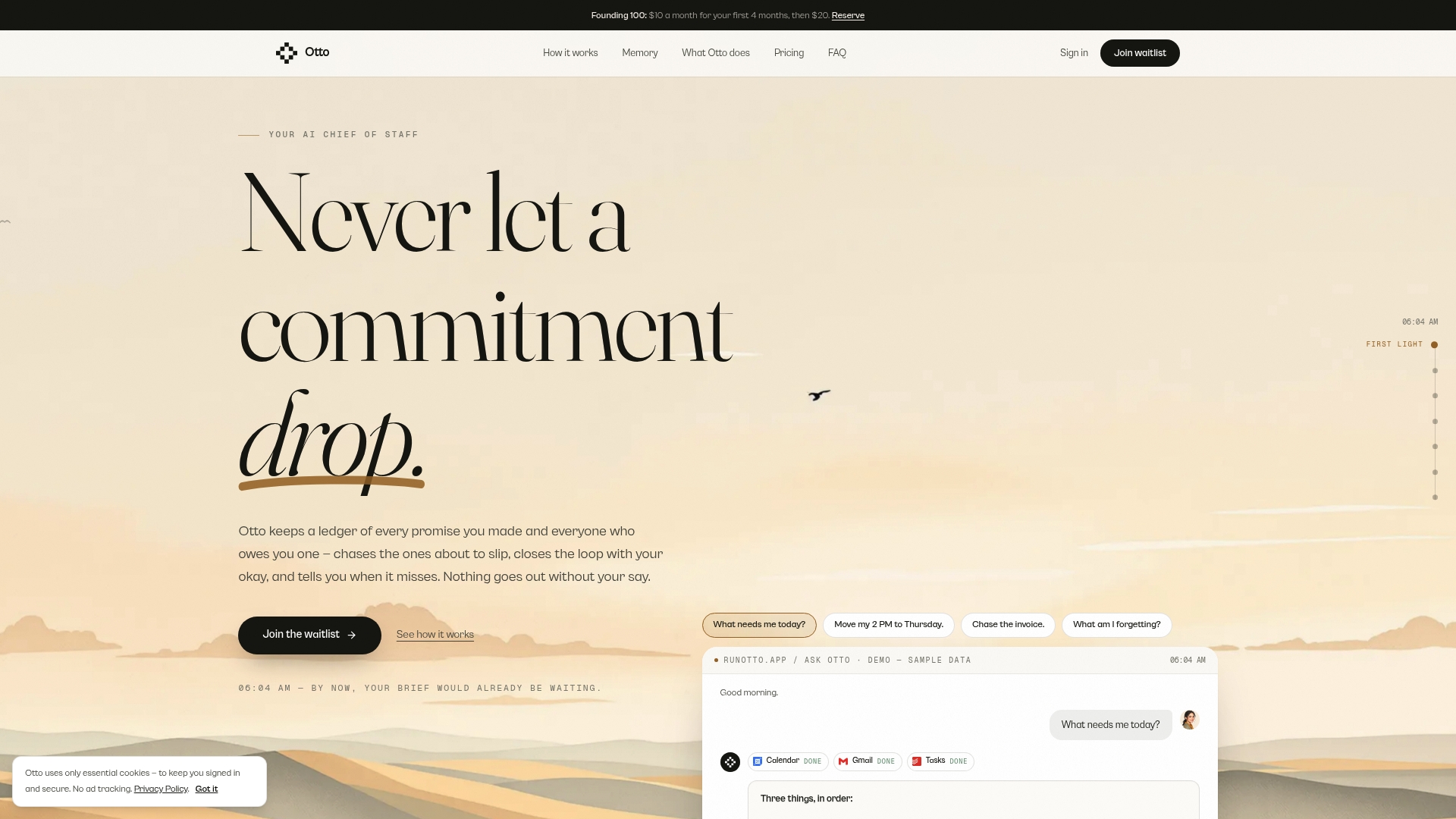
It listens in meetings, reads email and calendar, and turns spoken and written promises into tracked commitments with a receipt attached automatically, as explained in how to use AI to analyze calls. It drafts the follow-up nudge when a deadline is near, but nothing goes out without your explicit approval, so you stay the decision-maker, not the person retyping context between five different apps. If you’re currently the glue holding your own commitment tracking together across email, Slack, and a task board, try Otto and see what a single source of truth for every promise actually looks like.
Where to Go for Deeper Technical Detail
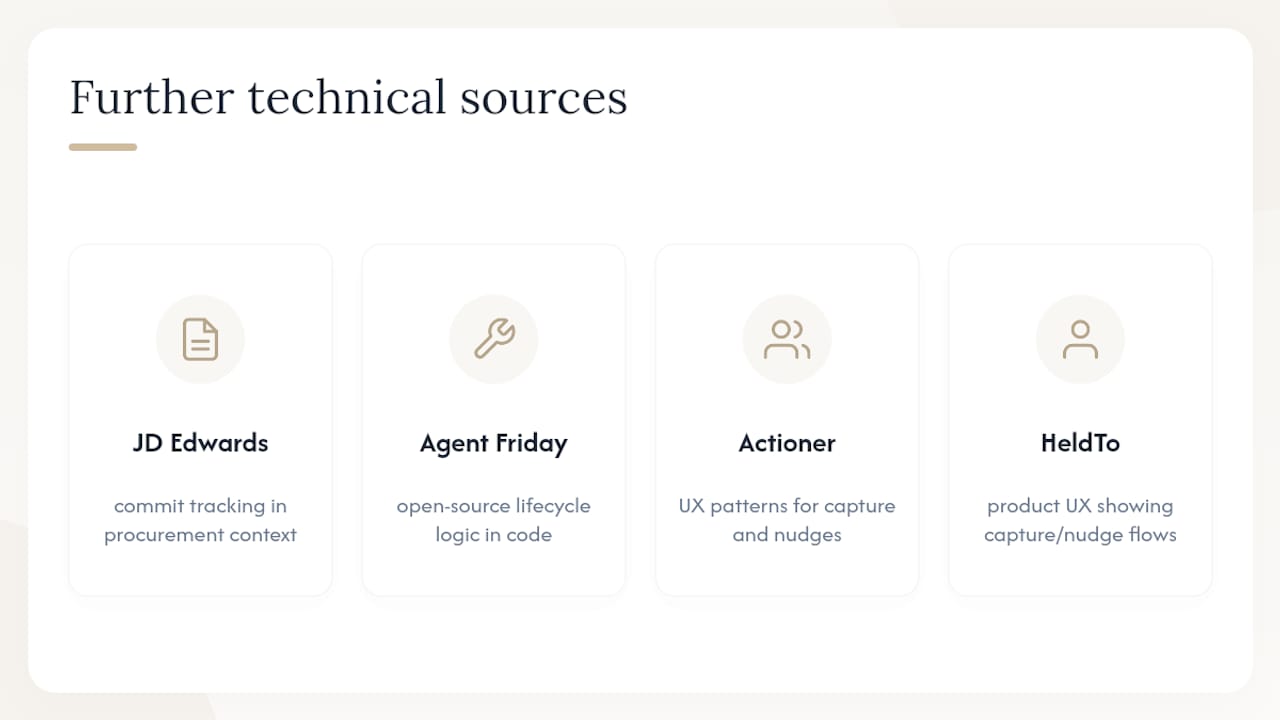
For readers who want to go further on specific pieces of this system, a few sources are worth a direct look. Oracle’s JD Edwards documentation covers commitment tracking in a procurement context, useful if your commitments are purchase obligations rather than task promises. Agent Friday’s commitment tracker is open source and shows the lifecycle logic in actual code. For UX patterns around capture and nudges, Actioner and HeldTo both show real product approaches worth studying.
Sources
FAQ
What Are the Levels of Commitment in a Tracking System?
Most systems use four to five practical states: active, completed, overdue, cancelled, and sometimes snoozed for renegotiated deadlines, as defined in Agent Friday’s tracker. These states describe where a promise sits in its lifecycle, not a personal commitment level.
What Is a Good Example of a Commitment Statement for Work?
A strong commitment statement names an owner, a specific deadline, and a concrete deliverable: “I’ll send the revised budget to finance by Thursday at noon” beats “I’ll get to the budget soon.” The clearer the statement, the easier it is to track and later verify.
What Counts as an Example of a Commitment at Work?
Common examples include agreeing in a meeting to deliver a report by a set date, promising a client a follow-up call, or telling a colleague you’ll review their document before Friday. Any spoken or written promise with an implied owner and timeframe qualifies.
How Often Should Teams Review Their Tracked Commitments?
Fast-moving teams benefit from a weekly review tied to PPC, while larger programs often review monthly to smooth out short-term noise. Variance reasons are best analyzed monthly, since weekly patterns are usually too small a sample to mean much.
Can Software Automatically Clear a Commitment as Done?
Some systems auto-clear commitments by detecting objective evidence like a merged pull request or an uploaded file, which reduces manual status updates. Items without a clear digital trail, like a relationship-based promise, still need a manual check before being marked complete.