 Otto
OttoReclaim Your First Hour: Daily Standup Automation for Founders
Reclaim Your First Hour: Daily Standup Automation for Founders

Daily standup automation is an automated personal morning briefing that synthesizes your email, calendar, meetings and captured promises into one prioritized “what to focus on today” list. For founders, operators and chiefs of staff, the payoff is time back at the start of the day. Otto is one example built around this idea, and any credible version of it should require your review before it acts on your behalf.
TL;DR:
- Daily standup automation synthesizes email, calendar, and meeting promises into a prioritized list, requiring human approval before actions are taken.
- The system must reliably capture commitments from various sources and effectively manage false positives to maintain trust and usefulness.
- Setting up involves connecting inbox and calendar first, enabling meeting transcription and promise capture, and establishing review and privacy defaults.
- Regularly measuring capture rate, false positives, and override frequency ensures the system remains accurate and improves over time.
- Governance controls should include data access, retention policies, and the ability to quickly rollback actions if errors occur.
Table of Contents
- What daily standup automation actually means
- How synthesis and prioritization actually work
- A quick setup checklist for a usable daily briefing
- How to judge accuracy, trust and ROI before adopting
- Privacy, governance and risk management for automated briefings
- Practitioner tips to avoid common failure modes
- Why this matters for busy operators
- Otto as a direct option worth trying
- Sources
- FAQ
What daily standup automation actually means
This article uses “daily standup automation” to mean a personal, cross-tool briefing, not a team tool. It has nothing to do with bots that collect status updates in Slack or Jira and post them to a channel for the whole team to read.
Instead, it means a system that pulls from your inbox, your calendar, your meeting transcripts and the promises you made in any of them, then hands you a single ranked list each morning. The inputs are personal: unread threads that need a decision, meetings that need prep, commitments you made on a call last week that are quietly overdue.
The output is a short, ordered brief: what needs a response now, what can wait, and what you already promised someone that has not been closed. It is built for one person’s day, not a team’s retrospective.
How synthesis and prioritization actually work
The system has to read across several sources at once: email threads, calendar events, meeting transcripts and any task or promise tracker you use. From there it applies ranking logic based on urgency, importance, who is waiting on what, and how many times you have already context switched between related items.
A useful version of this also manages disruption rather than adding to it. Research from the MIT Media Lab on disruption management found that mediating interruptions based on activity context improved performance on prioritized important and urgent tasks by notable percentages in a multi-application environment. The lesson for a daily briefing tool is the same: surface items when you can actually act on them, not the instant they arrive.
That only works with a human still holding the wheel. Key controls worth expecting from any system:
- Every draft, reply or scheduled action waits for your explicit approval before it goes out.
- Ranking logic is visible, so you can see why something was flagged urgent.
- You can override or reclassify an item, and the system remembers the correction.
- Low-value notifications get batched instead of interrupting you individually.
Explicit approval is not a formality. It is what keeps an automated briefing from becoming just another source of noise, which defeats the point of building one.
A quick setup checklist for a usable daily briefing
Getting a working version of this running takes less time than most people expect if you follow a fixed order, and consider professional support for AI automation and system integrations.
- Connect your inbox and calendar first, since these are the two sources that anchor everything else.
- Add meeting transcription so spoken commitments get captured, not just written ones.
- Turn on promise capture so anything you say you will do, in an email or out loud, lands on the list automatically.
- Set retention and privacy defaults before you connect anything sensitive, including who can see captured data and how long it is kept.
- Configure approval flows so nothing sends without your review, at least for the first few weeks.
- Set weighting rules for what counts as urgent versus important, and pick delivery windows that respect focus time.
- Run a short pilot of about one to two weeks, checking daily whether the system missed anything or flagged the wrong things.
- Refine the rules based on what the pilot shows, then extend the review cadence.
Pro Tip: Keep the first week in “draft only” mode. Reviewing suggested actions without letting anything auto-send is the fastest way to catch bad rules before they cost you something.
How to judge accuracy, trust and ROI before adopting
Before you rely on a daily briefing tool, check a few things that matter more than how polished the interface looks.
- Capture rate: does it consistently catch commitments made in email, calendar invites and meeting audio, or does it miss things buried in casual conversation.
- False positive rate: how often does it flag something as urgent that clearly was not, since that erodes trust fast.
- Morning readiness time: how long it takes you to go from opening the brief to knowing what to do first.
- Override frequency: if you are correcting the same category of item every day, the weighting rules need adjusting, not your patience.
- Hours reclaimed per week: a rough proxy is how much less time you spend manually cross-checking inbox, calendar and notes before you start real work.
The Forbes coverage of Microsoft’s 2025 Work Trend Index notes that a significant share of employees report fragmented, chaotic workdays, and argues that the more credible measure of any fix is deep-focus hours regained rather than raw task counts. That is the right frame for judging a personal briefing tool too.
Privacy, governance and risk management for automated briefings
A tool reading your inbox and calendar every morning needs real governance, not just a privacy policy nobody reads. The NIST AI Risk Management Framework organizes this into four functions, and they translate directly to a personal briefing setup.
- Govern: decide who can see captured data, who owns the retention policy, and who can turn approval flows on or off.
- Map: understand exactly which sources the system reads and what context it uses to rank items.
- Measure: track capture rate, false positives and override frequency on a regular basis, not just at setup.
- Manage: have a plan for what happens if the system misfires, including how to roll back an action and who to notify.
NIST’s framework also allows scaling: a solo pilot can run lighter governance than a company-wide rollout, as long as the plan accounts for tighter controls if adoption grows. At minimum, expect clear consent for meeting capture, access controls on who sees the ledger, and an audit trail you can review when something goes wrong.
Practitioner tips to avoid common failure modes
Treat the system as a disruption manager, not a notification firehose. Batch anything low-value and only interrupt you for items where the timing genuinely matters, echoing what the MIT Media Lab’s disruption research found about context-aware timing.
Start conservative. Keep approvals mandatory during the pilot, then loosen automation only for categories where the system has proven reliable over a few weeks. Review results daily during the pilot, then drop to a monthly check once the rules stabilize.
Pro Tip: Set different aggressiveness levels by role: a founder juggling investor emails needs tighter urgency thresholds than someone managing internal ops.

Why this matters for busy operators
I have watched enough founders lose the first hour of their day to manually piecing together what actually needs attention. A morning briefing that respects your approval and your time is not a convenience, it is a correction to how scattered that first hour usually is. Building in review steps from day one, rather than bolting them on later, is what separates a tool people trust from one they quietly stop using.
— Eddie
Otto as a direct option worth trying
Otto is built around the exact problem this guide describes: your email, calendar, meetings and commitments living in one shared memory instead of scattered across tools that never talk to each other. It captures every promise made in a meeting or an email into a single ledger and chases it until it is closed, and nothing is ever sent or finalized without your explicit approval.
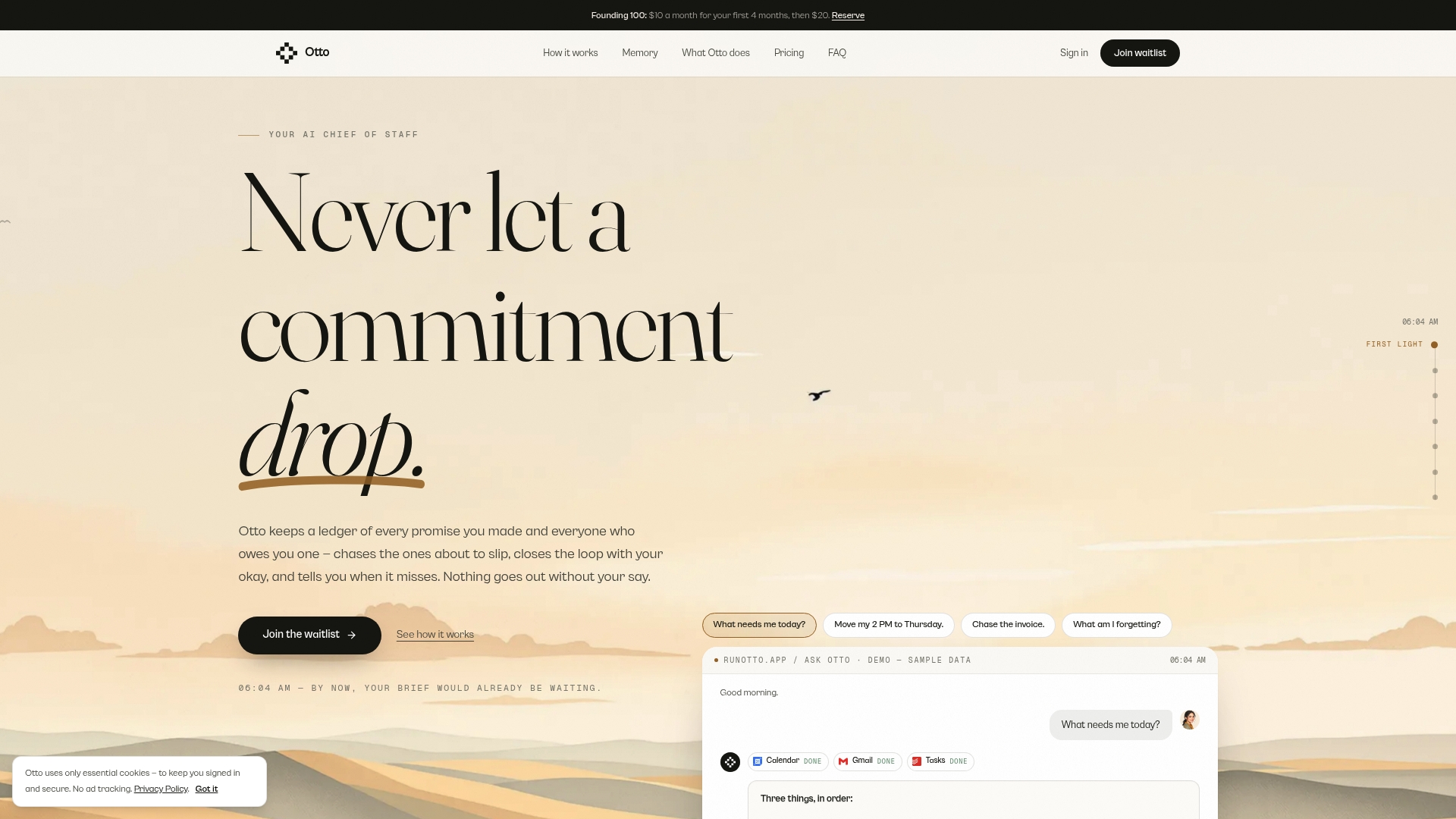
- Otto answers the one question a founder actually needs each morning: what to focus on today.
- Plans are available in free and paid tiers; current prices are on the pricing page.
- Built specifically for founders, operators and chiefs of staff tired of being the connective tissue between a dozen disconnected tools.
If a daily briefing that pulls from everything at once sounds like what your mornings are missing, you can try Otto directly.
Sources
For governance details, read the NIST AI RMF. For the disruption-management research behind timing logic, see the MIT Media Lab. For workload fragmentation data, see Microsoft’s reporting, and for additional analysis, the Forbes coverage of the Work Trend Index.
- Forbes — Microsoft Work Trend Index 2025 coverage
- MIT Media Lab — Disruption management research
- NIST — Artificial Intelligence Risk Management Framework: Generative AI Profile
FAQ
What is daily standup automation exactly?
It is a personal daily briefing that pulls information from your inbox, calendar, meetings and any promises you made, then ranks it into one prioritized list. It is not a team tool for collecting status updates in a chat app.
Does it replace human judgment on what to prioritize?
No, a well-built system drafts suggestions and rankings but should require your approval before sending anything or finalizing a priority order. This human-in-the-loop step is what keeps automation useful rather than risky.
How long should a pilot run before I trust it?
A one to two week pilot with daily review is generally enough to catch missed items and tune false positives, based on the pilot-and-iterate approach MIT Media Lab researchers recommend. Extend the pilot if you are still correcting the same category of mistake by the end of week two.
What should I check before adopting one of these tools?
Look at capture rate, false positive rate, how long it takes you to feel ready each morning, and how often you have to override its suggestions. The NIST AI RMF also recommends checking governance basics such as retention policy and access controls before rolling it out further.
Is Otto only for teams, or can one founder use it alone?
Otto is built for individual founders, operators and chiefs of staff, not team-wide status reporting. It works from one person’s inbox, calendar and meetings to produce that person’s own daily priority list.