 Otto
OttoEmail Triage Systems: Link Calendars, Keep AI Drafts for Review
Email Triage Systems: Link Calendars, Keep AI Drafts for Review

An email triage system sorts incoming messages into clear action outcomes, archive, label, task, draft, or escalate, before you ever open a thread to read it properly. The safest way to build one combines simple classification, deterministic decision rules, and human-gated drafts, since no reply with legal, billing, or client stakes should ever send itself. Done well, this gets you fewer interruptions and a clear list of what to actually do today.
TL;DR:
- Use deterministic rules for recurring senders and keywords, then add intent classification for ambiguous messages that need judgment or priority assessment.
- Keep replies as drafts for approval; route low confidence cases to tasks or human review, and never auto reply to billing, legal, or security messages.
- Check VIP senders before classification, send them to immediate attention, and retry failed or ambiguous classifications once before manual review.
- For shared Outlook mailboxes, create rules in Outlook on the Web with Full Access permission, then verify they work for another team member.
- Schedule two or three daily triage windows, batch low priority messages into a digest, and reserve notifications during quiet hours for VIP senders.
Table of Contents
- What email triage is and why it matters
- Core email triage workflow: intake, classify, decide, act/route, log
- Decision rules and safety gates for automation
- Automation vs classic inbox rules: strengths and limits
- Shared mailbox and setup notes: server-side rules and permissions
- Productivity practices that make triage stick
- Operator blueprint: build an AI-assisted triage
- Tools, integrations and a checklist for choosing tech
- Quick implementation checklist and 30/60/90 day goals
- Why human-in-the-loop triage prevents missed commitments
- Otto as an option: integrated, human-gated triage that sees email, calendar and meetings together
- FAQ
- Sources
What email triage is and why it matters
Triage means deciding the required action on a message before you read it in full. You are not answering yet, you are routing: does this need a reply today, a task next week, or nothing at all. That distinction alone removes most of the friction that makes inboxes feel unmanageable.
The real cost of an unsorted inbox is not email volume, it is interruption. Research on attention and context-switching points to the always-on nature of notifications, not the sheer number of messages, as the primary drain on productivity. Every ping that pulls you out of focused work carries a recovery cost, and processing messages as they land multiplies that cost across the day.
Folder-and-filter setups alone tend to break down over time because they rely on static patterns:
- They can match a sender or a keyword, but they cannot infer what a message actually wants from you.
- They stay brittle when a client changes their subject line convention or a vendor switches email domains.
- They offer no way to express priority or urgency, only placement.
A workable triage system needs both structure and judgment, which is why the workflow below pairs fixed rules with lightweight classification.
Core email triage workflow: intake, classify, decide, act/route, log
A triage workflow has several stages, and each one should be simple enough to run quickly per message.
- Intake: normalize the thread. Pull sender, subject, attachments, and prior thread history into one view, and pull calendar context when a message references a meeting or a deadline.
- Classification: sort into a small number of actionable buckets, support, billing, meeting, personal, noise, and assign a priority level (urgent, normal, low). Keep the bucket list short. A scheme with too many categories just becomes a second inbox to manage.
- Decision mapping: apply deterministic rules that take category, priority, and confidence together and output one action: archive, label, create a task, draft a reply, or escalate to a person.
- Human-gated action: stage the output. A drafted reply or a proposed calendar hold waits for your approval before it goes anywhere. Nothing with real stakes should send itself.
- Logging: record what happened for every thread that was not simple noise.
Pro Tip: Log the sender, a one-line gist, any deadline mentioned, the action taken, and the confidence score behind it, since this is what lets you audit triage decisions efficiently instead of re-reading email.
That last point matters more than it looks. Without a record of sender, gist, deadline, chosen action, and confidence, you have no way to tell whether your rules are working or quietly misfiring on a category you have not noticed yet.
Decision rules and safety gates for automation
The entire value of a triage system collapses the moment it sends something it should not have. Conservative thresholds are what keep automation useful instead of risky.
A workable starting point: low confidence always produces a draft or a task, never a send. High confidence can be trusted for low-stakes actions like auto-archiving a newsletter, as long as the action is still logged for review. Uncertain cases stay in a human queue.
Some categories should never be auto-responded to, regardless of confidence:
- Billing and payment disputes, where a wrong answer has financial consequences.
- Legal correspondence, where tone and wording carry liability.
- Security notices, where a false sense of resolution is worse than no response.
VIP and sender-list overrides change this calculus further. A message from a known VIP sender should route to immediate attention and skip the low-priority queue entirely, regardless of what the classifier guesses about content. Low-confidence or failed classifications need their own path too: log the failure, alert a human rather than guessing, and retry classification once more before falling back to a manual queue. Professionals report spending roughly 28% of the workday reading and answering email, which is exactly the budget a safe, conservative system is meant to claw back rather than put at risk.
Automation vs classic inbox rules: strengths and limits
Server-side rules and AI classification solve different problems, and conflating them is where most triage setups go wrong.
Static rules, the kind you build in Gmail filters or Outlook, are excellent at deterministic, repeatable actions: move this sender to a folder, label anything with “invoice” in the subject, forward a specific address automatically. Standard email rules can move, label, delete, or forward based on fixed criteria like sender or subject keywords, but they cannot understand what a message actually wants from the reader, and they become brittle the moment sender patterns or subject conventions shift. They are also essential infrastructure for shared mailboxes, where consistency across every team member matters more than nuance.
AI classification earns its place where rules run out: understanding intent behind ambiguous phrasing, scoring confidence so low-certainty cases get flagged, suggesting routing, and drafting a response for a human to approve. The practical answer is not choosing one over the other. Use deterministic rules for anything with a fixed pattern, and layer intent classification on top for everything that requires judgment.

Shared mailbox and setup notes: server-side rules and permissions
Shared mailboxes introduce a setup trap that catches most teams at least once: rules built in a desktop email client often do not run for anyone but the person who built them.
Outlook desktop rules are frequently client-side, meaning they only fire while that specific person’s client is open and processing mail, which makes them unreliable for a shared mailbox that multiple people access. Rules created in Outlook on the Web, by contrast, run server-side and apply consistently across every device and every user with access.
To set this up reliably:
- Confirm you have Full Access permission on the shared mailbox before attempting to create rules.
- Build rules in Outlook on the Web, not the desktop client, so they are stored server-side.
- Where delegated or admin access is available, use Exchange PowerShell’s
New-InboxRulecommand to apply rules centrally rather than per-user. - Verify by logging in as a different team member and checking the rule still applies, which confirms it is not tied to one person’s client session.
Productivity practices that make triage stick
A triage system only works if the habits around it hold up under a busy week. Three practices do most of the heavy lifting.
Scheduled triage windows, two or three fixed blocks a day rather than constant checking, cut down the interruption cost that comes from treating every arrival as urgent. A daily digest for non-urgent categories reinforces the same idea: batch the low-stakes stuff into one read instead of a dozen.
The two-minute rule gives you a fast filter for what belongs in the queue at all: if a reply genuinely takes under two minutes to write and send, do it immediately rather than logging it as a task you will revisit later. Anything longer goes into the queue for its scheduled slot.
- Set two or three fixed triage windows instead of checking continuously through the day.
- Use a daily digest for low-priority categories so they never trigger a notification individually.
- Apply the two-minute rule: reply now if it is fast, queue it if it is not.
- Keep quiet hours in place with a VIP exception list, so only genuinely urgent senders break through.
Pro Tip: Quiet hours work best when paired with a VIP exception list rather than an all-or-nothing mute, since the goal is protecting focus time without missing something that actually needs you.
Operator blueprint: build an AI-assisted triage
For teams building this with engineering support, the practical unit of work is a strict, structured output per message rather than free-text summaries.
A classification contract per thread should return: category, priority, requires_reply (boolean), safe_to_autoreply (boolean), recommended_action, confidence, and reasons (a short list explaining the call). Keeping this structured, rather than a paragraph of prose, is what makes downstream rules and audits possible.
- Apply confidence cutoffs first: low confidence routes to a draft or task, uncertain cases route to a human review queue, and high confidence is eligible for safe auto-actions on low-stakes categories only.
- Check the VIP list before anything else. A VIP sender overrides the category-based routing and goes straight to priority attention.
- Block auto-reply entirely on billing, legal, and security categories regardless of confidence score, full stop.
- Log every classification, action taken, and confidence score to a per-thread record for later review.
- Retry once on a failed or ambiguous classification, then fall back to a manual queue with an alert.
| Metric | What it tracks | Healthy direction |
|---|---|---|
| Auto-archive rate | Share of messages closed without human review | Rises slowly as rules prove reliable |
| Draft rate | Share of messages producing a staged draft | Stays steady; a spike signals low confidence |
| Escalation rate | Share routed to a human for a decision | Falls as rules mature |
| Median triage time | Time from arrival to a logged action | Shortens over successive weeks |
A short weekly health check, skimming escalations and any failed classifications, catches drift before it becomes a backlog.
Tools, integrations and a checklist for choosing tech
Whatever you build or buy, a few integrations are non-negotiable: Gmail or Outlook, your calendar, a task manager, and support for a VIP or identity list so important senders never get buried.
- Confirm the tool stages drafts for approval rather than sending on its own.
- Check that confidence scores are visible per message, not hidden inside a black box.
- Look for webhook or action support so triage outcomes can trigger tools you already use.
- Ask whether every decision is logged with an audit trail you can review.
- Ask your IT team or vendor directly whether rules run server-side on shared mailboxes, and how long logs are retained.
Teams managing shared support inboxes specifically should also look at dedicated workflow tooling. SendSync’s guide to scalable inbox workflows walks through collaborative assignment, tagging, and saved views built for multi-person mailboxes.
Quick implementation checklist and 30/60/90 day goals
Start small and let the data tell you where to tighten rules.
- Getting started: define your buckets, build server-side rules for every deterministic case (newsletters, known vendors, recurring invoices), and set an initial confidence baseline.
- Review: check draft rate, auto-archive rate, and how many interruptions you logged compared with an earlier period.
- As the system matures: tighten thresholds based on what the logs show, add alerting for repeated low-confidence categories, and track median triage time as your core efficiency number.
Why human-in-the-loop triage prevents missed commitments
Email rarely lives in isolation. A thread referencing “the call tomorrow” only makes sense with calendar context, and a promise made out loud in a meeting needs to land somewhere triage can see it. Keeping a human in the loop on every draft and every send is not a limitation, it is what prevents an automated system from confidently doing the wrong thing. If you set up one thing first, make it the approval gate, not the classifier.
— Eddie
Otto as an option: integrated, human-gated triage that sees email, calendar and meetings together
We built Otto around a different claim: your email, calendar, meetings, and commitments should live in one shared memory instead of four disconnected tools you have to keep synced in your head. That single memory is what lets triage account for a meeting that happened an hour ago or a promise you made out loud without you re-explaining it.
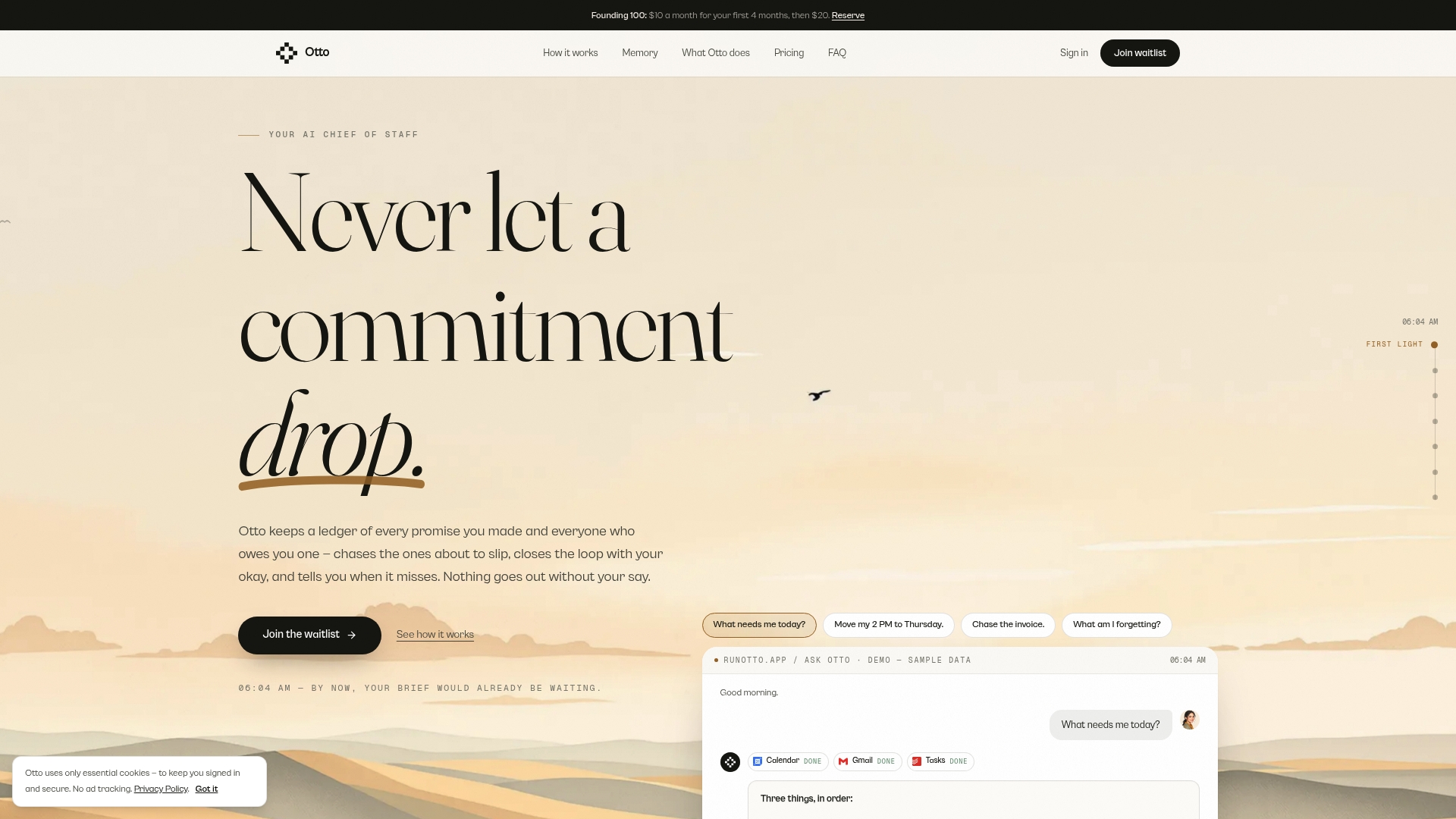
Every draft and every send still waits for your approval, and every open commitment lands in a single ledger we chase until it closes, so nothing quietly falls through between inbox, calendar, and call notes.
- We draft, you decide, every time.
- Commitments from email and meetings land in one ledger instead of scattered notes.
- Current prices for our plans are on our site.
If a unified, human-gated system sounds like what your inbox needs, start with Otto and see what it catches in the first week.
FAQ
What is an email triage?
Email triage is the process of sorting incoming messages into required actions, such as archive, task, reply, or escalate, before processing them in depth. The goal is deciding what each message needs rather than reading and responding to everything in arrival order.
Is email harvesting illegal?
Email harvesting, the practice of collecting addresses without consent for spam or unsolicited outreach, is restricted or illegal under data protection and anti-spam laws in many jurisdictions. Rules vary by country, so check the specific regulation that covers your location, such as anti-spam or data privacy legislation, before collecting or using addresses in bulk.
Can Copilot triage emails?
Microsoft’s Copilot tools include email summarization and drafting features inside Outlook, which can support parts of a triage workflow. For reliable team-wide sorting across a shared mailbox, server-side rules and a defined classification schema remain the more dependable foundation to build on.
Is there a free tool for email testing?
Several email providers offer free tiers suitable for testing filters, rules, and basic classification logic, including Gmail’s native filter system and Outlook on the Web. For testing an AI-assisted triage workflow specifically, Otto offers a Free plan.