 Otto
OttoStop Missing Promises: Executive Follow Up System for Executives
Stop Missing Promises: Executive Follow Up System for Executives

An executive follow-up system is a structured process that turns spoken promises and email threads into a tracked ledger with clear owners, deadlines, and escalation rules, so nothing slips through the cracks. The outcome is simple: commitments actually close, and every morning starts with clarity on what needs attention instead of a scramble through three inboxes. The four elements that matter most are an owner, a checkpoint, a time boundary, and an escalation path.
TL;DR:
- A structured follow-up system relies on capturing commitments into a simple ledger with an owner, deliverable, due date, and checkpoint type to ensure nothing is overlooked.
- Implementing a two-week pilot that focuses on minimal schema and channel-specific triggers can surface friction points and improve trust in the system before scaling.
- A multi-step follow-up cadence, including a clear ask, a gentle nudge, and a reframed message, achieves higher reply rates than single reminders.
- Automating the follow-up process by integrating meeting notes, emails, and calendars reduces manual work and improves capture accuracy.
- Success depends less on message tone and more on recording commitments in a reliable system, treating follow-up as infrastructure rather than etiquette.
Table of Contents
- Step-by-step system blueprint for executives
- Channel and cadence playbook for follow-up
- Tools, integrations, and automation patterns for executives
- Ownership, checkpoints, and escalation rules
- Measurement, KPIs, and review cadence
- Practitioner notes from building these systems
- Why most follow-up advice misses the point
- How Otto turns this system into software
- Sources
- FAQ
Step-by-step system blueprint for executives
Most follow-up failures trace back to the same root cause: commitments live in someone’s head or scattered across a meeting note, an email thread, and a calendar invite that never talk to each other. Building a real system means fixing that gap deliberately, not adding another app to check.
Start with an honest audit before building anything.
- Audit the failure points. Look at your last twenty commitments and trace where each one was made: a live meeting, an email chain, or a hallway conversation, then note where it got lost.
- Map the ideal information flow. Decide which channels feed your commitment ledger and define a schema: what a commitment is, who owns it, and what “done” looks like.
- Define minimal artifacts and roles. Every tracked item needs an owner, a deliverable, a due date, and a checkpoint type, nothing more.
- Document short standard operating procedures and pilot for two weeks. Keep the rules on one page and test them with a small group before rolling out further.
- Iterate on measurable signals, then plan a one-month review. Watch for missed checkpoints and noisy alerts, then adjust before scaling.
The artifacts matter more than the process documentation. A commitment ledger only works if people trust it to reflect reality, which means the schema has to be light enough to update in seconds.
- Keep the ledger fields to owner, deliverable, due date, and checkpoint type.
- Avoid adding approval layers before the pilot proves the basic loop works.
A two-week pilot with one team surfaces the friction faster than a company-wide rollout ever will. Watch for false positives in what counts as a “commitment,” and fix the capture logic before you expand.
Channel and cadence playbook for follow-up
A follow-up cadence works best as a sequence, not a single reminder. Data from Belkins’ 2025 study on sales follow-up statistics shows that later steps in a sequence often outperform the first, with the third message frequently landing more replies than the first two combined when it reframes the ask rather than repeating it.
- Email step 1: send the ask clearly and immediately, no preamble.
- Email step 2: a short nudge two to three business days later.
- Email step 3: a reframed message with a new angle, not a copy of step 1, timed roughly a week out.
- LinkedIn: after email stalls, a connection request that references the prior outreach performs better than a cold one.
- Calling: reserve this for after multi-channel outreach has run its course, framed as a warm follow-up rather than a cold pitch.
Reply-rate benchmarks vary by channel. Cold-email research from CopyCrest found that the top 5% of cold-email senders reach a 16.3% reply rate, largely by keeping sequences tight, three to five steps, since longer sequences raise spam complaints without adding meaningful replies.
Stop the sequence after several touches with no response. Continuing to escalate beyond this point risks damaging the relationship rather than improving it.
Tools, integrations, and automation patterns for executives
The goal of automation here is no more alerts, it is fewer manual handoffs. The core pattern is: capture a promise, assign an owner, schedule a checkpoint, then trigger a reminder or escalation automatically.
- Prioritize tools that pull from meeting notes, email, and calendar into one place rather than three separate dashboards.
- Evaluate inbox assistants, meeting transcription tools, task backlogs, and calendar schedulers by how well they surface promises, not by feature count.
- Route low-confidence captures to a review queue instead of the main ledger to cut noise.
Pro Tip: Tag every captured commitment with its source channel so you can spot which channel generates the most missed follow-ups over time.
Disconnected systems and fragmented data are a common reason automated follow-up breaks down, since a tool that cannot see the full picture will always miss something.
Ownership, checkpoints, and escalation rules
Every tracked commitment should carry four fields: owner, reason it matters, time boundary, and escalation path. That framing removes the ambiguity that causes repeated clarifying questions.
Three checkpoint types cover most cases:
- Acknowledgement: confirms the commitment was received and understood.
- Deliverable milestone: confirms real progress at a midpoint.
- Confirmation of closure: confirms the commitment is actually done, not just sent.
Set a clear threshold: nonresponse after a few days triggers an automated nudge, and continued silence escalates to a manager. Keep nudges short and neutral, and reserve escalation language for genuine blockers, otherwise the system turns into a notification sink nobody trusts.
Measurement, KPIs, and review cadence
A follow-up system needs a small set of numbers, not a dashboard nobody opens. Track the percentage of commitments closed on time, average time to closure, the size of the overdue backlog, and which channel generated each follow-up.
Pull these from the ledger itself, cross-referenced against calendar and inbox timestamps to catch gaps between what was promised and what happened. Run a short monthly review and a deeper quarterly one, each testing one change to cadence or routing rather than several at once.
| Week | On-time closure | Overdue backlog | Primary channel |
|---|---|---|---|
| 1 | Baseline | Baseline | |
| 2 | Compare to baseline | Compare to baseline | Email plus LinkedIn |
| 3 | Trend check | Trend check | Email plus LinkedIn plus calls |
| 4 | Monthly review | Monthly review | All channels |
Practitioner notes from building these systems
A few rules hold up across teams: keep the ledger lighter than anyone expects, assign one owner per commitment even when a group is involved, and review the backlog weekly, not monthly. Early pilots usually fail from over-engineering the schema, not from lacking tools. The fix is almost always to cut fields, not add them.

Why most follow-up advice misses the point
The conventional advice treats follow-up as a communication skill: write a better email, time your nudge well, sound more professional. That’s not wrong, but it solves the wrong layer of the problem. The real failure point is structural: commitments made in a meeting never make it into the same system as commitments made over email, so no amount of message polish fixes a ledger that does not exist.

What the research actually supports is narrower than most guides suggest. A three-to-five-step cadence works, channel switching works, and reframing a message rather than repeating it works. Beyond that, the details matter less than whether a commitment is tracked at all. Executives who get this right treat follow-up as infrastructure, not etiquette. They build the ledger first and worry about tone second.
If you take one thing from this, prioritize capture over cadence. A perfect email sequence chasing a commitment nobody logged is still a missed commitment.
— Eddie
How Otto turns this system into software
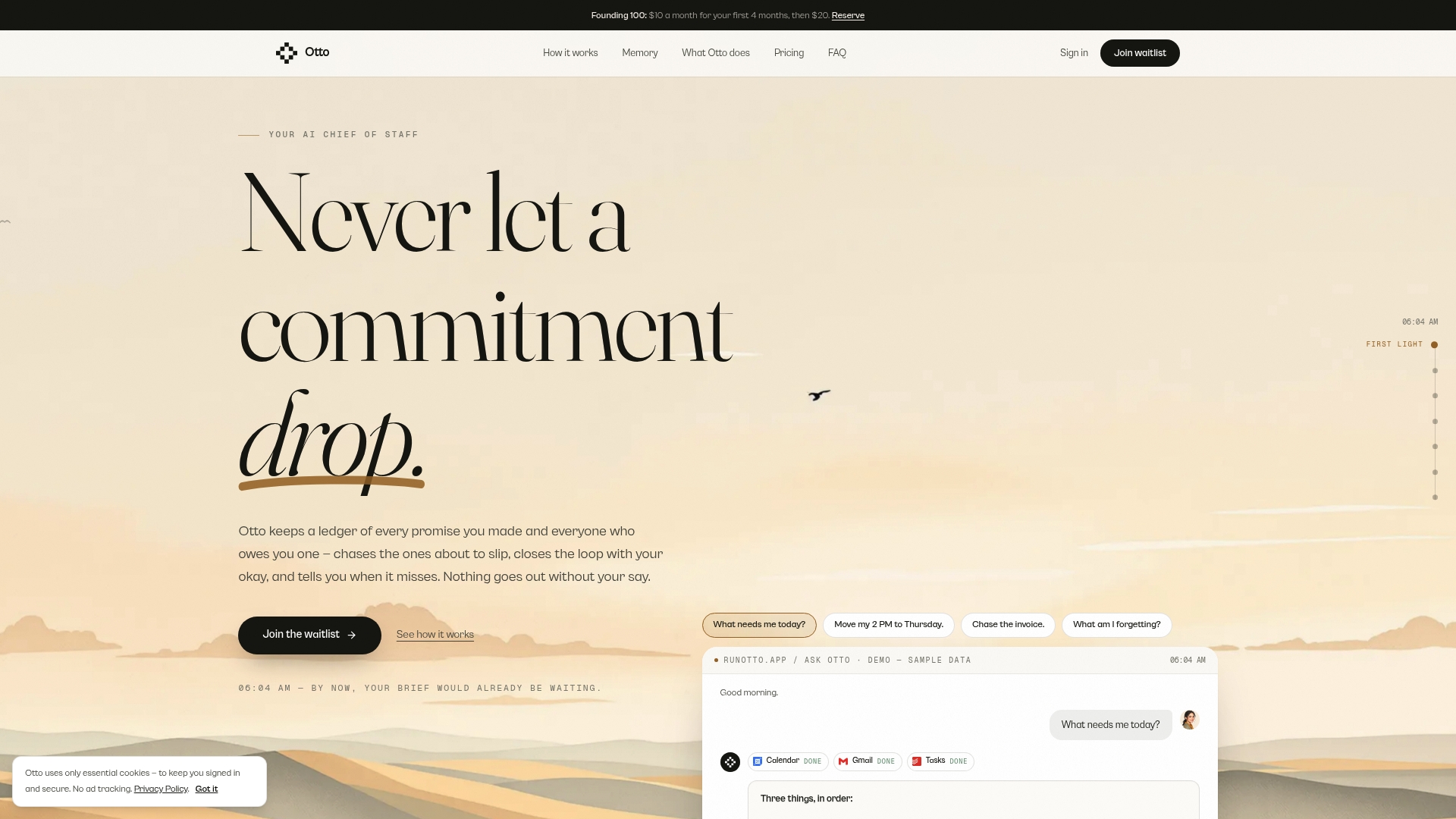
Otto captures promises made in meetings, email, and calendar into a single ledger, then follows up until each one closes, which is the exact structure this article describes, minus the manual glue work of copying context between tools yourself.
- If your current setup is a spreadsheet and good intentions, a dedicated tool like Otto removes the manual capture step entirely.
- If you already have a working process, Otto fits as the layer that keeps it running without a person watching every thread.
A small pilot, two to four weeks with a founder or a chief of staff and their team, is enough to see whether the ledger approach fits your workflow. Check plan options, including the Free, Upgraded, and Max plans, and start where it makes sense for your team’s size.
Sources
- Six tips for crafting an effective follow-up message (Forbes Councils)
- Sales follow-up statistics in B2B: Belkins’ 2026 study
- Cold Email Benchmarks 2025: Why the Top 5% Get 16.3% Replies | CopyCrest Research
FAQ
How do you say follow up professionally?
The clearest way is to lead with the ask, state why it matters, and give a time frame, rather than opening with an apology for “checking in.” Forbes Councils guidance recommends mirroring the recipient’s own language, which signals you were actually listening the first time.
What is the best sales tracking software?
There is no single best option, since the right tool depends on whether you need pipeline tracking, commitment tracking, or both. Look for software that unifies email, calendar, and meeting data into one place rather than judging tools by feature count alone.
What are the top email automation tools?
Rather than a fixed ranking, evaluate tools by category: inbox assistants, meeting transcription tools, task backlogs, and calendar schedulers, then check how well each surfaces commitments automatically. Otto is one option built specifically around capturing promises from meetings and email into a single follow-up ledger.
What’s a good example of a follow-up?
A strong follow-up names the original ask, adds new context or a reframed angle rather than repeating the first message, and gives a clear next step. Belkins’ 2025 data on sequence performance shows that a reframed third message often outperforms the first two combined.