 Otto
OttoProtect CEO Time: Founder Calendar Planning in 14 Days, 3 Skeletons
Protect CEO Time: Founder Calendar Planning in 14 Days, 3 Skeletons

The most effective founder calendar strategy is simple to state and hard to live by: protect 3 to 6 hours a week of non-negotiable strategic thinking time, run a 14-day calendar audit to see where your hours actually go, then rebuild your week around a repeatable skeleton. Start now: set a recurring 30-minute alarm today and pick a start date for your audit in the near future.
TL;DR:
- Founders should track time in 14-day audits to accurately identify how much is spent on strategic, operator, reactive, and comfort tasks.
- Protect 3 to 6 hours weekly for deep strategic thinking and build a repeatable calendar skeleton tailored to your company’s growth stage.
- Delegate low-impact, habitual tasks first by creating clear decision frameworks and batch communication to reclaim focus.
- Implement fixed cadences for weekly, monthly, and quarterly reviews based on company size and external deadlines to maintain control.
- Use integrated tools like Otto to unify calendar, email, and meetings, ensuring consistent follow-up and reducing scattered information.
Table of Contents
- How to run a founder calendar audit
- Designing a calendar skeleton and the CEO week
- Operating rhythm: weekly, monthly, and quarterly cadence
- A 90-day plan to shift your time toward strategic work
- Protecting deep work and meeting hygiene
- Delegation and handoffs that actually stick
- Tools and workflows that make calendar planning repeatable
- What this means for how you see your own role
- Otto: one place for your calendar, email, meetings, and commitments
- FAQ
- Sources
How to run a founder calendar audit
You cannot fix what you have not measured, and most founders are wrong about where their time goes. The fix is a 14-day calendar audit: block out every 30 minutes of your working day and tag it into one of four buckets.
- Strategic (CEO) work: decisions only you can make, like fundraising strategy, key hires, or product direction.
- Operator work: tasks that keep the business running but someone else could eventually own, like approving expenses or reviewing routine contracts.
- Comfort work: tasks you enjoy or are good at but that no longer need the founder, like writing every piece of marketing copy.
- Reactive work: anything triggered by someone else’s message, ping, or last-minute request.
At the end of 14 days, do the math. Add up strategic minutes and divide by total tracked minutes to get your strategic percentage. Do the same for reactive time. Count how many times you switched between categories in a single day, and average your meeting length across the two weeks.
| Metric | How to calculate it | What it tells you |
|---|---|---|
| Strategic % | Strategic minutes ÷ total minutes | How close you are to CEO-level focus |
| Reactive % | Reactive minutes ÷ total minutes | How much of your day others control |
| Context switches | Count of category changes per day | How fragmented your attention is |
| Average meeting length | Total meeting minutes ÷ number of meetings | Whether meetings run longer than needed |
Harvard Business School tracked 27 CEOs across nearly 60,000 hours of calendar data and found that leaders spend a large share of their working time in meetings, which is exactly the kind of baseline this audit is designed to surface for your own week. A practitioner-built audit framework categorizing time into CEO, operator, reactive, and comfort buckets consistently shows a gap between how founders think they spend time and how they actually spend it.
If more than 40% of your blocks are tasks that genuinely do not require your judgment, that is the clearest signal you have a delegation problem, not a time management problem.
Designing a calendar skeleton and the CEO week
A calendar skeleton is a weekly template of recurring blocks that you build once and defend consistently thereafter. The idea, described by executive coach Molly Graham, is that where you place your time becomes a signal to your whole company about what actually matters, and a skeleton protects that signal from getting overwritten by whoever asks for a meeting next.
Three skeletons cover most founder situations, and each one answers a different question about where your attention needs to go.
- Early-stage founder: heavy execution, with two or three 90-minute maker blocks daily protected for building product or closing early customers.
- Scaling founder: a mix of recruiting blocks, weekly 1:1s with direct reports, and at least one protected half-day for strategic planning.
- Fundraising or seasonally anchored founder: investor meetings clustered into specific days, with the rest of the week ring-fenced for the business so fundraising does not swallow everything.
| Skeleton type | Daily focus blocks | Weekly recurring anchors | Primary risk if ignored |
|---|---|---|---|
| Early-stage | 2 to 3 maker blocks | Customer calls, build time | Strategy never gets scheduled |
| Scaling | 1 strategic block | 1:1s, recruiting, metrics review | Calendar fills with other people’s priorities |
| Fundraising | Investor clusters | Pipeline review, team sync | Core business stalls during the raise |
Place your hardest thinking work in your personal peak-energy window, whatever time that is for you, and guard it the same way you would guard a meeting with your biggest customer. Core rituals like weekly planning, 1:1s, and a metrics review belong at fixed, predictable times so your team can plan around them instead of chasing your availability.
Themed days work well once a team passes a handful of people: Monday for planning and metrics, Tuesday and Wednesday for deep execution, Thursday for people and recruiting, Friday for review and loose ends. Test any skeleton for three weeks before judging it. A new rhythm always feels awkward in week one.

Operating rhythm: weekly, monthly, and quarterly cadence
Different decisions need different time horizons, and mixing them into one ad hoc calendar is where most founders lose control. A clean operating rhythm separates execution reviews from strategic ones.
- Weekly: a metrics review, a short priorities check, and a running decision list so nothing important gets revisited from scratch.
- Monthly: a leadership review, an investor update, and an all-hands to keep the wider team aligned on direction.
- Quarterly: a strategy rewrite, OKR setting, and talent calibration across the leadership team.
Timing matters as much as content. Field guidance on startup operating rhythm suggests avoiding formal weekly and monthly rhythms before roughly 15 employees, since the overhead outweighs the benefit at that size, but installing them by around 30 employees to avoid coordination collapse as decisions stop fitting in hallway conversations.
The same guidance points to anchoring cadence to real external deadlines rather than arbitrary dates: a monthly close, a seasonal enrollment period, or a compliance filing date forces genuine progress in a way an internally invented deadline rarely does. A compliance-focused guide for UK startups is a useful example of how regulatory deadlines can double as a forcing function for your quarterly calendar, though the specific rules will depend on your own jurisdiction. Whatever your market, the principle holds: borrow deadlines from the outside world whenever you can, because they carry a consequence your own calendar cannot invent on its own.
A 90-day plan to shift your time toward strategic work
Changing a calendar is not a weekend project. A staged 90-day restructure, outlined in practitioner guidance on founder calendar audits, works because it tackles one failure mode at a time instead of trying to fix everything at once.
- Weeks 1 to 2: run the audit and establish your baseline strategic, operator, reactive, and comfort percentages.
- Weeks 3 to 4: kill comfort work first. It is the easiest category to cut because you do it out of habit, not necessity.
- Weeks 5 to 6: delegate operator tasks, each paired with a one-page decision framework so the person taking it over knows exactly where their authority starts and stops.
- Weeks 7 to 8: build reactive defenses: office hours, a Slack response-time norm, and a rule that urgent does not mean right now.
- Weeks 9 to 10: rebuild your calendar into the skeleton you designed, block by block.
- Weeks 11 to 12: re-audit using the same categories and compare against your baseline.
The micro-tasks matter more than the week labels. Write the decision frameworks as single pages, not documents. Set office hours for the kinds of requests that used to interrupt you mid-block. Batch email into two or three fixed windows a day instead of checking constantly. Cap meetings at 30 minutes by default and require an agenda before anything gets booked.
Track four numbers throughout: strategic time percentage, context switches per day, average meeting length, and your delegation ratio, meaning the share of operator tasks that now have a named owner besides you. Coaching-based calendar audits report founders moving strategic time from the low teens into roughly one-third to two-fifths range over a few months of sustained practice, which lines up closely with a 90-day cycle.
Pro Tip: Re-run the exact same 14-day audit format in week 11, using the same categories and tracking method, so the comparison to your baseline is apples to apples.
Protecting deep work and meeting hygiene
A skeleton only works if the blocks inside it survive contact with other people’s calendars. Deep work needs rules, not good intentions.
- Protect deep-work blocks of sufficient length to overcome start-up time, such as around 90 minutes, since anything shorter rarely gets past the warm-up phase before being interrupted.
- Pad blocks by 10 to 15 minutes on each side to absorb meetings that run long.
- Single-task inside protected blocks: no email, no Slack, one piece of work at a time.
- Require every meeting to have a stated purpose, a named owner, a written agenda, and a pre-read when the topic is complex.
- End every meeting with a concrete decision or clear next step, not a vague sense that it was useful.
Time-blocking and meeting hygiene are standard recommendations in entrepreneurship guidance, and a partner resource on protecting deep work covers practical ways to defend uninterrupted time against a culture of constant availability.
One of the most effective guardrails against fragmented attention is batching communication into fixed windows rather than responding continuously. Check email twice or three times a day at set times instead of leaving it open in the background. Move non-urgent updates to async formats like a recorded Loom walkthrough or a shared Notion doc instead of a live meeting, and set office hours as the one place urgent-but-not-emergency requests can land, so they stop landing inside your focus blocks.
Delegation and handoffs that actually stick
The audit tells you what to delegate. A decision framework tells the other person how to run with it without checking back every step. Practitioner guidance on calendar audits recommends writing a one-page decision framework for each handoff rather than managing the task from a distance, because the friction in most failed delegations is ambiguity, not ability.
- Decision framework fields: context, objective, guardrails, the specific threshold at which a decision can be made without you, the owner’s name, and a review cadence.
- Handoff template fields: context, acceptance criteria, named owner, an escalation path for when something goes wrong, and a firm decision date.
- Pick your first three delegated tasks from your comfort-work and operator-work categories, the ones you do often but that carry the lowest strategic risk if someone else owns them this week.
Accepting the gap between how much strategic time you thought you had and how little you actually have is itself an identity shift. Most founders resist the first handoff not because the framework is unclear, but because they have not yet separated their own judgment from the task.
Tools and workflows that make calendar planning repeatable
A skeleton and an audit are only as durable as the tools behind them. A few categories cover most of what a founder needs.
- Scheduling gates like Calendly filter incoming meeting requests before they hit your calendar at all.
- Time trackers like Toggl or RescueTime turn the 14-day audit from a manual guess into logged data, and the Pomodoro technique gives you a simple structure for the focus blocks themselves.
- Async update tools like Loom or Notion replace status meetings with recorded or written updates that people can consume on their own time.
- Automation bridges like Zapier connect the pieces so a meeting booked in one tool triggers a reminder or a task in another.
A practical workflow strings these together: run the 14-day tracker, identify your reactive patterns, build a decision framework or an automation rule for the worst offenders, then hand off the task with a clear owner and a follow-up check.
The gap in most of these setups is that each tool only sees its own slice. Your scheduler does not know what you promised on a call, your notetaker does not know what is sitting in your inbox, and you end up being the one who remembers everything and copies it between tools. Otto is built around a shared memory across email, calendar, and meetings, so a commitment made on a call and a related email thread live in the same place instead of two. It drafts follow-ups and surfaces what to focus on each day, but nothing goes out without your explicit approval first.
Pro Tip: Before adding any new tool to your stack, ask whether it closes a gap your calendar audit actually revealed, not whether it looks useful in a demo.
What this means for how you see your own role
The hardest part of founder calendar planning is not the audit or the skeleton. It is accepting that your job changes as the company grows, from doing the work to deciding what work gets done and by whom. That shift shows up as specific behaviors: saying no to meetings you would have taken a year ago, writing a decision framework instead of answering the same question twice, and treating your calendar as a budget you spend on purpose rather than a diary other people fill in for you.
Most founders know this intellectually long before they act on it. The audit is what finally makes the gap between what you believe and what your calendar shows impossible to ignore.
— Eddie
Otto: one place for your calendar, email, meetings, and commitments
Rebuilding your calendar only works if the information behind it is not scattered across five tools you have to manually reconcile. Otto is an AI chief of staff that keeps email, calendar, meetings, and commitments in one shared memory, so nothing has to be re-explained to a different tool.
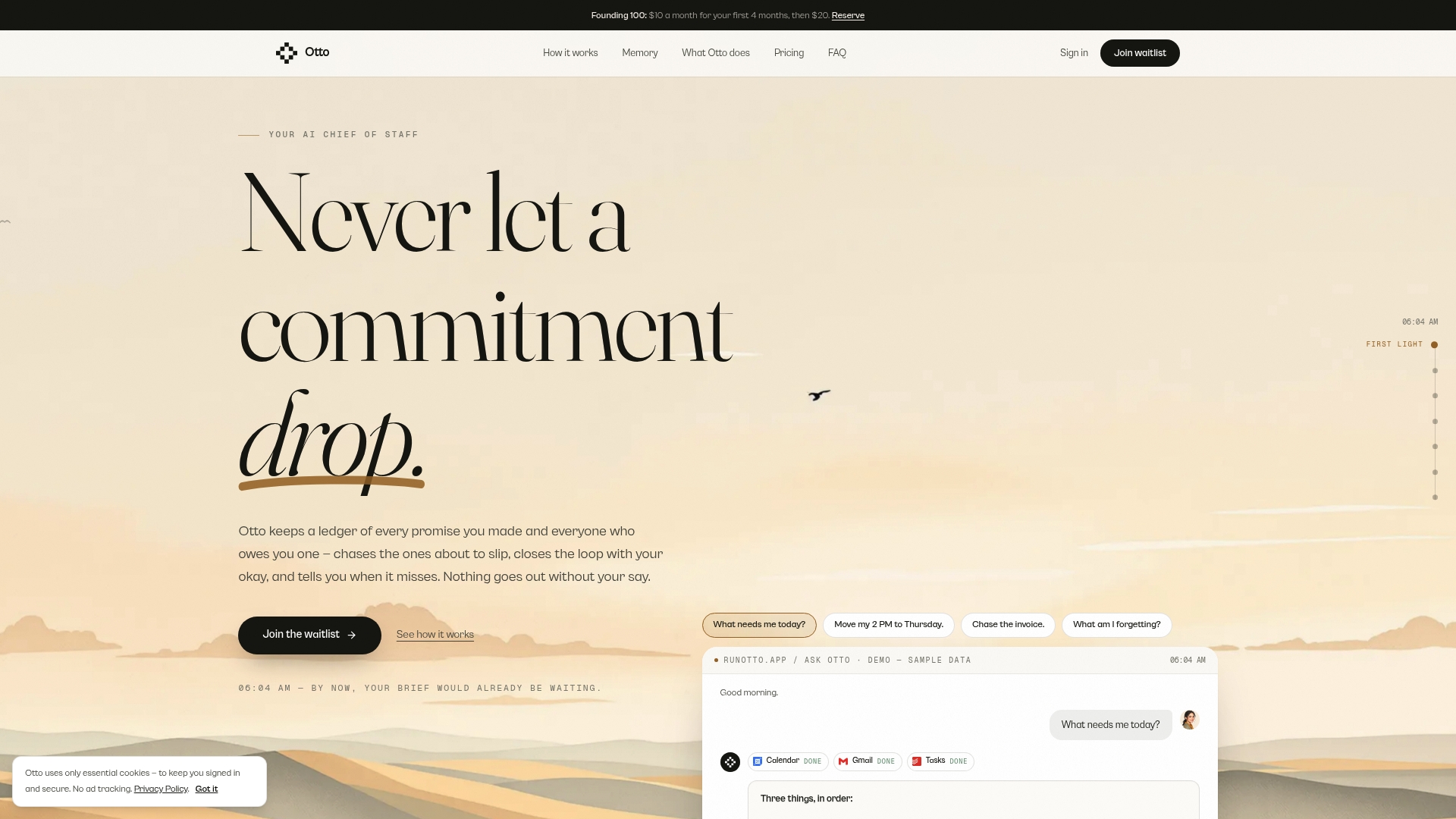
It fits founders and operators who are tired of being the glue between a notetaker, an inbox, and a calendar that never quite agree with each other. Otto listens in meetings and reads your email and calendar to capture every promise into one ledger it follows up on, drafting the follow-up but never sending anything without your approval. It is available on a Free plan at $0 per month, an Upgraded plan at $20 per month, or a Max plan at $50 per month, depending on how much you need it to carry. Check the plans at Ottohq.
FAQ
How many hours should a founder protect for strategic work each week?
Aim for 3 to 6 hours of fully protected strategic blocks each week as a floor, building toward a 40% strategic-time share of your total calendar within 90 days of tracking your audit data. Below that level, most founders end up spending the majority of their time on work someone else could own.
What is a calendar audit and how long should it run?
A calendar audit means tracking your time in 30-minute increments for 14 days and tagging each block as strategic, operator, comfort, or reactive. The 14-day window is the standard practitioner recommendation because it is long enough to capture a normal mix of weeks without becoming a burden to maintain.
When should a startup formalize a weekly operating rhythm?
Most startups should avoid a formal weekly and monthly rhythm before around 15 employees, since the coordination overhead outweighs the benefit at that size, and should have one firmly in place by around 30 employees, according to field guidance on startup operating rhythm. Below that range, direct conversation usually works better than a scheduled process.
What should I delegate first when restructuring my calendar?
Start with tasks in your comfort-work and operator-work categories, the ones you do out of habit rather than necessity and that carry low risk if someone else owns them. Pair each handoff with a one-page decision framework covering context, guardrails, and a named owner so the person taking it over does not need to check back constantly.
Can a tool like Otto replace a calendar audit?
No, a tool does not replace the audit itself, since the audit is a measurement exercise you run on your own time. Otto can make the resulting workflow easier to sustain by keeping your calendar, email, and meeting commitments in one shared memory, with Free, Upgraded, and Max plans depending on how much of that you want automated.