 Otto
Otto5 Plug and Play Freelance Client Reminders to Stop Chasing Payments
5 Plug and Play Freelance Client Reminders to Stop Chasing Payments

Set up an automated pre-due, on-due, and staged overdue reminder sequence now, and put a payment link in every message. This standardizes your tone, kills the awkward “should I email again?” hesitation, and gets you paid faster and more consistently. Tools like invoicing software with built-in reminders work, or you can run the whole thing through something like Otto, which drafts follow-ups for your approval instead of leaving you to remember.
TL;DR:
- Sending pre-due reminders 5 to 7 days in advance and including a payment link increases the likelihood of on-time payments.
- Escalating overdue messages at 7, 14, and 30 days, with clear language and consistent details, helps motivate prompt client responses.
- Adjust your reminder schedule for clients with shorter or longer payment terms, such as Net 7 or Net 60, to match their billing cycles.
- Automating follow-ups with tools like invoicing software or Otto reduces stress and maintains a professional tone without manual effort.
- Pausing work after 30 to 60 days overdue often prompts faster resolution, with escalation to legal or collections options if unpaid beyond 60 days.
Table of Contents
- Ready-to-Use Reminder Sequences for Every Payment Stage
- When to Send Each Reminder Based on Your Payment Terms
- How to Write Reminders That Actually Get a Response
- Setting Up Automated Reminders Without Losing the Personal Touch
- Escalation Steps When Reminders Aren’t Working
- Handling International Clients and Mixed Payment Terms
- Why Templates Changed How I Chase Payments
- Otto Handles the Follow-Up So You Don’t Have To
- Sources
- FAQ
Ready-to-Use Reminder Sequences for Every Payment Stage
Five touches cover almost every invoice scenario: a heads-up before the due date, a same-day nudge, and three escalating overdue messages. Practitioner guidance recommends sending the first reminder 5 to 7 days before the invoice is due and putting a payment link in every single message, no exceptions.
The five-touch sequence:
- Pre-due (5 to 7 days out): Subject: “Invoice #[number] due [date].” Body: “Hi [name], just a heads-up that invoice #[number] for $[amount] is due on [date]. Here’s the payment link: [link]. Let me know if you have any questions.”
- Due date: Subject: “Invoice #[number] is due today.” Body: “Hi [name], invoice #[number] for $[amount] is due today. Pay here: [link]. Thanks for staying on top of it.”
- 7 days overdue: Subject: “Invoice #[number] is now 7 days past due.” Body: “Hi [name], I wanted to flag that invoice #[number] ($[amount], due [date]) is now a week overdue. Payment link: [link]. Let me know if something’s holding it up.”
- 14 days overdue: Subject: “Following up: invoice #[number] is 2 weeks overdue.” Body: “Hi [name], invoice #[number] is now two weeks past due. Please process payment at your earliest convenience: [link]. If there’s an issue on your end, let’s talk today.”
- 30 days overdue (final notice): Subject: “Final notice: invoice #[number], 30 days overdue.” Body: “Hi [name], this is a final notice for invoice #[number] ($[amount]), now 30 days past due. Payment is required within 5 business days: [link]. If I don’t hear back, I’ll need to pause active work and consider next steps.”
For retainers, swap “invoice” for “retainer payment” and reference the billing cycle date instead of a due date. For large balances, add a line offering a short call to discuss payment plans. Every template needs four fixed elements: invoice number, exact amount, due date, and a working payment link, plus a clear next step the client can act on immediately.
When to Send Each Reminder Based on Your Payment Terms
The standard five-touch timeline assumes Net 30 terms, although the actual gap between touches matters more than the calendar date. Send the pre-due nudge before the deadline, a same-day reminder, then escalate at 7, 14, and 30 days past due, with a real escalation conversation kicking in around 45 to 60 days.
If you invoice on Net 7 or Net 15 terms, compress the schedule. A Net 7 client gets a pre-due reminder at 2 days out instead of 7, then follows the same overdue cadence at 7, 14, and 30 days past the (much earlier) due date. Net 60 clients, common with larger companies and their accounts payable cycles, need the opposite adjustment: push your pre-due reminder further out and expect the “polite nudge” phase to run longer before anything counts as seriously late.
| Touch point | Standard timing | Tone |
|---|---|---|
| Pre-due | 5 to 7 days before due date | Friendly, informational |
| Due date | Day of | Neutral, routine |
| First overdue | 7 days past due | Polite, slightly direct |
| Second overdue | 14 days past due | Firm, action-oriented |
| Final notice | 30 days past due | Direct, states consequences |
| Escalation review | 45 to 60 days past due | Formal, references terms |
How to Write Reminders That Actually Get a Response
Start every message assuming good intent. Most late payments come from a forgotten invoice, a slow account payable queue, or a client juggling too many vendors, not deliberate stalling. Open with that assumption, and only escalate the tone once the data (days overdue, prior non-response) actually justifies it.
Every reminder, at every stage, needs the same four non-negotiable fields: invoice number, exact dollar amount, due date, and a clickable payment link. Skip any of these and you’re just adding friction to your own request. Pair that with one explicit call to action, whether it’s “pay here,” “let’s schedule a call,” or “confirm receipt of this notice.”
Here’s how the language should shift as time passes:
- Day 1 to 7 overdue: “Just following up on invoice #4521, now a few days past due.”
- Day 14 overdue: “This invoice is two weeks past the agreed due date. Please process payment or let me know what’s causing the delay.”
- Day 30 overdue (final notice): “This is a final notice. Per our agreement, payment was due on [date]. If I don’t receive payment within 5 business days, I’ll need to pause current work and may pursue additional remedies.”
The 14 and 30-day messages should read firmer, not angrier. You’re stating facts and consequences, not venting.
Pro Tip: Write all five templates in one calm sitting before you’re actually chasing a late payment. Drafting them while frustrated tends to produce language you’ll regret sending, and having them ready means you never have to compose a reminder under stress.

Setting Up Automated Reminders Without Losing the Personal Touch
Three practical automation routes cover almost every freelancer’s setup. Invoicing platforms with built-in reminder features are the lowest-effort option if you already use one for billing. Lightweight reminder apps and workflow tools work well if your invoicing software doesn’t automate follow-ups on its own. Calendar-based or email automation rules are the manual fallback: functional, but they require you to remember to build the triggers yourself.
Whichever route you pick, the setup checklist stays the same:
- Draft all five templates first, before mapping anything to a schedule.
- Assign each template to its trigger interval (pre-due, due, 7d, 14d, 30d).
- Test the entire sequence against a dummy invoice to confirm timing and formatting.
- Verify the cancellation trigger actually stops remaining reminders the moment payment lands.
- Keep a log of every sent message, since a documented reminder trail can matter later if you need proof of good-faith follow-up.
This is where a tool like Otto fits differently than a standalone invoicing app. Because it holds your email, calendar, and meeting notes in one place, it can catch a payment promise a client makes out loud on a call and connect it to the actual invoice, then draft the follow-up for your approval instead of sending it blind. Nothing goes out without you signing off first, which matters when a client relationship needs a human touch, not just a scheduled blast.
Escalation Steps When Reminders Aren’t Working
Pausing active work is the sharpest lever you have, and it’s most effective between 30 and 60 days overdue. For clients with a dedicated accounts payable team, a pause often gets faster internal attention than another email to your usual contact, because it forces someone else in the organization to prioritize the invoice.
- Phrase the pause plainly: “I’m pausing work on [project] until invoice #[number] is settled. Happy to resume as soon as payment clears.”
- Only apply late fees if your contract explicitly states them; if it doesn’t, add a simple late fee clause (a flat amount or percentage) to future agreements rather than trying to charge one retroactively.
- If 60 days pass with no resolution, your remaining options are a formal demand letter, small claims court, or a collections agency.
Laws on late commercial payments vary by country, so confirm your local rules before threatening legal action. In the UK, the Late Payment of Commercial Debts (Interest) Act 1998 gives suppliers a right to statutory interest and compensation for recovery costs on unpaid commercial debts.
Handling International Clients and Mixed Payment Terms
International clients complicate reminders in three ways: currency, time zone, and payment method. State invoice amounts in the currency you actually invoiced in, and never assume a client’s local currency matches the number on your invoice. If you bill in US dollars but your client pays in euros or another currency, note that any conversion happens on their end, not yours.

Time zones affect when a reminder actually lands in someone’s inbox, so schedule sends for the client’s local morning rather than yours. A reminder that hits at 3 a.m. their time gets buried by the time they open their inbox.
Payment method matters more internationally than domestically. Bank wires can take 3 to 5 business days to clear, which means a client who “paid” 4 days ago may genuinely not be late yet. Build a short buffer into your overdue calculations for wire transfers, and confirm which method a client will use before your invoice’s due date arrives, not after.
Varying Net terms across a client roster is normal once you work internationally. Some regions and larger companies default to Net 45 or Net 60 as standard practice, not as a red flag. Keep a simple internal record of each client’s actual terms so your automated cadence pulls from the right start date for each one, rather than applying a single default across every invoice you send.
Why Templates Changed How I Chase Payments
Writing five reminder templates once, in a calm ten minutes, did more for my invoicing than any tool I bought afterward. Before, every late payment meant composing a fresh email while already annoyed, which usually made the message sound worse than I intended. After, the system just ran: same tone, same information, every time, and I stopped dreading the follow-up entirely.
— Eddie
Otto Handles the Follow-Up So You Don’t Have To
Otto gives freelancers one place where email, calendar, and meeting notes actually talk to each other, so a payment date a client mentions on a call doesn’t get lost the second the meeting ends. It captures that kind of promise automatically, drafts the follow-up reminder, and waits for your approval before anything goes out.
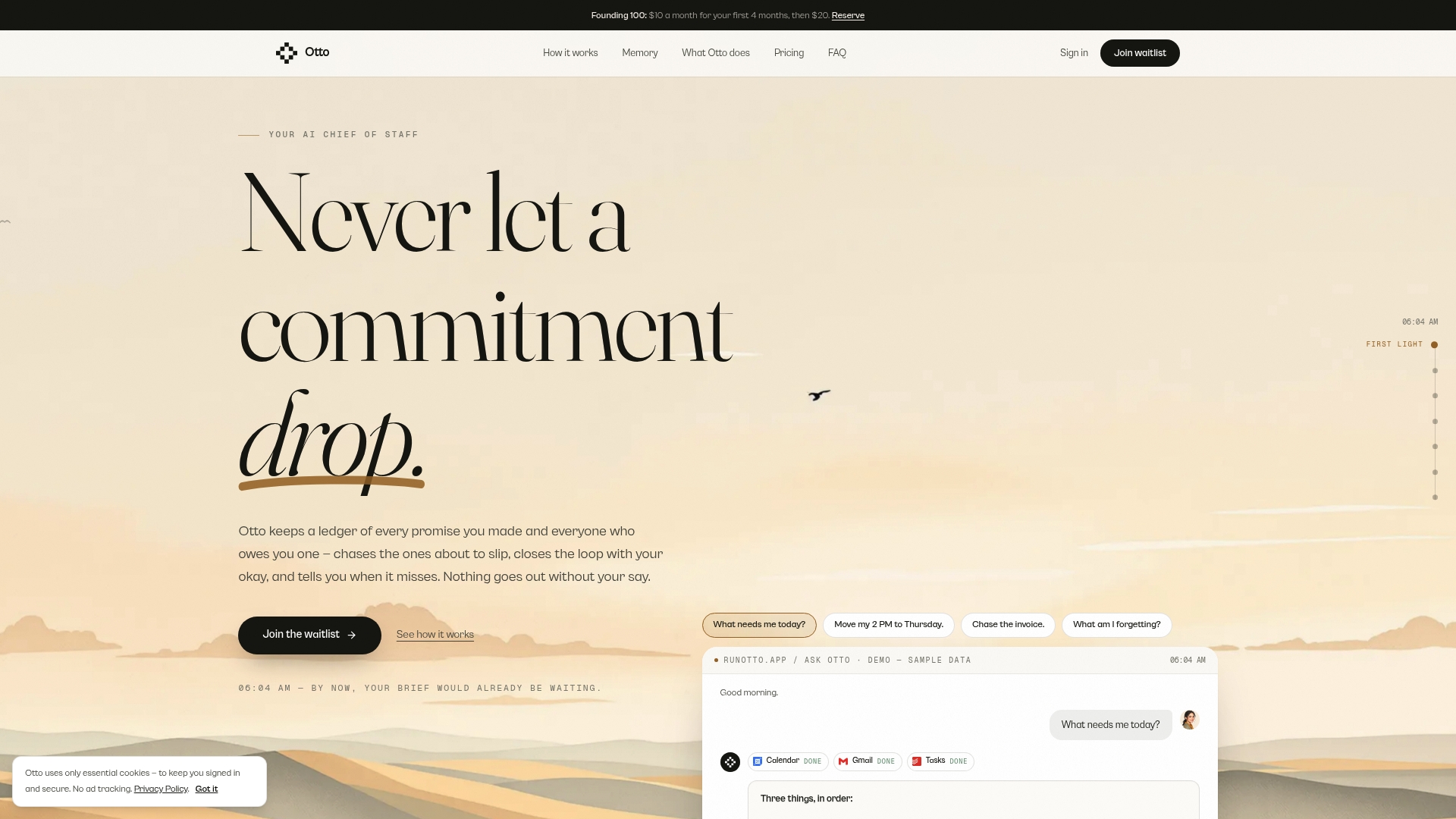
That matters because most reminder tools only see your inbox or your invoicing software, never both at once. Otto sees the whole picture: the meeting where a client said “I’ll pay by Friday,” the calendar, and the actual overdue invoice, then connects them without you having to manually cross-reference anything. Reminders stop the moment payment clears, and every draft still passes through you first, so nothing goes out sounding like a robot wrote it.
Otto offers multiple subscription plans including free and paid options; current prices are available on Otto’s pricing page. If chasing invoices manually has eaten enough of your week, try Otto and set up your first automated reminder sequence today.
Sources
FAQ
How Do I Professionally Say “Just a Reminder”?
Lead with the invoice details instead of an apologetic tone: “Just a heads-up that invoice #[number] for $[amount] is due on [date].” Skip phrases like “sorry to bother you,” which undercuts the professionalism of a routine business request.
How Should Freelancers Talk to Clients About Money?
Treat payment conversations as standard business communication, not a personal favor you’re asking for. State amounts, dates, and links plainly, and save the extra warmth for project updates, not for money asks. The Freelancers Union recommends setting explicit terms upfront so the conversation never feels like a surprise later.
How Do I Bill a Client as a Freelancer?
Send an itemized invoice with your name, the client’s name, a unique invoice number, the amount, payment terms (Net 15, Net 30, etc.), and a payment link. Set the due date at the time of invoicing, not after work wraps, so your reminder cadence has a clear starting point.
How Do I Remind My Client for Payment?
Send a pre-due reminder 5 to 7 days before the deadline, a same-day nudge, and then staged overdue messages at 7, 14, and 30 days, each with the invoice number, amount, and payment link included. Automating this sequence through invoicing software or a tool like Otto removes the guesswork of remembering when to send the next one.
What Happens If a Client Still Doesn’t Pay After 30 Days?
Pause active work, since that step alone often prompts action, especially with clients who have an internal accounts payable process. Beyond 60 days, escalate to a formal demand letter, small claims court, or a collections agency, depending on your jurisdiction’s rules and the invoice amount.