 Otto
OttoFreelancer Time Management: A Practical Weekly System
Freelancer Time Management: A Practical Weekly System

Do this now: open tomorrow’s calendar and block your first two hours as deep work, then set a 30-minute window at midday and another before you log off for client replies. Everything else gets scheduled around those anchors, not the other way around.
- Block tomorrow’s first two hours for your hardest task, no exceptions.
- Set two daily 30-minute windows for client communication.
- Add a recurring weekly block for outreach and admin, even 90 minutes.
- Tools like Otto can absorb the follow-up tracking so nothing slips between inbox, calendar, and meetings.
Key Takeaways
Freelancer time management works best as a weekly system of protected blocks, explicit client windows, and a recurring investment period, not a daily to-do list.
| Point | Details |
|---|---|
| Build a weekly template | Anchor deep work in the morning, batch client replies into two daily windows, and reserve one day for admin and outreach. |
| Set one client per block | Never split a focus block between clients; the double context reload costs more time than it saves. |
| Track before you optimize | Run a two-week time audit separating billable, admin, and outreach hours before changing your schedule. |
| Start hard, end with a ritual | Tackle your hardest task first each morning, and close every day with a 15-minute shutdown routine. |
| Reduce tool fragmentation | An AI chief of staff like Otto centralizes email, calendar, and meeting commitments so nothing gets lost between tools. |
Table of Contents
- Setting Boundaries With Clients Without Losing the Client
- A Weekly Time-Block Template You Can Copy Tomorrow
- Pomodoro or Ultradian Blocks? Match the Sprint to the Task
- Prioritization Frameworks That Actually Fit Freelance Work
- Track Your Time, Then Audit It Like a Business
- Protect the Pipeline: Outreach Is a Scheduling Problem, Not a Marketing One
- Tools and Automation That Cut Admin Friction
- End Each Day and Week With a Ritual, Not a Trail-Off
- How an AI Chief of Staff Closes the Context-Switching Gap
- Why the Advice Everyone Gives Freelancers Is Half Right
- A Simpler Way to Hold Your Week Together
- Sources
Setting Boundaries With Clients Without Losing the Client
Boundaries are the operating system underneath every other time-management tactic. Without them, deep-work blocks get eaten by “quick calls,” and admin time balloons into evenings. Freelancers who set explicit expectations early tend to protect more billable hours later, because clients calibrate to whatever response speed you establish in week one.
- State your response window in the kickoff call: “I check messages at 10am and 4pm, and reply within one business day.”
- Put it in writing. Add a short line to your contract or onboarding email: “Support hours are Monday through Friday, 9am to 5pm. Rush requests outside that window carry a 25% fee.”
- Define scope limits before work starts. List what’s included and what triggers a change order, in the proposal itself.
- When a client pings you at 9pm expecting an instant answer, reply the next morning within your stated window. Consistency, not apology, resets the pattern.
Pro Tip: Keep a canned response ready: “Got it, I’ll have this back to you by [specific time].” It buys you room without sounding evasive, and it trains clients to expect a timestamp, not an instant reaction.
Clients who test these limits almost always back off once they see the work still arrives on time. The Freelancers Union has long argued that freelancers who track and communicate their hours bill more accurately and get pushed around less.
A Weekly Time-Block Template You Can Copy Tomorrow
To-do lists tell you what to do; they never tell you when. A weekly template solves that by pre-assigning every category of work a fixed slot, so decisions happen once a week instead of forty times a day.
Here’s a starting structure for a five-day week:
- Morning anchor (2 to 3 hours): your hardest or highest-value task, before checking email.
- Client response windows (30 minutes, twice daily): batched replies, not constant checking.
- Deep-work blocks (afternoons): one client per block, never split.
- Investment block (roughly 20% of the week, or about one full day): outreach, admin, invoicing, skill-building.
- Buffer time (Friday afternoon): overflow, rescheduled calls, catch-up.
A Time Budget Framework that pre-allocates hours across billable work, business development, and recovery is designed specifically to reduce the feast-and-famine swings that hit freelancers who only react to whatever’s loudest that week.
If you work across time zones or run on a night-owl schedule, shift the anchor block to whenever your energy peaks. The structure matters more than the clock time. Cap your work-in-progress to two or three active clients at once, and never let a single focus block serve two clients. Splitting it forces a double context reload that quietly kills throughput.
Pomodoro or Ultradian Blocks? Match the Sprint to the Task
Batching groups similar small tasks together; sprints protect a stretch of time for one thing. Both exist to solve the same problem: every switch between tasks carries a hidden reload cost, and freelancers juggling five clients pay that tax constantly.
- Use 25-minute Pomodoro sprints for shallow, repetitive work: invoicing, email triage, scheduling, quick edits.
- Use 60 to 90 minute blocks for deep creative or technical work, matching your body’s natural ultradian rhythm.
- Take a real break between blocks, not a scroll through your phone. A short walk resets attention better than a screen swap.
- Build a 10 to 15 minute buffer after client calls before diving into the next task, so you’re not carrying one conversation’s context into another.
Regular physical movement during these breaks isn’t just a wellness footnote. Research from Brookings links regular exercise to measurable gains in cognitive performance and output, which is exactly what a mid-afternoon slump needs more than a fourth coffee.
Prioritization Frameworks That Actually Fit Freelance Work
- Reframe Eisenhower’s grid for freelancing. “Urgent” isn’t whatever client emailed last; it’s whatever affects payment or a hard deadline. “Important” is whatever builds your pipeline or your rate. A loud request that’s neither should wait.
- Apply the Pareto principle to your client list. A small share of your clients usually generates most of your revenue and least of your stress. Protect their time slots first, and be honest about which relationships cost more than they pay.
- Use Parkinson’s Law on purpose. Work expands to fill the time allotted, so give tasks tighter deadlines than feels comfortable. It also sharpens your quoting: if a task reliably takes three hours, stop quoting five.
- Start with the hardest task, not the easiest. Research from Kellogg Insight found that tackling difficult work early tends to improve completion rates, since willpower and focus are both highest before the day fills up with smaller distractions.
Track Your Time, Then Audit It Like a Business
Billing trackers and behavioral trackers solve different problems, and freelancers who only use one are missing half the picture. A billing tracker (time-tracking software or a simple spreadsheet) tells you what to invoice. A behavioral tracker, which can be as basic as a note app, tells you where your actual hours went versus where you planned them.
Run this for two weeks before changing much else:
- Log every block of work in 30-minute increments, tagged by client and task type.
- Separate billable hours from admin, outreach, and “unplanned interruption” time.
- At the end of each week, compare planned hours to actual hours per category.
- Flag any task that consistently runs over your quoted estimate.
Freelancers Union recommends exactly this kind of measurement before overhauling your systems, since guessing at time leaks usually just adds new habits on top of bad data.
Protect the Pipeline: Outreach Is a Scheduling Problem, Not a Marketing One
Pipeline maintenance dies first in a busy month, which is exactly when you need it most three months later. Treating outreach as optional guarantees the feast-and-famine cycle every freelancer complains about.
- Put outreach inside your investment block, not on a “someday” list. Even 30 minutes, four times a week, compounds.
- Set a small, concrete weekly target: three outreach messages, one portfolio update, one follow-up on a stalled quote.
- Framing pipeline work as a recurring block rather than an occasional scramble is what actually prevents the dry months.
- Delegate or automate what you can: templated outreach emails, scheduled social posts, auto-reminders for stalled proposals.
Tools and Automation That Cut Admin Friction
The goal isn’t more apps. It’s fewer apps that talk to each other. Upwork’s productivity research points to a handful of categories worth having: automatic time trackers, project and task managers, and centralized communication tools, rather than a pile of single-purpose apps you forget to open.
- Billing trackers: automatic time capture tied directly to invoicing.
- Calendar blockers: tools that physically reserve your deep-work hours so meeting requests can’t land there.
- Async communication: loom-style video updates or shared docs instead of another call.
- Follow-up automation: scheduled reminders so a stalled invoice or unanswered proposal doesn’t quietly disappear.
Start small this week: automate one recurring reply, turn on meeting transcription so you stop taking manual notes, and set one follow-up reminder you’d otherwise forget. Automating repetitive administrative tasks tends to save more hours than people expect, mostly because the tasks themselves were never big, just constant.
End Each Day and Week With a Ritual, Not a Trail-Off
- Close open loops (5 minutes): note what’s unfinished so tomorrow starts with a list, not a memory search.
- Log today’s hours (5 minutes): billable, admin, outreach. This feeds your weekly audit automatically.
- Set tomorrow’s anchor task (5 minutes): decide your hardest task tonight, before the morning’s noise arrives.
Weekly, add: total hours worked, billable ratio, estimate accuracy on quoted jobs, and your top three priorities for next week.
Pro Tip: Do the shutdown ritual at the same time every day, even on light days. The consistency matters more than the content, and it’s what actually prevents work from bleeding into your evening.

How an AI Chief of Staff Closes the Context-Switching Gap
Most freelancers run five or six tools that never speak to each other: a calendar, an inbox, a notes app for meetings, a task manager, an invoicing tool. Every switch between them costs a small reload of memory, and by Friday those small costs add up to hours nobody scheduled.
An AI chief of staff like Otto works differently because it holds email, calendar, and meeting notes in one shared memory instead of six disconnected ones.
- It listens in meetings and captures verbal commitments you’d otherwise have to remember to write down.
- It reads email and calendar together, so a promise made on a call and a deadline buried in a thread live in the same place.
- It surfaces a daily focus recommendation based on everything it can see at once, not just whichever tool you happened to open first.
- Nothing goes out without your approval. Otto drafts follow-ups; you decide whether they send.
Why the Advice Everyone Gives Freelancers Is Half Right
Most freelancer productivity advice stops at “track your time” and “use a calendar,” as if the problem were discipline. It usually isn’t. The freelancers I’ve seen struggle most aren’t lazy or disorganized; they’re running six tools that don’t talk to each other, so every day starts with reassembling context instead of doing the work. The weekly template and the investment block matter because they turn scattered intentions into fixed slots. But the deeper fix is reducing how much of your day goes to remembering things software should remember for you. Try the system imperfectly before you try it perfectly. A messy week-one calendar beats a polished one you never actually build.
— Eddie
A Simpler Way to Hold Your Week Together
Everything in this system still requires a calendar, a client list, and follow-through. What it doesn’t require is you personally holding every promise, deadline, and half-remembered call detail in your own head. Otto watches your email, calendar, and meetings from one shared memory, so a commitment you made out loud on a Tuesday call doesn’t quietly vanish by Thursday. It drafts the follow-ups; you approve what actually goes out.
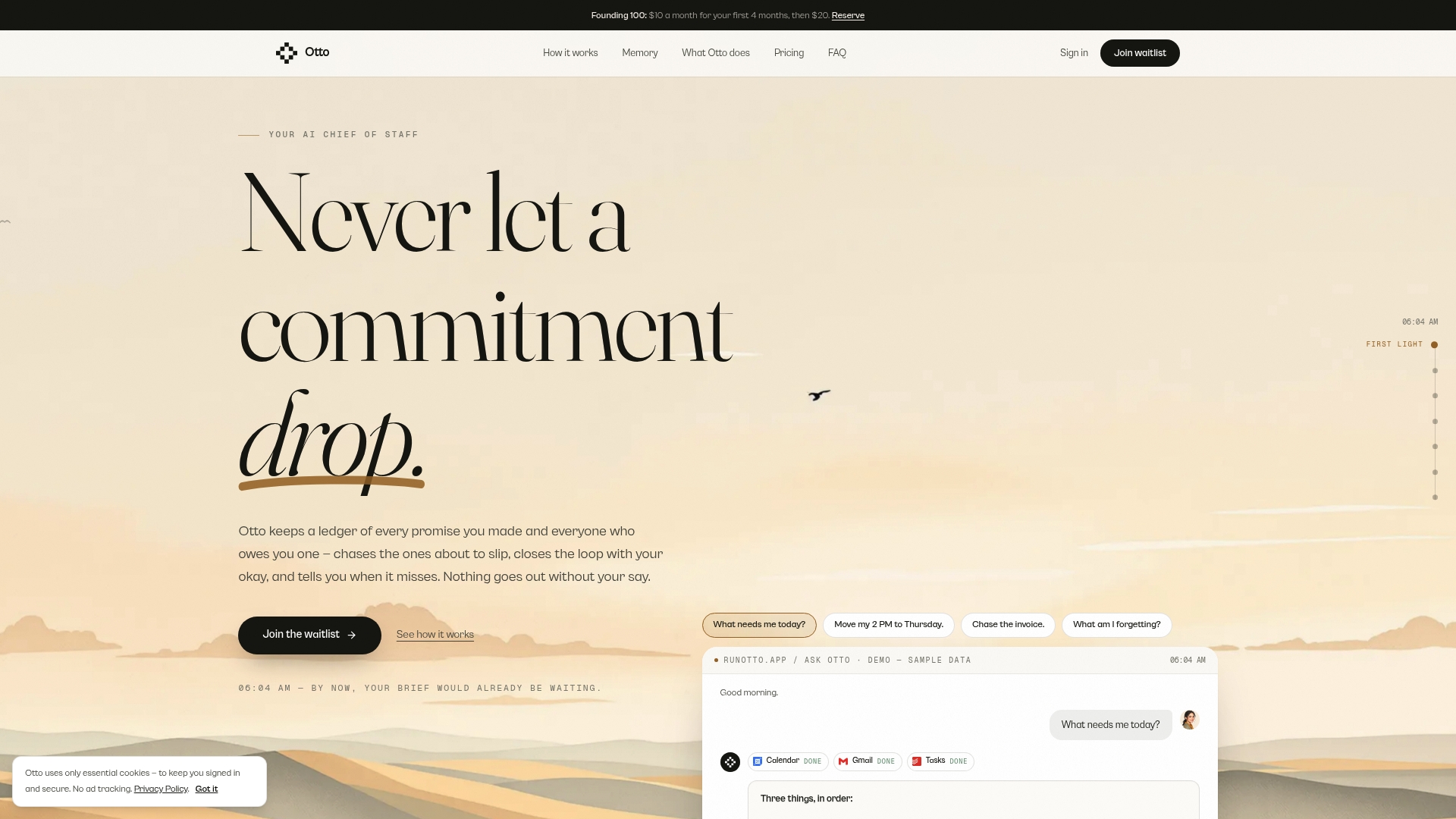
That’s the practical difference for a freelancer juggling three or four clients: less time spent reconstructing what you agreed to, more time in the deep-work block you just built. Otto doesn’t replace your weekly template or your time-tracking habit. It removes the manual glue work between the tools you already use. Try building your week around it at Otto’s chief-of-staff platform and see whether your Monday morning starts with a plan instead of a scramble.
Sources
For deeper reading, see Forbes on time management tips, Freelancers Union on time tracking, and Upwork’s productivity tools guide.
- Tracking Your Time as a Freelance Writer | Freelancers Union
- Web productivity tools for freelancers | Upwork
- Time management for freelancers: a system that actually works | Make10000Hours