 Otto
Otto10 Minute Weekly Check Ins Make Personal OKRs Stick for Busy People
10 Minute Weekly Check Ins Make Personal OKRs Stick for Busy People

Personal OKR tracking is the practice of setting one to three quarterly objectives, attaching two to five measurable key results to each, and reviewing them on a fixed weekly and quarterly rhythm. The habit that makes or breaks the whole system is a 10-minute weekly check-in where you log real numbers, not a vague “still working on it.” Pick a lightweight tracker today, whether that’s a spreadsheet or a notes app, and write down the current value for at least one key result before you close this tab.
TL;DR:
- Tracking progress weekly requires less than 10 minutes if the tracker automates data collection from email, calendar, and meeting notes.
- Successful OKRs have measurable key results with clear start and target values, avoiding vague tasks disguised as goals.
- Setting only one to three objectives per quarter with two to five key results distributes focus and improves long-term alignment.
- Scoring each key result between 0.0 and 1.0 and aiming for approximately 60 to 70 percent achievement ensures stretch without discouragement.
- Simplifying logging by consolidating commitments reduces reconstruction time, preventing the habit from fading due to logistical friction.
Table of Contents
- What Tools Actually Work for Personal OKR Tracking?
- How Do You Write Effective Personal OKRs?
- What’s the Weekly and Monthly Tracking Routine?
- How Should You Score and Interpret Your OKR Progress?
- What Mistakes Sink Most Personal OKR Systems?
- Why Does Personal OKR Tracking Fail Even for Organized People?
- What Do Personal OKR Examples and Templates Actually Look Like?
- How Do You Keep Personal OKRs From Turning Into a To-Do List?
- What Does a Good Quarterly Retrospective Look Like?
- How Do You Align Personal OKRs With Long-Term Goals?
- What Are the Biggest Challenges in Personal OKR Tracking?
- How Do You Balance Ambition and Realism in Personal OKRs?
- What Questions Should You Ask During a Personal OKR Review?
- The Real Reason Most Personal OKR Systems Quietly Die
- Let Otto Handle the Reconstruction Work
- Sources
What Tools Actually Work for Personal OKR Tracking?
You don’t need enterprise software to run a personal OKR management system. What you need is a tool that holds five specific fields without friction, and doesn’t add so much overhead that you abandon it by week three.
Five formats cover almost everyone:
- Spreadsheet templates (Google Sheets or Excel): fully customizable, free, and easy to chart trends across quarters.
- Notion or template kits: good if you already live in a workspace tool and want OKRs next to your notes and calendar.
- Single-user goal-tracking apps: built specifically for OKRs, often with built-in scoring and reminders.
- Browser extensions or local trackers: minimal, private, no account required, ideal if you don’t want your goals living on someone else’s server.
- Command-line or plain-text tools: fast for people who already track everything in markdown files or terminal notes.
Whatever format you pick, it needs to capture six things: the objective, each key result with its starting value and target, current progress, the date of the last update, and a slot for the end-of-quarter score. Miss any of those fields and your quarterly retrospective becomes guesswork.
Choose based on three trade-offs: how much privacy you need, whether it has to sync with a calendar or task app you already use, and how many clicks it takes to log a number. A tool that takes 90 seconds to update wins over one that takes five minutes, every time, because the friction compounds weekly.
How Do You Write Effective Personal OKRs?
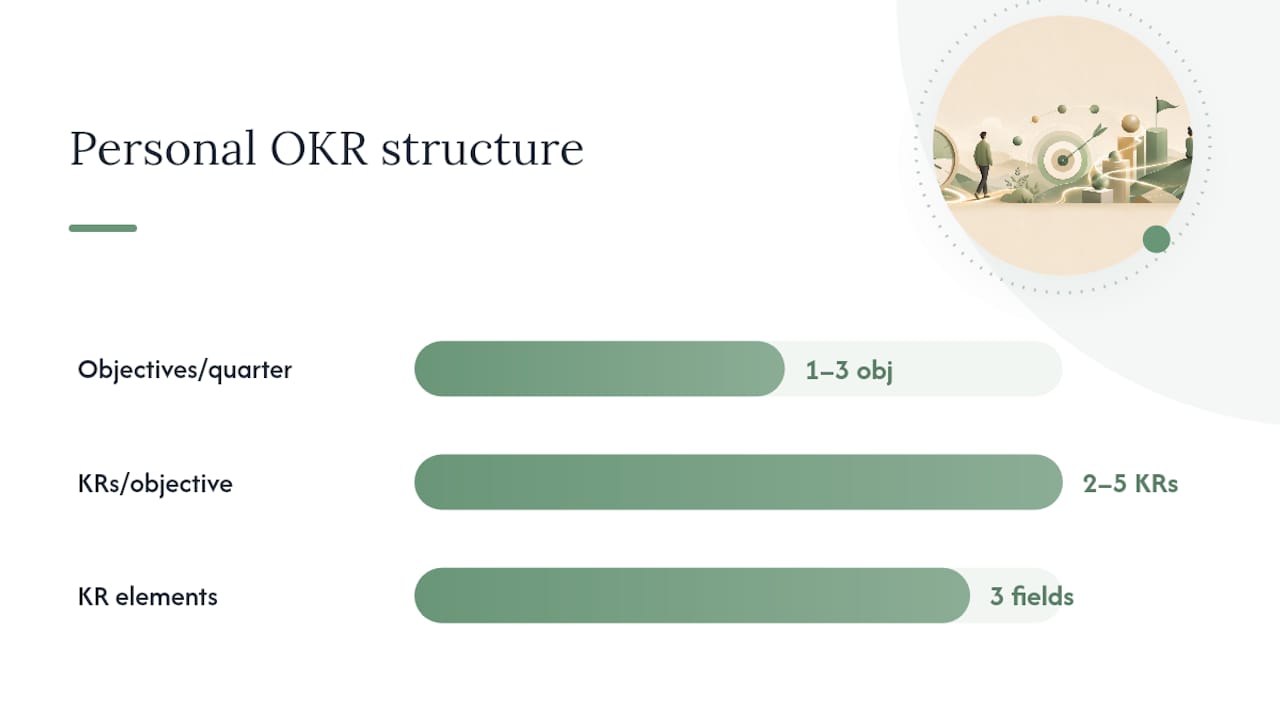
Effective personal OKRs follow a simple structural rule: one to three objectives per quarter, each with two to five key results, and every key result needs a starting value, a target, and a stated way to measure it. Objectives describe a qualitative outcome you want. Key results are the numbers that prove it happened.
The most common mistake is writing a task disguised as a key result. “Read a book on negotiation” is a task, it either happens or it doesn’t, with no gradient of progress. Turn it into a measurable outcome by asking how you’ll prove the change actually happened. “Complete negotiation certification at 80% or higher” gives you a number to track weekly, not just a checkbox.
Here’s the conversion pattern in three domains:
- Health: Objective: Build a sustainable strength training habit. Key results: Complete 36 gym sessions (from 0), increase deadlift max from 135 to 185 pounds, hit a 7,000 average daily step count across the quarter.
- Career: Objective: Establish visibility as a subject-matter expert. Key results: Publish 6 articles or posts (from 0), speak at 2 industry events (from 0), grow a professional newsletter list from 200 to 800 subscribers.
- Learning: Objective: Build conversational proficiency in Spanish. Key results: Complete 40 hours of structured lessons, hold 8 unscripted conversations with a native speaker, score 70% or higher on a B1-level placement test.
Notice that every key result has a start number, an end number, and a way to measure it. That’s the difference between okrs for individuals that actually work and a wish list that quietly dies in a notes app by February.
What’s the Weekly and Monthly Tracking Routine?
A sustainable personal OKR management routine has three layers, and each one has a different time budget and a different job.
- Weekly check-in, 10 minutes. Update each key result’s current number, rate your confidence in hitting the target (high, medium, low), name one blocker if you have one, and pick a single next step to work on as explained in Track Employee Leadership Growth Metrics That Matter. This step alone is the biggest lever in the whole system: progress monitoring is consistently linked to higher goal achievement across the research on habit formation, and a 10-minute cadence is short enough to survive a busy week without becoming another chore you resent.
- Monthly trajectory check, 30 minutes. Compare your actual progress against how much of the quarter has elapsed. If you’re five weeks into a 13-week cycle and only 20% toward a key result, you’re behind pace, and that’s a signal to change your tactics or, occasionally, the target itself.
- Quarterly scoring and retrospective, 45 to 60 minutes. Score every key result on the 0.0 to 1.0 scale, write down what worked and what didn’t, and decide what carries into next quarter versus what gets dropped.
Pro Tip: Calculate your monthly trajectory with one formula: current value divided by target value, divided by the fraction of the quarter that’s passed. A result under 1.0 means you’re behind pace, and it tells you that faster than any gut feeling will.
How Should You Score and Interpret Your OKR Progress?
Score every key result between 0.0 and 1.0 at the end of the quarter, where 1.0 means you hit the target exactly and anything above reflects you exceeded it. The scale isn’t about pass or fail. It’s about calibration over time.
Here’s the number that surprises most first-time OKR users: achieving roughly 60 to 70 percent of an ambitious target is generally considered a success, not a shortfall. OKRs are designed around stretch targets on purpose, so a 0.65 average score across your key results usually means you set the bar correctly, not that you underperformed.
A few practical rules make the scoring process actually useful instead of just a number you write down and forget:
- Track progress (the objective number) and confidence (your subjective read on whether you’ll hit target) as two separate fields at every check-in, not one blended gut check.
- Watch for a gap between the two. High confidence with stalling progress is an early warning sign you’ll miss if you only track one metric.
- Look at scores across three or four quarters, not just one. A pattern of consistently scoring above 0.9 means your targets are too easy. A pattern of scoring under 0.4 means they’re too aggressive.
- Keep past quarters in a read-only archive so you’re not tempted to quietly edit old targets to make your history look better.
What Mistakes Sink Most Personal OKR Systems?
Three mistakes account for most abandoned personal OKR practices, and all three have a fast fix.
- Writing tasks instead of measurable key results. If your key result reads like something you could check off in one sitting, “organize my files,” “read three books,” it’s a task. Rewrite it with a start value, a target, and a measurement method: “Organize and label 100% of client files by category” gives you something to actually score.
- Setting too many objectives or key results. Three objectives with five key results each means 15 numbers to track weekly. Almost nobody sustains that. Trim to one or two objectives with two or three key results apiece for your first quarter, and add more once the habit is solid.
- Skipping the weekly check-in. This is the mistake that kills the whole system, because a quarter of OKRs you never look at is just a document, not a practice. Fix it by putting a recurring 10-minute slot on your calendar at the same time every week, and pair it with something you already do reliably, like your Sunday planning session or Monday morning coffee.
One more worth naming: keep personal OKRs separate from any performance OKRs your employer assigns you. Mixing the two creates role conflict and turns a system meant to build personal accountability at work into another source of external pressure.
Why Does Personal OKR Tracking Fail Even for Organized People?
The friction that kills most personal OKR practices isn’t laziness. It’s fragmentation. Your calendar lives in one app, your commitments live in email threads and meeting notes, and your OKR tracker lives somewhere else entirely. Every weekly check-in becomes an exercise in reconstructing what actually happened across three or four disconnected tools before you can even update a number.
That reconstruction cost is the real reason people abandon a work accountability system after a few weeks, not lack of discipline. Personal accountability is a learned competency built on consistent, low-effort habits, and habits that require you to hunt for information don’t survive a busy week.
When your calendar, your inbox, and your meeting notes all live in one place, a weekly check-in stops being an archaeology project and becomes a two-minute glance. The friction was never the scoring math. It was always the scavenger hunt for what you’d already committed to doing.
This is the gap Otto is built to close. Because it reads email, calendar, and meeting transcripts into one shared memory, the promises you made out loud on a call and the deadlines buried in a thread both surface in the same place your OKR numbers live, which turns the weekly check-in from a reconstruction exercise into a quick confirmation.
What Do Personal OKR Examples and Templates Actually Look Like?
A usable personal OKR template needs six columns, no more: objective, key result, starting value, target value, current value, and last updated date. Add a seventh for confidence level (high, medium, low) if your tracker supports it, and you’ve covered everything a quarterly review needs.
A finished quarter filled in looks like this:
Notice the template doesn’t need narrative explanation. The numbers tell you exactly where you stand: on pace for the spending target, slightly behind on the emergency fund, exactly on pace for the tracking streak. That’s the entire point of good personal OKR examples: they make status visible at a glance without a paragraph of context.
If you’re building your first template from scratch, start with a single objective and copy the structure above into a spreadsheet. Resist the urge to add extra columns for notes, tags, or priority levels in your first quarter. Those additions feel useful but they’re exactly the kind of complexity that turns a five-minute weekly update into a fifteen-minute one, and fifteen minutes is where most people quit.
How Do You Keep Personal OKRs From Turning Into a To-Do List?
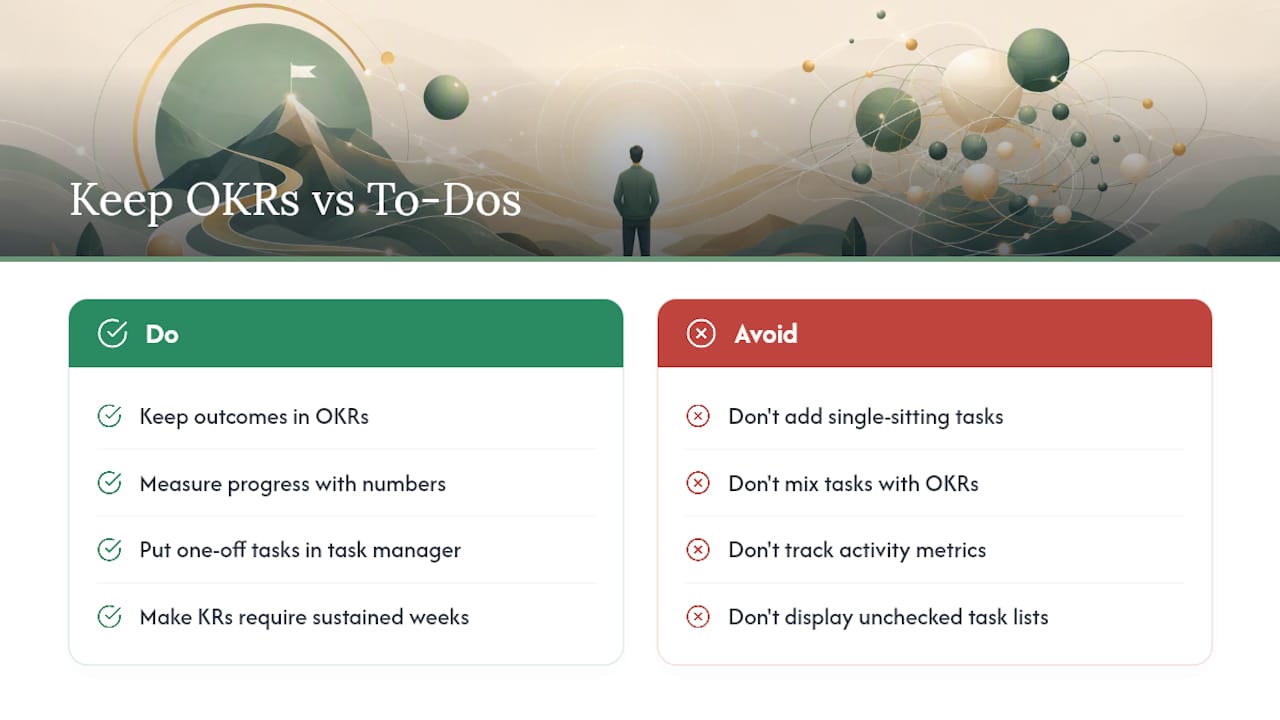
The clearest test for whether something belongs in your OKRs or your task list is this: can it be checked off in one sitting, or does it require sustained progress over weeks? “Send three client proposals” is done the moment you hit send. “Increase proposal-to-client conversion from 20% to 35%” requires weeks of iteration, and that’s the marker of a real key result.
Task lists and OKRs solve different problems, and conflating them is the single most common reason personal OKR goal setting collapses into just another chore list. A task list tracks what you need to do today. An OKR tracks whether the accumulated effect of dozens of small actions is actually moving a number in the direction you want.
A practical separation rule: if a to-do item doesn’t roll up into one of your quarterly key results, it doesn’t belong anywhere near your OKR tracker. It goes in your regular task manager instead. Your OKR sheet should only ever show objectives, key results, and their numbers, never a growing list of unchecked boxes.
Watch for a subtler version of this mistake: key results that are technically measurable but still describe activity instead of outcome. “Attend 12 networking events” measures effort, not result. “Generate 5 qualified job leads from networking” measures the outcome you actually care about. The fix is the same one used earlier for converting tasks into key results: ask what number would prove the effort worked, and track that number instead of the activity itself.
What Does a Good Quarterly Retrospective Look Like?
A quarterly retrospective has three parts: scoring, reflection, and a decision about what carries forward. Skipping any one of them turns the retrospective into a formality instead of the tool that actually improves your next quarter’s OKRs.
Start with scoring, using the 0.0 to 1.0 scale for every key result based on where you landed against the target. Then move to reflection, and this is where most people rush. Spend real time on why a key result landed where it did, not just whether it did. A key result that scored 0.3 because you deprioritized it after week 4 tells a different story than one that scored 0.3 because the target was unrealistic from the start.
The final part, deciding what carries forward, is where the archive-past-quarters discipline pays off. If a key result scored low because you ran out of time, not because the goal was wrong, carry it into next quarter with the same target. If it scored low because the target itself was miscalibrated, adjust the number rather than repeating a target you already know was wrong.
Keep every past quarter visible and unedited. A read-only archive of prior scores is what lets you spot a pattern, three straight quarters of easy 0.9 scores, or two straight quarters of missed fitness targets, that a single quarter’s data can never show you. Without that history, every quarter starts from zero information, and you end up recalibrating by feel instead of by evidence.
How Do You Align Personal OKRs With Long-Term Goals?
Quarterly OKRs work only when they’re a slice of something bigger, not a disconnected sprint you invent fresh every 13 weeks. Before writing quarterly objectives, spend 15 minutes naming one or two multi-year goals: a career milestone, a health target, a financial number you want to hit by a certain age.
Then ask a simple question for each proposed objective: if I achieve this quarter’s key results, does it move the needle on that longer goal, or is it just busy work that feels productive? An objective to “publish 6 industry articles” only earns its place if it connects to a longer arc like building a reputation that leads to a promotion or a client pipeline, not because writing feels virtuous on its own.
This alignment check also protects against a subtler failure: chasing a new shiny objective every quarter with no thread connecting them. If your key results from Q1 have nothing to do with your key results in Q2, you’re probably reacting to whatever felt urgent last month rather than executing a plan. A useful habit is to review your one or two long-term goals at the start of every quarterly planning session, before you write a single key result, so the quarter’s OKRs get built as a step toward something rather than as a standalone list.
What Are the Biggest Challenges in Personal OKR Tracking?
Three challenges show up again and again for people running a personal OKR practice solo, without a team or manager holding them to it.
The first is motivation decay. Week one enthusiasm rarely survives to week nine of a 13-week quarter. The fix isn’t willpower, it’s structure: a fixed weekly check-in time, tied to an existing habit, removes the need to feel motivated in order to show up.
The second is inconsistent tracking. Life gets busy, a check-in gets skipped, then two, and by week five the numbers are stale enough that updating them feels pointless. The fix is accepting an imperfect update over no update. A rough estimate logged in 60 seconds beats a perfectly accurate number you never get around to entering.
The third is isolation, the lack of any external accountability that a workplace OKR system provides through a manager or a team review. Since most personal OKR management happens without that built-in pressure, you have to manufacture your own: share your quarterly objectives with one trusted person, or simply make your weekly check-in visible to yourself in a way that’s hard to ignore, like a dashboard you see every morning.
A structured accountability tactic worth borrowing from workplace competency frameworks is building what amounts to a personal commitment dashboard, a single visible place where your active promises to yourself live, so avoiding them takes more effort than just doing the check-in.
How Do You Balance Ambition and Realism in Personal OKRs?
The right level of ambition for a personal key result is one where hitting 100% feels genuinely uncertain, not a guarantee and not a fantasy. If you’re confident you’ll hit every target before the quarter even starts, the bar is too low to teach you anything. If you can’t picture a realistic path to any of them, it’s too high to sustain motivation past week three.
A useful gut check: write your key result target, then ask yourself honestly what percentage chance you’d give yourself of hitting it exactly as written. If the answer is above 90%, raise the target. If it’s below 30%, you’ve likely set an aspiration rather than an OKR, and it’s worth lowering it or breaking it into a smaller first-quarter step.
This is also where the 60 to 70 percent success benchmark becomes genuinely useful day to day, not just at scoring time. Knowing in advance that landing at 0.65 is a win changes how you set the number in the first place. It gives you permission to write a target that stretches you without setting yourself up for a quarter that feels like failure even when you made real progress.
A key result that assumes 10 hours a week of free time you don’t actually have isn’t ambitious, it’s disconnected from your calendar. Look at your actual recurring commitments before setting a target, not your idealized version of a week with no interruptions.
What Questions Should You Ask During a Personal OKR Review?
A good review runs on a short, consistent set of questions rather than an open-ended reflection that drifts. Ask the same ones every week and every quarter so your answers become comparable over time.
For the weekly check-in: What’s the current number for each key result? Has my confidence gone up, down, or stayed the same since last week? What’s the one blocker in my way right now? What’s the single next step I’ll take before the next check-in?
For the quarterly retrospective: Which key results scored above 0.7, and what specifically drove that? Which scored below 0.4, and was that a target problem or an execution problem? What pattern shows up when I compare this quarter’s scores to the last two? What carries forward unchanged, what gets adjusted, and what gets dropped entirely?
One question belongs in both: is this still connected to a goal I actually care about? OKRs quietly drift from meaningful to habitual, where you keep tracking a number out of momentum rather than genuine interest. Asking that question periodically is often what saves a personal OKR practice from becoming just another spreadsheet nobody opens.
The Real Reason Most Personal OKR Systems Quietly Die
Most advice on personal OKRs focuses on the framework, objectives, key results, scoring, when the actual failure point is almost always logistics. People don’t quit because they picked the wrong template or wrote a bad key result. They quit because the weekly check-in required them to reconstruct their week from three different apps before they could even open the tracker, and that reconstruction cost eventually outweighs the value of the habit itself.
The conventional fix is discipline: try harder, block time, use a habit tracker on top of your OKR tracker. That’s backwards. The better fix is removing the reconstruction step entirely, so the information you need for a check-in is already sitting in one place instead of scattered across your inbox, calendar, and meeting notes.
If you take one thing from this playbook, let it be this: the scoring scale and the quarterly cadence matter less than whether your weekly check-in takes 10 minutes or 25. Optimize for that number first. Everything else, ambition calibration, retrospective quality, long-term alignment, gets easier once the habit itself stops costing you more than it’s worth.
— Eddie
Let Otto Handle the Reconstruction Work
Every friction point covered above traces back to the same root cause: your commitments live scattered across email, calendar invites, and meeting notes, and someone has to manually stitch them together before a weekly check-in means anything. Otto removes that job by keeping email, calendar, meetings, and every promise you’ve made in a single shared memory, so the numbers behind your key results are already visible instead of buried in three different apps.
A practical way to test it: run one quarter where you use Otto to capture a single weekly check-in, just log one key result’s progress each week and see how much faster it goes when the context is already there instead of scattered across your inbox. Nothing goes out or gets scheduled without your approval; Otto drafts, you decide. If a lower-friction weekly habit is what your personal OKR practice has been missing, see how Otto works and start your first quarter with less overhead than the last one.