 Otto
OttoManagers: 8 Steps to Schedule Recurring Check Ins on Major Calendars
Managers: 8 Steps to Schedule Recurring Check Ins on Major Calendars

Yes, you can set recurring check-ins by choosing a cadence, picking the start date and end condition, adding participants and a repeatable agenda, then sending a recurring calendar invite. Weekly, biweekly, monthly, and quarterly cadences each fit a different purpose, and most calendar tools let you attach an agenda, links, and prep notes directly to the invite. The detailed steps below walk through picking the right rhythm and setting it up correctly the first time.
TL;DR:
- Weekly check-ins should last 15 to 20 minutes for standups and up to 30 or 60 minutes for broader team syncs, depending on purpose.
- Recurring meetings should be named specifically, with attendees added before setting recurrence, and ended with a relevant agenda and notes attached.
- Most platforms support flexible recurrence options like weekly, monthly, or custom patterns, which can be edited or canceled individually or as a series.
- Stagger start times and set end dates for team-wide scheduling to prevent calendar congestion and reduce errors when creating multiple series at once.
- Running check-ins as experiments, tracking engagement, and tying them to measurable outcomes improves long-term usefulness and prevents ritual fatigue.
Table of Contents
- Choosing the right cadence and meeting length
- How do I set up a recurring check-in step by step?
- Setting attendees and building a repeatable agenda
- Managing a series: edits, skips, and endings
- Scheduling recurring check-ins across a whole team
- Running check-ins as experiments, not box-ticking rituals
- A practitioner’s take on recurring check-ins
- Let Otto handle the follow-up your check-ins generate
- FAQ
- Sources
Choosing the right cadence and meeting length
The cadence you pick should match what the conversation is actually for. Weekly check-ins work best for operational updates and quick standups, while longer-term conversations need more room to breathe.
- Weekly check-ins for quick standups run 15 to 20 minutes, and broader team syncs often stretch to 30 or 60 minutes, according to Youcanbook.
- Monthly check-ins for development and well-being conversations typically run 30 to 45 minutes, per the same source.
- Quarterly check-ins for strategy and career discussions run about 60 minutes.
One in four minutes of a quarterly check-in goes to career or strategy talk that a weekly standup has no room for, which is why combining cadences, rather than picking just one, tends to serve teams better. A five-person startup team might run a 15-minute Monday standup plus a 30-minute monthly one-on-one, while a larger department layers in quarterly reviews on top of both.
How do I set up a recurring check-in step by step?
The mechanics are nearly identical across Teams, Outlook, Google Calendar, and Zoom, even though the menus look different. Each platform asks for the same core inputs in roughly the same order.
- Name the meeting with something specific, like “Weekly 1:1, Jordan and Priya,” not just “Check-in.”
- Add attendees before setting recurrence, since some tools lock the attendee list once a series starts.
- Pick the first date and time, which anchors every future occurrence.
- Choose the recurrence pattern: daily, every weekday, weekly, monthly, yearly, or custom.
- Set the interval, such as every two weeks, or a relative pattern like the first Monday of each month.
- Set an end condition, either a specific end date or a fixed number of occurrences.
- Attach the agenda, meeting links, and any prep notes directly in the invite body.
- Send the invite and confirm it lands correctly on attendees’ calendars.
Calendar platforms including Teams and Outlook support these daily, weekly, monthly, yearly, and custom recurrence options, and editing a series can update all future occurrences or just one, depending on which option you choose when you save the change, according to UMA Technology. For monthly reviews, a relative pattern like “first Monday” keeps the weekday consistent even as the date shifts month to month, which matters more than it sounds once a meeting lands on a weekend and has to be manually rescheduled. The series itself lives with whichever calendar provider created it, so edits made there typically sync out to attendees’ calendars, though a change made directly on an attendee’s copy of the event usually stays local to them rather than propagating back to the organizer.
Setting attendees and building a repeatable agenda
Who belongs in the invite depends entirely on what kind of check-in it is. A one-on-one needs just the manager and the direct report, a team check-in needs the full working group, and a channel-wide meeting might include stakeholders who only need the headlines.
- Keep one-on-one attendee lists fixed: manager and direct report only, with no exceptions for “just this once.”
- Use a consistent agenda template: progress since last time, current blockers, top priorities, quick wins, and named action owners.
- Attach a shared notes document to the invite so the agenda and history live in one place instead of scattered emails.
- Record action owners inside the notes or invite itself, not in a separate tracker nobody opens.
A clear, repeatable agenda turns a routine meeting into something closer to a strategic touchpoint, balancing progress, blockers, recognition, and development rather than drifting into status theater.
Pro Tip: Reuse the exact same agenda headers every time. A recognizable structure lets attendees prep in two minutes instead of starting from a blank page.
Managing a series: edits, skips, and endings
A recurring series needs occasional surgery, and knowing whether to touch the whole series or a single occurrence saves a lot of confusion down the line.
- Edit a single occurrence when the change is temporary, like moving one week’s meeting because of a holiday.
- Edit the whole series when the change is permanent, like shifting from weekly to biweekly going forward.
- Changing frequency or the end date on a series usually updates every future invite automatically, but occurrences already marked as discussed or already annotated by other attendees may not carry the update cleanly.
- Deleting a series removes all future occurrences from attendees’ calendars, though past occurrences and any notes attached to them typically remain.
- Some platforms require organizer-level permissions to edit or cancel a series, so a delegate or assistant may need elevated access before making changes.
Recurrence patterns and end conditions, whether a set end date or a fixed number of occurrences, are standard across most platform documentation, and conflicts can prevent individual occurrences from being created even when the series itself saves successfully, per Oracle’s documentation.
Scheduling recurring check-ins across a whole team
Bulk scheduling makes sense when HR or a department head needs to stand up dozens of one-on-ones or team syncs at once, but it is worth avoiding when a single flexible template would serve better.
- Verify permissions and group membership before creating a batch of recurring invites, since a missing member can mean redoing the whole set.
- Check for calendar conflicts across the group rather than assuming everyone’s availability matches.
- Stagger start times across a team to avoid stacking everyone’s check-ins into the same overloaded morning.
- Set sensible end dates for each series instead of letting every meeting run indefinitely by default.
Staggering start times and setting clear end dates reduces calendar congestion when creating a recurring series for many people at once, a point echoed in Oracle’s guidance on team-scale scheduling. Shared team calendars and reusable meeting templates make this kind of bulk setup far less error-prone than building each invite from scratch, and for teams managing appointments across CRM and calendar systems, tools that sync appointment data can cut down on double-booking.
Running check-ins as experiments, not box-ticking rituals
Treat a new cadence as a trial rather than a permanent fixture from day one. Meeting cadence works best when it is predictable and tailored to the team, and successful remote teams often run it as an experiment rather than setting it in stone, according to Slack. A practical version: pick a cadence, run it for several weeks, collect data on engagement and action completion, then adjust based on what the data shows.
Three metrics are worth tracking from the start: the percentage of action items closed before the next check-in, whether meetings start and end on time, and attendee participation rate. A check-in that consistently runs long or where the same two people do all the talking is a signal to adjust the format, not just the schedule.
Pro Tip: Tie every recurring check-in to one or two measurable outcomes. A check-in with no outcome attached tends to drift into a status update nobody needed.
The manual part of this cycle, chasing down who owns what from last week’s notes, is usually where cadences quietly fall apart. Capturing commitments as they are made, whether in the meeting itself or in the email thread that follows it, matters more than the meeting format itself. An AI chief of staff that sits across email, calendar, and meetings can log a promise made out loud and carry it forward automatically instead of relying on someone’s memory of who said what.

A practitioner’s take on recurring check-ins
Most recurring check-ins fail quietly, not because the cadence is wrong but because nobody revisits whether it still fits. The fix is smaller than it sounds: pick one cadence, build a template agenda, run it for four to six weeks, track three metrics, then adjust. Skip the ritual that has stopped earning its slot on the calendar.
— Eddie
Let Otto handle the follow-up your check-ins generate
Recurring check-ins are only as useful as the follow-through after them, and that is where most managers lose time copying action items from notes into email, then into a reminder, then into next week’s agenda. This AI chief of staff can sit across email, calendar, and meetings at once, so a promise made out loud in a check-in gets logged the same way a commitment made over email does, without anyone re-explaining it later.
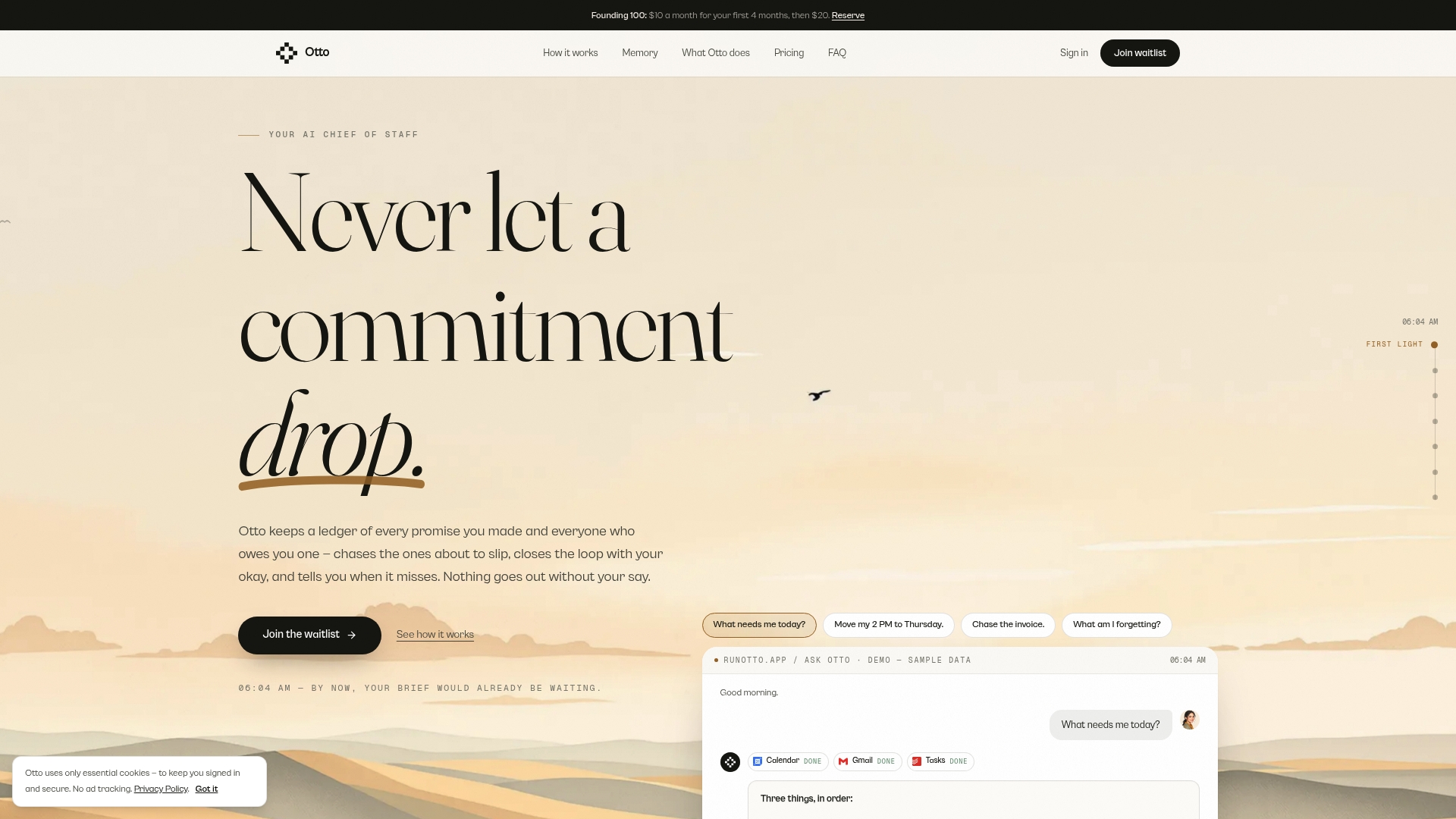
The AI drafts the follow-up message or reminder, but nothing goes out without your approval first. If recurring check-ins keep generating action items that quietly disappear between sessions, explore Otto’s plans and see which one fits the way your team already works.
FAQ
What does “weekly check-in” mean?
A weekly check-in is a short, recurring meeting that typically lasts under half an hour, where a manager and a direct report or team review progress, surface blockers, and confirm priorities for the coming week, according to youcanbook.me. It is built for frequent, lightweight updates rather than deep strategic conversation.
What is the purpose of check-ins?
Check-ins exist to keep communication predictable: a set rhythm where progress, blockers, and priorities get discussed before they turn into bigger problems. Running them as a consistent cadence, rather than an ad hoc meeting, is what makes a team’s communication schedule in the first place, per Slack.
What does “regular check-in” mean?
A regular check-in is any meeting set on a fixed, repeating schedule, whether that is weekly, monthly, or quarterly, rather than scheduled one-off whenever a need comes up. The point is predictability: attendees know when it happens and what to prepare, which is the core idea behind a well-run meeting cadence.
How do I choose between weekly and monthly check-ins?
Match the cadence to the conversation’s purpose: weekly works for operational updates and quick blockers, while monthly suits development and well-being conversations that need more time, typically 30 to 45 minutes according to youcanbook.me. Many teams run both at once rather than choosing only one.