 Otto
OttoHow to Set Up Slack Google Calendar Integration
How to Set Up Slack Google Calendar Integration

Yes, Slack has an official Google Calendar app that connects your calendar to Slack for meeting alerts, RSVPs, join links, and automatic status updates. It’s a free add on built directly into the Slack app directory, not a third-party workaround.
There’s one catch worth knowing before you install it. Slack status sync only tracks your primary Google Calendar, and it never displays the meeting name, just your availability state like “In a meeting.”
- Meeting alerts, RSVP buttons, and join links show up directly in Slack
- Status changes automatically to reflect busy or out-of-office time
- Shared and secondary calendars still need to be managed in Google Calendar itself
Key Takeaways
Slack’s official Google Calendar app handles reminders, RSVPs, and status sync, but it only tracks your primary calendar and stops short of managing follow-ups or shared commitments.
| Point | Details |
|---|---|
| Install through the app directory | Add the official app from the Slack Marketplace and connect your Google account from the Home tab. |
| Status sync follows one calendar | Only your primary Google Calendar drives Slack status changes, not secondary or shared calendars. |
| Meeting titles stay private | Slack status shows availability only, never the name of the event you’re in. |
| Fix syncing issues by reconnecting | Revoking and reauthorizing the app in Configuration resolves most missing-event problems. |
| Otto covers what notifications can’t | Otto tracks meeting promises and follow-ups across tools, complementing Slack’s notification layer. |
Table of Contents
- How Do You Set Up Slack Google Calendar Integration?
- How Do You Configure Notifications and Status Sync?
- What Can You Do With the Integration Inside Slack?
- How Do You Manage Channel and Shared Calendar Notifications?
- How Do You Fix Slack Google Calendar Sync Problems?
- Sources
How Do You Set Up Slack Google Calendar Integration?
Getting connected takes about three minutes on desktop and roughly the same on mobile. The process runs through the Slack App Directory, where the Google Calendar app for Slack lists as an official integration.
On desktop:
- Go to the Slack Marketplace page for Google Calendar and click “Add to Slack.”
- Review the permissions request and accept it. Slack needs read access to your calendar events and the ability to update your status.
- Once redirected back to Slack, open the app’s Home tab from the sidebar.
- Click “Connect an account” and sign in with the Google account tied to your work calendar.
- Choose which calendars you want visible in Slack. Note that only your primary calendar drives status sync, regardless of how many others you select.
On mobile, the flow is nearly identical but starts differently: open Slack, tap “Apps” (or use the Jump To search), find Google Calendar, and tap into its Home tab. Connecting an account opens an in-app browser where you sign into Google and tap “Allow.” The permissions and calendar-selection screens match the desktop version exactly.
Pro Tip: If you manage more than one Google Calendar, set your main work calendar as primary in Google Calendar’s own settings before connecting. Slack pulls status data from whichever calendar Google marks as primary, and switching it after the fact means reconnecting the integration.
How Do You Configure Notifications and Status Sync?
Once connected, head back to the app’s Home tab in Slack and look for Notification Preferences. This is where you set how far in advance you want meeting reminders (five minutes, ten, or right at start time) and whether you want a daily digest of your schedule delivered each morning.
Status Sync lives in a separate settings toggle, and it’s worth understanding the rules before you flip it on:
- Only events you’ve accepted, or that show as “busy,” trigger a status change
- Out-of-office and PTO events map to Slack’s “Out of Office” status automatically
- Overlapping meetings resolve to whichever event started most recently
- Your status text never includes meeting titles, only availability
A significant portion of Slack’s own support traffic around this integration involves confusion about which calendar drives status, according to patterns reflected in Slack’s Marketplace documentation on the primary-calendar limitation. If you’re the type who gets pulled into three meetings back to back, set reminder lead time to at least ten minutes and turn on the morning digest. That combination gives you a heads up without turning Slack into a second notification stream you have to manage.
What Can You Do With the Integration Inside Slack?
The point of connecting Google Calendar to Slack isn’t just seeing your schedule. It’s acting on it without opening another tab. A few workflows cover most of what knowledge workers actually need day to day.
- Check your schedule with slash commands. Type
/gcal todayor/gcal tomorrowin any channel or DM to pull up your agenda instantly, a feature documented on Slack’s Google Calendar app page. - RSVP without leaving Slack. When an invite arrives, the app card shows Yes, No, and Maybe buttons right in the message.
- Create events from Slack. Use the Home tab’s “Create event” option, pick which calendar it belongs to, and share the resulting event card to a channel or a direct message.
- Join meetings from reminder cards. When a calendar event includes a video conferencing link, Slack surfaces a “Join” button directly on the reminder, so you skip the calendar app entirely.
These four actions replace a surprising amount of tab switching. Instead of alt-tabbing to Google Calendar to confirm a meeting or grab a Zoom link, you handle it inline while staying in whatever conversation you were already having.
How Do You Manage Channel and Shared Calendar Notifications?
Individual setup covers your own schedule, but teams often want shared visibility, on call rotations, launch dates, or a shared team calendar posting into a channel. You do that by inviting the Google Calendar app to a specific channel, either by @ mentioning it there for the first time or adding it through the channel’s integration settings.
- Use channel notifications for recurring team events like sprint reviews or on-call handoffs
- Reserve direct pings for anything time-sensitive that needs individual acknowledgment
- Workflow Builder can automate recurring event posts, useful for weekly standups or release windows
Shared calendar management itself, adding attendees, changing recurring event details, still happens in Google Calendar. Slack is the notification layer, not the editing interface.
How Do You Fix Slack Google Calendar Sync Problems?
Most sync issues trace back to one of three causes, and the fix is usually faster than the troubleshooting.
- Missing events or stale reminders: Go to the app’s Configuration tab and revoke authorization, then reconnect. This clears cached permission errors and is Slack’s own recommended first step for missing event issues.
- Status not updating: Confirm you accepted the event (tentative RSVPs don’t trigger status changes) and check that the event lives on your primary calendar.
- Overlapping meetings showing the wrong status: This is expected behavior, not a bug. Slack picks the most recently started event when two overlap.
- App not appearing for teammates: This usually means a workspace admin needs to approve the app for domain-wide use.
Pro Tip: Before assuming something’s broken, check which Google account is connected. It’s common to accidentally link a personal Gmail account instead of a work one, especially if you’re signed into multiple Google accounts in the same browser.
What Does the Integration Share, and Is It Secure?
The app only ever shares your availability state, never meeting titles or attendee details, in your Slack status.
Slack maintains published security registry documentation through the Cloud Security Alliance, giving workspace admins a way to verify the platform’s security posture before approving calendar integrations for a team.
- Review connected app permissions periodically in Slack’s app settings
- Keep sensitive personal events on a separate calendar from your work primary
- Revoke access anytime if you change roles or leave a workspace
How Do You Disconnect Google Calendar From Slack?
- Open the app’s Home tab, go to Settings, and select “Disconnect Calendar.”
- For a full cutoff, revoke Slack’s access from your Google Account’s Connected Apps page instead.
- Once disconnected, reminders and status updates stop immediately. Reconnecting later restores the same setup in minutes.
When Does Slack Alone Stop Being Enough?
Slack and Google Calendar together are genuinely good at cutting down notification noise and calendar tab switching. What they don’t do is track the promise you made on a call last Tuesday or the follow-up you owe a client. That’s a different job, and native integrations were never built for it. Tools like Otto exist for exactly that gap, turning scattered commitments into one tracked list instead of a memory test.
— Eddie
Where Otto Fits Once Your Calendar Is Already Connected
Slack and Google Calendar handle notifications well. Neither one remembers that you told a client “I’ll send this by Friday” on a call, or that a teammate is waiting on a document you promised in a Slack thread three days ago.
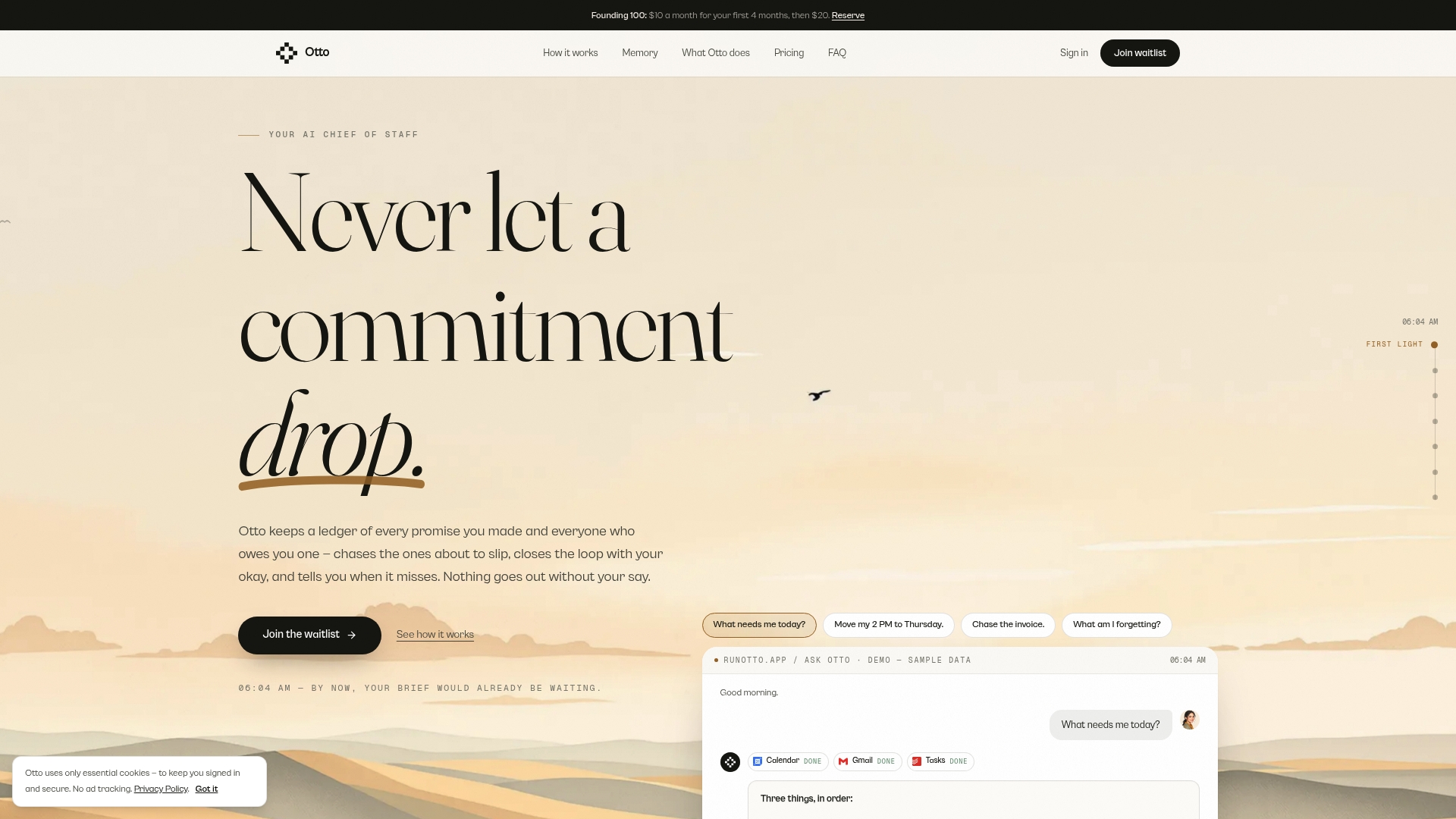
Otto works from a shared memory across your email, calendar, and meetings, so a commitment made anywhere gets captured and chased until it’s closed. It complements the setup you just built: your calendar keeps handling reminders and status, while Otto keeps track of the actual follow-ups and drafts the outreach for your approval, nothing goes out without you signing off first. If your team has outgrown “just check Slack for updates,” see how Otto’s AI chief of staff handles the parts calendars and notifications never could.
Sources
For exact screenshots and admin settings, consult Slack’s Google Calendar help page, the Marketplace listing, and Zapier’s automation recipes for workflows beyond the native app.