 Otto
OttoBusy professionals: Sync tasks to Notion, or use an AI assistant
Busy professionals: Sync tasks to Notion, or use an AI assistant

Yes, you can sync tasks to Notion using turn-key apps, automation platforms like Zapier or n8n, or a custom API integration with webhooks. Turn-key apps get you running fastest, custom builds give you the most control, and automation platforms sit in between. If you want speed, start with a dedicated app; if you want reliability at scale, plan for webhooks and API calls; if you’re tired of maintaining any of it, an integrated assistant removes the sync work entirely.
TL;DR:
- Most sync failures result from permission issues, schema mismatches, or missing properties, rather than flaws in the tools themselves.
- Turn-key apps offer rapid setup for simple use cases, while APIs and webhooks provide scalable, reliable long-term solutions for complex workflows.
- Proper field mapping, including unique IDs and stable relations, is essential to prevent data corruption and duplicate items over time.
- Automated two-way syncs may be limited or require careful configuration, making small test batches crucial before scaling up.
- Otto offers a single shared memory for tasks, emails, and meetings that eliminates ongoing sync maintenance by centralizing commitments in one place.
Table of Contents
- Quick options at a glance: choose by goal and technical willingness
- Prerequisites: Notion database schema and permissions to check first
- How the approaches work in practice: step-by-step for apps, automations, and custom builds
- Field mapping and sync rules: recommended mappings and conflict strategies
- Common pitfalls and a short troubleshooting checklist
- Why an integrated assistant that unifies context can be a better long-term choice
- Author recommendation: pilot plan based on common reader constraints
- Otto: an integrated alternative to building and maintaining syncs
- Authoritative docs and integration resources to follow next
- Sources
- FAQ
Quick options at a glance: choose by goal and technical willingness
Before you connect anything, match the method to what you actually need. Someone syncing a personal to-do list has different requirements than a team piping in tasks from five tools at once.
- Turn-key sync apps: built for non-developers who want a working connection between an existing task tool and Notion within minutes, with limited customization.
- Automation platforms (Zapier, IFTTT, n8n): best for people comfortable building simple trigger-action workflows and willing to maintain them as tools change.
- Custom API and webhooks: suited to teams with developer resources who need bidirectional sync, custom logic, or high-volume reliability.
- Integrated assistants: fit people who want tasks, email, and calendar commitments handled without building or maintaining a sync at all.
The fastest path to something working today is a turn-key app pointed at a single Notion database. The most reliable long-term setup is usually a custom webhook listener that fetches full content from the Notion API rather than trusting the event payload alone. If you’re not sure which camp you’re in, pilot a turn-key app on one project first. It tells you within a week whether your workflow needs more control than the app gives you.
Prerequisites: Notion database schema and permissions to check first
Most sync failures trace back to setup, not the tool itself. Check these before connecting anything:
- Confirm your tasks live in a top-level database, not a subpage. Subpages don’t expose the same API access or property structure that a database does.
- Verify the database has a Status property (select or status type), a Title property, and a Date property for due dates. Missing or mistyped properties are the most common cause of failed field mapping.
- Check that the integration or OAuth connection has been explicitly shared with the database. Notion integrations only see what they’re invited into.
- Confirm workspace-level permissions allow the integration to read and write, not just view.
- Run a manual test: create one item through the integration and confirm it appears with the correct property values before scaling up.
Pro Tip: Duplicate your task database before your first sync test, so a bad mapping doesn’t scramble live data.
How the approaches work in practice: step-by-step for apps, automations, and custom builds
Each method follows a different setup pattern, and knowing the sequence ahead of time saves a lot of troubleshooting later.
Turn-key apps:
- Connect via OAuth and authorize access to your workspace.
- Select the target database from the picker.
- Map a handful of fields (title, status, due date) rather than everything at once.
- Run test creates, updates, and completions to confirm each direction works.
Automation platforms:
- Build a trigger (new task, status change) in the source tool.
- Add a transform step to reshape the data into Notion’s property format.
- Add the action step that creates or updates the Notion page.
- Use unique IDs to prevent the same task from being created twice on re-runs.
Custom API and webhooks:
- Set up a webhook subscription in your Notion integration settings.
- Verify the cryptographic signature on incoming events before trusting them, a step the Notion webhook reference treats as essential for reliability.
- Treat the webhook payload as a signal only. Notion’s own documentation on database content updates notes these events can arrive aggregated and delayed, so your integration needs to call the API separately to fetch the authoritative page content.
- Implement conflict resolution for cases where both sides changed the same task.
A key limitation applies across Zapier’s Todoist integrations and most automation-platform setups: they’re commonly one-way rather than true two-way sync, which means updates made in Notion may not flow back to the source tool without extra configuration. Whatever method you choose, test in small batches of five or ten items first, watch the logs, and confirm updates flow in both directions before trusting it with real work.
Field mapping and sync rules: recommended mappings and conflict strategies
Good mapping is what separates a sync that works from one that quietly corrupts data over time.
- Title or name: maps directly to Notion’s title property, the only required field in any database.
- Status: map to a select or status property with matching option values on both sides, since mismatched labels silently fail to update.
- Due date: map to a date property, watching for time zone differences between systems.
- Notes or description: map to a rich text or page content block, depending on how much formatting you need to preserve.
- Assignee: map to a person property when both systems support user identity, otherwise fall back to a text field.
Use Notion’s relation properties, paired with a unique ID field from the source system, to keep stable links between a task and its project or parent item, rather than relying on titles that can change. For conflicts, pick one clear rule: last-write-wins based on timestamp, or a designated source-of-truth system that always overrides the other side. Add a timestamped audit field so you can trace exactly when and where a change originated.
Pro Tip: Represent completion with a status change rather than deletion. Archiving or deleting synced items tends to break the link between systems and can trigger duplicate recreation on the next sync cycle.
Common pitfalls and a short troubleshooting checklist
Most sync problems fall into a handful of predictable categories.
- Permission errors: recheck that the integration is explicitly shared with the database, not just the workspace.
- Rate limits and delays: batched or delayed events are expected behavior, not a bug, according to Notion’s webhook documentation, which notes that event delivery can lag and should be handled with retries rather than assumed to be instant.
- Schema drift: a renamed property or changed property type breaks existing field mappings without warning, so re-check mappings after any database redesign.
- Duplicated items: usually caused by missing unique IDs, which let the same source task get recreated on every run instead of being matched to its existing counterpart.
Notion webhook events are lightweight by design. The database content updated reference confirms these events function as signals rather than full data payloads, meaning your integration must always fetch the current object state rather than trusting what arrived in the event itself.
Why an integrated assistant that unifies context can be a better long-term choice
Every sync method above solves the same narrow problem: moving task data between two systems. None of them touch the bigger issue, which is that tasks rarely start as tasks. They start as a promise made on a call, a line in an email thread, or a note from a meeting that never gets written down anywhere structured.
Otto works from a different starting point. It reads email, calendar, and meeting content into one shared memory, so a commitment made out loud in a call and a task synced from Notion live in the same ledger instead of two disconnected systems. Teams juggling promises across a dozen tools benefit most from this, since the manual work of copying context between apps is exactly what an integrated assistant removes. Otto never sends or finalizes anything without explicit approval, so the drafting happens automatically while the decisions stay with you.

Author recommendation: pilot plan based on common reader constraints

If speed matters most, pick a turn-key app and run it on a single database for two weeks before touching anything else. If reliability matters more, skip straight to a webhook listener with signature verification and a small monitored test batch, since retrofitting reliability onto a fragile pilot costs more time than building it right the first time.
Switch to an integrated assistant once you notice the sync breaking repeatedly, once commitments start spanning more tools than the sync covers, or once the maintenance cost outweighs what the sync saves you.
— Eddie
Otto: an integrated alternative to building and maintaining syncs
If you’ve read this far, you already know that syncing tasks to Notion means picking a method, mapping fields, and then maintaining that setup indefinitely. Otto skips that work by keeping tasks, email, and calendar commitments in one shared memory instead of two systems you have to keep in sync.
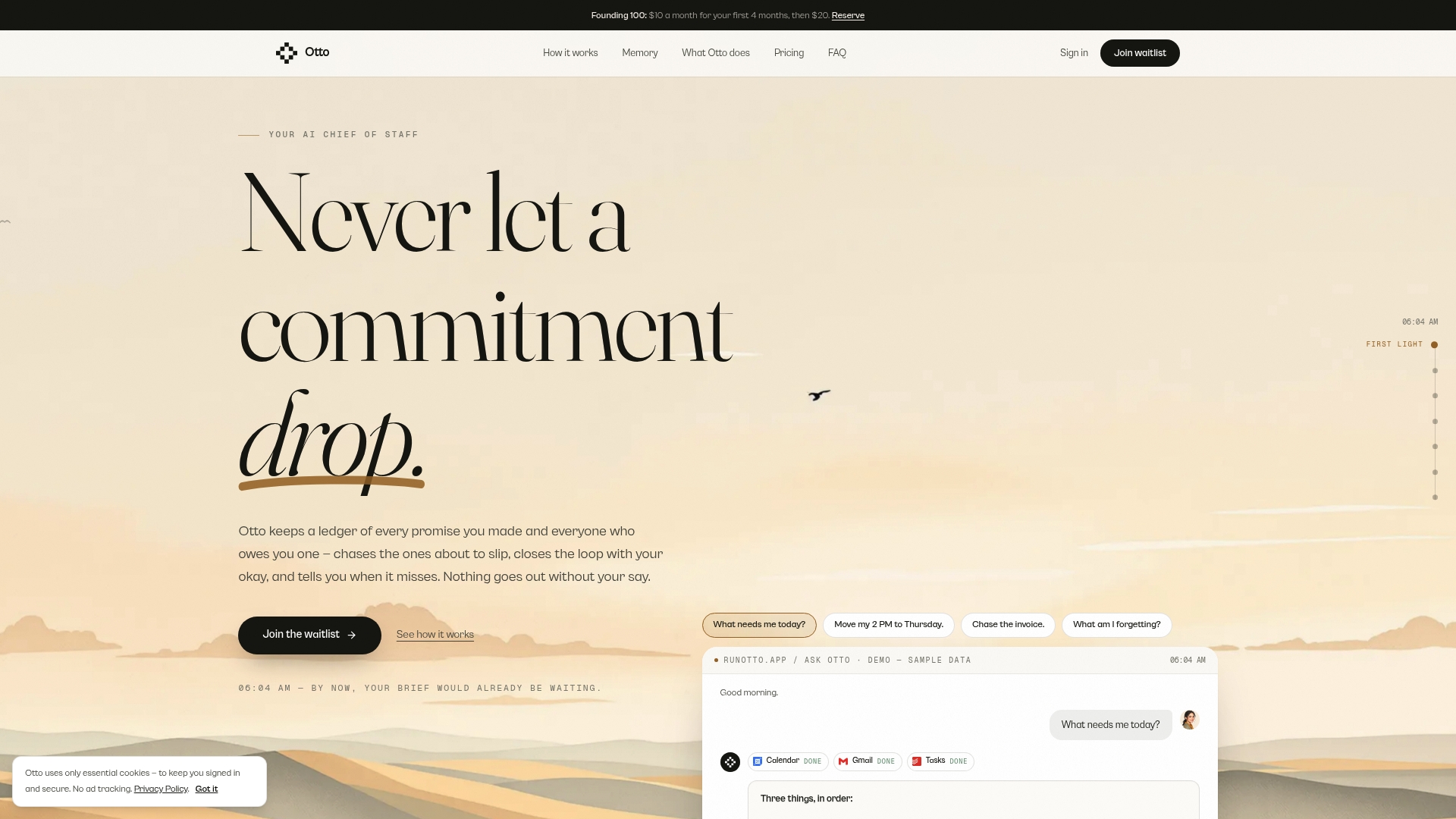
- Otto centralizes commitments from email, calendar, and meetings so nothing has to be manually copied into Notion or anywhere else.
- Every action Otto drafts requires your explicit approval before it’s sent or finalized.
- Otto offers Free, Upgraded ($20 per month), and Max ($50 per month) plans, all listed on the Otto landing page.
If a fragile sync is the thing standing between you and a clear task list, try Otto and see what a single shared memory looks like in practice.
Authoritative docs and integration resources to follow next
For hands-on setup work, these are the references worth keeping open while you build.
- Notion’s webhook reference for signature verification and event handling.
- Notion’s database content updated docs for how aggregation and delay affect real-time syncs.
- Zapier’s Todoist integration page for practical no-code automation examples.
- theNeedle’s guide on organizing your email inbox for keeping commitments captured from email manageable before they reach any task system.
Sources
- Notion developer documentation — Webhooks
- Notion developer docs — Database content updated
- Zapier integrations: Todoist
FAQ
Can I sync Google Tasks with Notion?
Yes, though Google Tasks has no native two-way sync with Notion, so most people use an automation platform or a custom integration to move tasks between the two. Open source tools like n8n are commonly used for this because they offer more flexible connection logic than closed commercial automations.
Why are people moving away from Notion?
Some users find that maintaining databases, properties, and sync integrations across multiple tools adds ongoing overhead rather than reducing it. This isn’t universal, but it’s a common complaint among people managing tasks across several disconnected apps rather than one unified system.
How do I sync tasks in Notion?
You connect a source tool to a Notion database through a turn-key app, an automation platform, or a custom API integration, then map fields like title, status, and due date between the two. The right choice depends on whether you prioritize quick setup or long-term reliability, since automation platforms are often one-way while custom webhook builds support two-way updates.
How do I link a task to a project in Notion?
Use a relation property to connect a task database to a project database, which creates a stable link that survives title changes. Pairing the relation with a unique ID field keeps the connection accurate even as tasks get renamed or reorganized.
Does Otto replace the need to sync tasks into Notion?
Otto keeps tasks, email, and calendar commitments in one shared memory rather than syncing them across separate systems, which removes the maintenance that a traditional sync requires. It still requires your explicit approval before taking any action, so nothing gets sent or finalized automatically.