 Otto
OttoManagers: Choose the Right Task Prioritization Framework in 10 Minutes
Managers: Choose the Right Task Prioritization Framework in 10 Minutes

Pick the framework that matches the decision in front of you, not the one your last team swore by. Quick daily triage runs on matrices like Eisenhower. Backlog ranking needs a scoring model like RICE. Flow problems need visibility tools like Kanban. Personal execution needs a capture system like GTD paired with Ivy Lee. The rest of this piece maps each decision type to the right tool, gives you a ten-minute selection checklist, and shows how a shared record of commitments makes any of these frameworks easier to sustain.
TL;DR:
- Using a shared capture system can significantly reduce forgotten commitments and improve morning triage efficiency.
- Matching the framework to the decision type, such as RICE for backlog ranking or Eisenhower for daily triage, ensures more effective prioritization.
- Running a short, two-week pilot of new tools and routines helps gauge their practicality based on measurable signals like triage time and task closure rates.
- Enforcing discipline with WIP limits, consistent tagging, and role clarity is crucial for frameworks like Kanban and GTD to function properly.
- Incorporating routine review sessions and embedding prioritization into daily habits sustains framework adoption and team alignment over the long term.
Table of Contents
- What Are the Main Task Prioritization Frameworks?
- When Should You Use Which Prioritization Method?
- How Do You Choose the Right Framework for Your Team?
- What Daily and Weekly Routines Make Prioritization Actually Stick?
- Three Worked Examples You Can Copy Directly
- Why Scattered Capture Breaks Even Good Frameworks
- Building a Prioritization Checklist Your Team Will Actually Use
- A Few Rules I Actually Trust When Prioritizing Teams
- A Practical Next Step for Teams That Keep Losing Track of Commitments
- Sources
What Are the Main Task Prioritization Frameworks?
Every prioritization framework falls into one of four families: triage matrices that sort by urgency and importance, scoring models that rank by calculated value, flow systems that manage visibility and work-in-progress, and capture systems that turn scattered commitments into a defensible next-action list. Here’s what each named framework actually does and where it tends to break.
- Eisenhower Matrix. Sorts tasks into four boxes: urgent/important, important/not urgent, urgent/not important, neither. Fast for daily decisions with one or two people. Falls apart with more than a handful of items because everything starts looking “urgent.”
- RICE. Scores initiatives on Reach, Impact, Confidence, and Effort, then divides to rank them. Built for backlog decisions where you have real usage data. Weak without decent estimates. This is the classic RICE vs ICE prioritization debate: RICE adds Reach for more precision, ICE drops it for speed when you’re short on data.
- MoSCoW. Buckets requirements into Must have, Should have, Could have, Won’t have. Good for scoping a release with stakeholders in the room. Prone to “everything is a Must” unless someone enforces the Won’t category.
- Value vs. Effort. Plots items on a two-axis grid to spot quick wins versus time sinks. Works well for a quick team workshop. Loses precision fast, since “value” is often a guess dressed up as a plot point.
- Impact-Effort Matrix. Nearly identical to Value vs. Effort but framed around business impact specifically. Useful when leadership wants a visual case for resourcing. Same weakness: subjective inputs unless backed by data.
- Ivy Lee Method. Write down six tasks for tomorrow, ranked by importance, work them in order. Built for individuals, not teams. Too rigid for jobs with constant interruptions.
- Kanban. A visual board with columns and work-in-progress limits that expose bottlenecks. Strong for operations and support teams managing continuous flow. Needs discipline to enforce WIP caps, or the board just becomes a to-do list with more columns.
- GTD (Getting Things Done). A full capture and clarification system: everything goes into an inbox, gets processed into next actions, projects, or reference material. Excellent for people drowning in scattered inputs. Heavy to set up and easy to abandon without a weekly review habit.
- Pomodoro. Twenty-five-minute focused work intervals with short breaks. Solves execution, not prioritization. Best paired with something else that decides what goes into the next Pomodoro.
None of these are competitors. They solve different problems at different altitudes, which is exactly why the next section maps decision type to framework instead of crowning one winner.
When Should You Use Which Prioritization Method?
The mistake most managers make is picking a framework they like rather than one that matches the decision type. A backlog ranking decision and a daily triage decision have almost nothing in common except that both got labeled “prioritization.”
Daily triage, the “what do I do in the next two hours” question, calls for the Eisenhower Matrix or a simple Ivy Lee list. Both are fast, need zero data, and work for a team of one. Backlog ranking, deciding which of forty feature requests gets built next quarter, needs RICE. You have usage data, multiple stakeholders will question the order, and a score gives you a defensible answer when someone pushes back.
Sprint scoping, locking a release to a fixed date, is MoSCoW’s home turf. It forces the “Won’t have” conversation before the sprint starts instead of during a missed deadline. Flow improvement, reducing bottlenecks in a support queue or ops pipeline, is Kanban’s job. It’s not really a ranking tool at all. It exposes where work piles up so you can fix the actual constraint. Personal execution, getting your own day done without losing track of loose commitments, runs best on GTD for capture and Pomodoro for the doing.
| Decision type | Recommended framework(s) | Why it fits |
|---|---|---|
| Daily triage | Eisenhower, Ivy Lee | No data needed, fast, works solo |
| Backlog ranking | RICE | Defensible score, handles stakeholder pushback |
| Sprint scoping | MoSCoW | Forces scope cuts before the deadline, not after |
| Flow improvement | Kanban | Exposes bottlenecks rather than just ranking items |
| Personal execution | GTD + Pomodoro | Captures loose ends, then protects focused blocks |
Layering frameworks is often smarter than picking one and forcing it to do everything. A product team might run RICE for quarterly ranking, then hand the top items to a Kanban board for execution, with Eisenhower filtering the daily fires that inevitably show up mid-sprint. Atlassian’s breakdown of prioritization frameworks makes a similar point: the frameworks people reach for most, RICE, Kano, MoSCoW, and Value vs. Effort, are built for different stages of the same pipeline, not for replacing each other.
How Do You Choose the Right Framework for Your Team?
You don’t need a committee to pick a prioritization method. You need fifteen minutes, five questions, and a willingness to test before you commit.
- What’s the decision granularity? If you’re ranking dozens of items with real trade-offs, you need a scoring model. If you’re deciding what happens next in the next hour, a matrix is overkill.
- What data do you actually have? RICE without usage numbers is just a fancy guess. If your team can’t estimate Reach or Confidence with any honesty, drop to ICE or a simpler Value vs. Effort grid instead.
- How often does this decision repeat? Daily decisions need something you can run in under two minutes. Quarterly decisions can tolerate a slower, heavier framework.
- How much rigor does the outcome need to survive scrutiny? A backlog decision that goes to the board needs a documented score. A personal to-do list doesn’t.
- How disciplined is the team already? Kanban only works if people actually respect WIP limits. GTD only works with a weekly review. Be honest about whether your team will maintain the ritual, not just adopt the artifact.
Ask stakeholders directly: What decision are we actually trying to make? What happens if we get the ranking wrong? Who needs to be able to defend this order later? The answers usually point to the framework family before you’ve even opened a spreadsheet.
Watch for red flags that mean it’s time to switch. If your Eisenhower board has forty items in the “urgent and important” box, you’ve outgrown a matrix and need scoring. If your RICE scores take longer to argue about than the work itself would take to finish, you’ve over-engineered a decision that didn’t need it.
Run a two-week pilot before rolling anything out team-wide. Track three signals: how long triage takes each morning, how many committed tasks slipped past their deadline, and whether the team actually used the framework without being reminded. GoalsAndProgress’s guidance on testing task management techniques backs this up. Short, measurable pilots beat a company-wide mandate that nobody asked for.
Pro Tip: Don’t pilot a new framework and a new tool at the same time. Change one variable, or you won’t know which one fixed (or broke) anything.
What Daily and Weekly Routines Make Prioritization Actually Stick?
A framework without a routine is just a document nobody opens twice. The habit is what makes any of these methods survive past week one, and Slack’s research on prioritization points to the same conclusion: teams that embed prioritization into daily rhythm, rather than treating it as a one-time exercise, stay aligned longer.
Start each morning with a fifteen-minute triage. One person owns the call. Whatever comes in overnight, email, Slack messages, meeting follow-ups, gets sorted into three buckets: today, this week, or the backlog. Write down what got decided and why, even in one line, so the next person doesn’t relitigate it.
Run a weekly grooming session tied to whichever framework you picked. If you’re on RICE, this is when scores get updated with fresh data. If you’re on Kanban, this is when you look at the board and ask which column is clogged. If you’re on MoSCoW, this is your checkpoint to confirm the Won’t list hasn’t quietly grown a Should.
Tooling should reinforce the framework, not fight it:
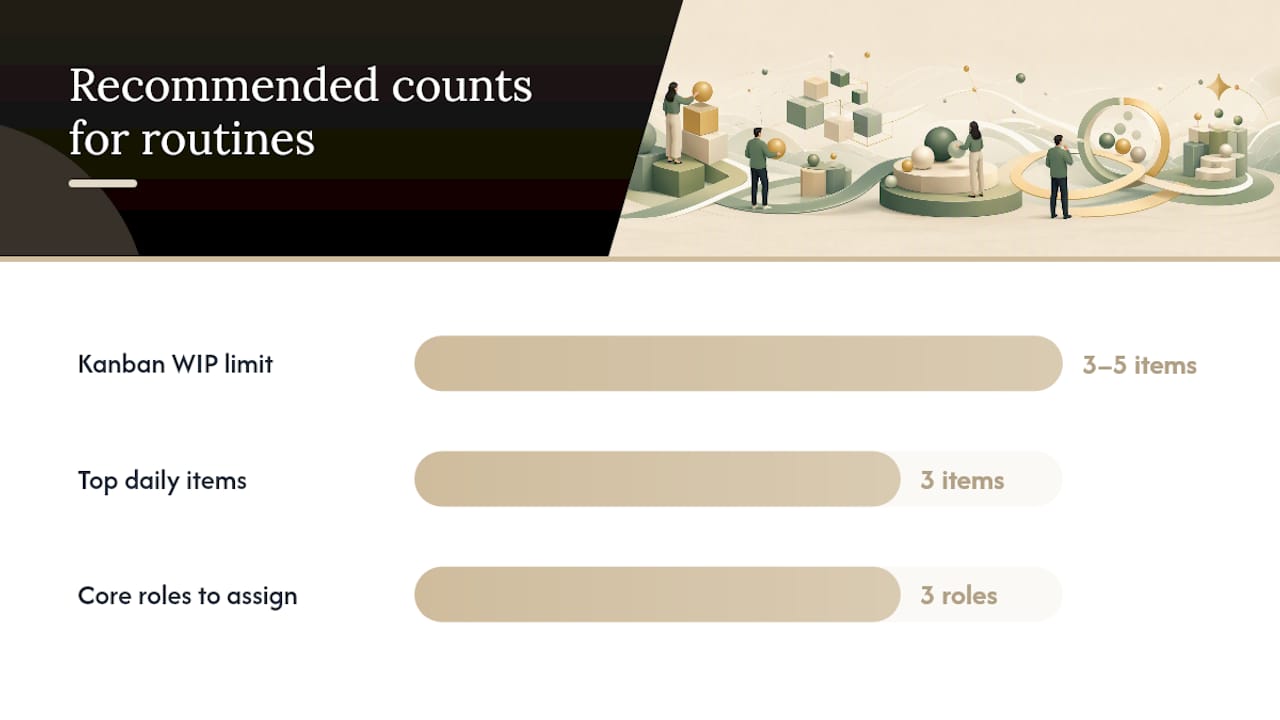
- Set a hard WIP limit on your Kanban board, three to five items per column per person, and actually enforce it instead of treating it as a suggestion.
- Use consistent tags across your task tool (“urgent,” “blocked,” “waiting-on-client”) so triage takes seconds, not a re-read of every ticket.
- Block calendar time for your top three daily items before the day fills up with meetings, not after.
- Run a dedicated Slack channel for interrupt-driven work so it doesn’t bleed into your main planning channels.
Assign three roles clearly, even on a small team: a capture owner who makes sure nothing falls through the cracks, a triage owner who makes the daily call, and a follow-up owner who chases open commitments until they close. On a team of three, one person can hold all three roles. On a team of thirty, they need to be separate jobs or things quietly slip.
Three Worked Examples You Can Copy Directly
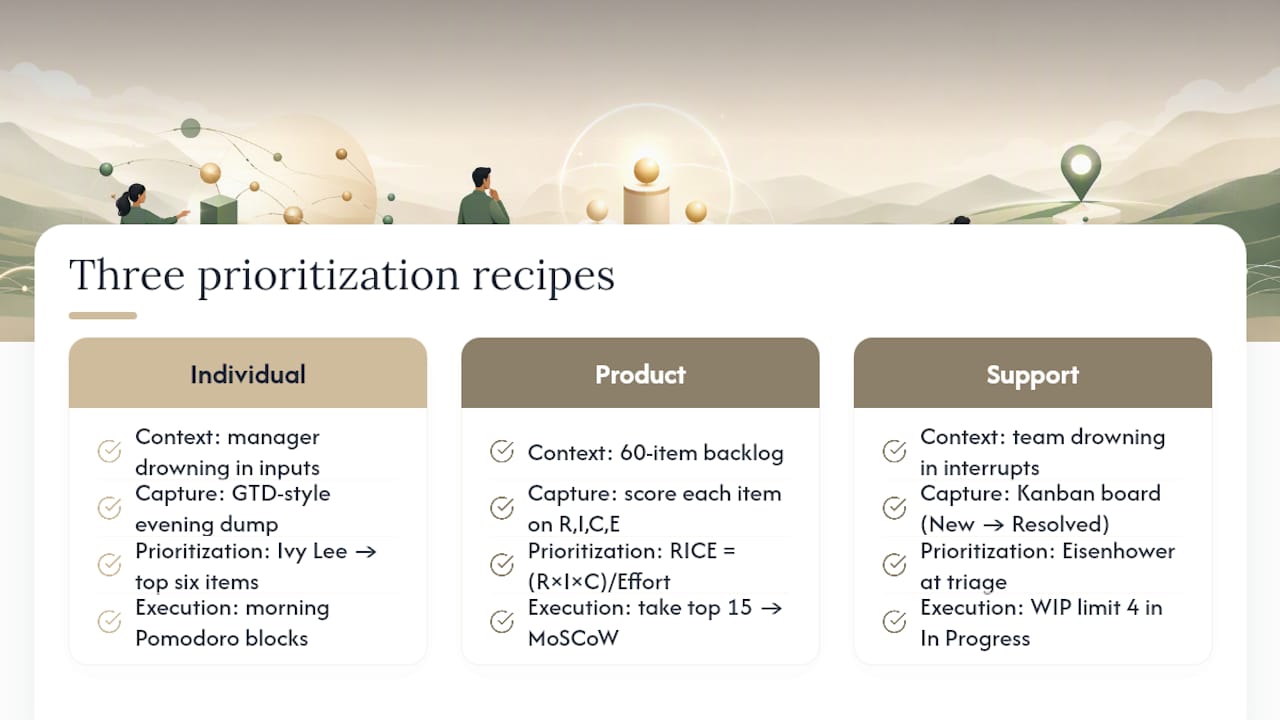
The individual manager drowning in inputs. Start every evening with a GTD-style capture dump: every open email, Slack thread, and verbal commitment from the day’s meetings goes into one inbox. From that list, pull the six most important items using Ivy Lee, ranked in order. The next morning, block your calendar in Pomodoro sessions, working item one until it’s done or blocked, then moving to item two. This combination fixes the two most common failure points at once: things get forgotten, and the day gets hijacked by whatever email arrived first.
The product team ranking a sixty-item backlog. Score each item on Reach (how many users touch this per quarter), Impact (on a 1 to 3 scale), Confidence (as a percentage), and Effort (in person-weeks). Divide (Reach × Impact × Confidence) by Effort to get a RICE score, then sort descending. Take the top fifteen and run them through MoSCoW against the next release date: the top five become Must, the next five Should, the rest Could. That gives engineering a defensible scope line instead of a debate that reopens every planning meeting.
The support team drowning in interrupts. Set up a Kanban board with columns for New, Triaged, In Progress, Blocked, and Resolved, with a WIP limit of four tickets per agent in “In Progress.” As tickets land, apply Eisenhower at the triage step: urgent-and-important tickets breach SLA risk and jump the queue, important-but-not-urgent tickets go into the normal flow, and everything else gets logged and batched for a slower day. This keeps SLA compliance visible on the board itself instead of buried in a spreadsheet nobody checks until it’s already breached.
Why Scattered Capture Breaks Even Good Frameworks
Every framework in this article assumes you actually captured the input correctly. Most don’t, because commitments live in five different places: an inbox, a calendar, a meeting transcript, a Slack thread, and someone’s memory of what they said out loud on a call. Research on project failures consistently points back to the same root cause: structured planning and resource tracking fails not because the framework was wrong, but because the inputs feeding it were incomplete.
There’s also a cognitive cost to fragmented tracking. Research on attention and executive function shows that external structure, visible boards, timers, defined work-in-progress limits, reduces attention residue and improves execution, especially when the alternative is holding half-finished commitments in your head. A scoring model or a matrix can’t compensate for a list that’s missing half the work in the first place.
This is where Otto fits as a practitioner example, not a pitch. Otto listens across email, calendar, and meetings and holds every commitment in one ledger instead of five disconnected tools. That doesn’t replace RICE or Kanban. It feeds them a complete list before you score or sort anything.
Practical signals worth tracking if you pilot this kind of shared capture:
- How much shorter your morning triage gets when nothing needs re-explaining from a meeting three days ago.
- Whether verbal commitments from calls actually show up on your task list without someone manually typing them in.
- How many promises get chased to closure without a manual follow-up email.
Building a Prioritization Checklist Your Team Will Actually Use
A framework survives adoption when it’s written down somewhere shorter than a training deck. Build a one-page checklist your team can reference in under a minute, not a policy document nobody rereads after week one.
Start with the decision type at the top: daily triage, backlog ranking, sprint scoping, or flow management. Underneath, list the exact inputs required, usage data for RICE, stakeholder sign-off for MoSCoW, WIP limits for Kanban, so nobody starts scoring with half the information. Add a line for who owns the final call, because a framework without a named decision-maker just produces a longer argument.
A simple template that works for most teams:
Decision type: ___ Framework in use: ___ Required inputs: ___ Decision owner: ___ Review cadence: ___ Pilot end date and signals to check: ___
Keep this template in whatever tool your team already opens daily, a pinned Notion page, a Slack channel topic, a shared doc, rather than burying it in a wiki nobody visits. Revisit it at the end of your two-week pilot and edit it based on what actually happened, not what you hoped would happen. Most teams find their first version needs at least one field cut and one field added once real work has run through it.
A Few Rules I Actually Trust When Prioritizing Teams
Cap daily musts at three. Anyone who tells you they have ten priorities today has zero. Require a defensible next action for every open item before it earns a place on the list. Vague tasks are where good frameworks quietly die. Only score when you have real numbers behind Reach, Impact, or Confidence. A guess dressed up in a RICE spreadsheet is still a guess, just one that looks more official than it is.
The trap I see most is teams switching frameworks the moment one stops feeling perfect, instead of asking whether the routine around it collapsed. A framework rarely fails on its own logic. It fails because nobody enforced the WIP limit or ran the weekly review.
— Eddie
A Practical Next Step for Teams That Keep Losing Track of Commitments
Every framework in this article works better when the list feeding it is complete, and that’s the specific gap Otto is built to close. Otto runs on one shared memory across your email, calendar, and meetings, so a commitment made out loud on a call lands in the same ledger as a task assigned over Slack or buried in an inbox thread.
That matters most at two moments this article keeps circling back to: morning triage and follow-up. Instead of reconstructing yesterday’s promises from five different tools, The tool surfaces what’s still open and chases it until it closes, drafting the follow-up for your approval rather than sending anything on its own. If you’re running RICE on a backlog or Kanban on a support queue, that’s one less place for an input to fall through before it ever reaches your framework.
Try it as a two-week pilot alongside whichever framework you picked from this article. Track three numbers: how many commitments got captured without manual entry, how much time your morning triage took on day one versus day ten, and how many promises got closed without a follow-up email you had to write yourself. Start with Otto and see whether those numbers move before you commit to anything longer.