 Otto
OttoOne Governance Change That Fixes Unified Task Lists for Oracle APEX
One Governance Change That Fixes Unified Task Lists for Oracle APEX

A unified task list pulls every pending action, from approvals to assignments to follow-ups, into one inbox-style view instead of forcing users to hunt across separate apps and modules. It answers a single question for anyone logged in: what do I need to act on right now? You need one the moment a person’s work spans more than one system, whether that’s Oracle APEX approvals, email threads, or a project tracker, and role-based views like My Tasks, Admin Tasks, and Initiated by Me decide what each person sees.
TL;DR:
- A unified task list consolidates actions from multiple systems into one view, filtering tasks based on roles like My Tasks, Admin Tasks, or Initiated by Me.
- The source ID in each task is crucial for linking directly back to the original record or document, preventing loss of context.
- Building a reliable system involves enforcing structured outcomes, such as fixed decision states, and routing tasks by role, not by individual names.
- Effective search and filtering tools, including suggestion chips and stacked filters, are essential when managing thousands of tasks to maintain trust and usability.
- Otto differentiates itself by automatically capturing commitments from email, calendar, and meetings into one ledger, reducing reliance on manual entry and verbal promises.
Table of Contents
- Core Components and How a Unified Task List Behaves at Runtime
- My Tasks, Admin Tasks, and Initiated by Me: Who Sees What
- How to Build a Unified Task List in Oracle APEX
- Search, Filters, and Sorting: Making Tasks Findable at Scale
- Governance Rules That Keep a Unified Task List Trustworthy
- How Otto Consolidates Tasks Across Email, Calendar, and Meetings
- The One Change That Actually Fixes a Broken Task List
- Try a Unified Task List Built Around Your Actual Commitments
- Sources
- FAQ
Core Components and How a Unified Task List Behaves at Runtime
Every task in the list is really a task instance, a single record carrying an assignee, an initiator, a due date, a current state, and a source record ID that points back to whatever created it, an approval step, a support ticket, a workflow trigger. That source ID matters more than it looks. Lose it, and you lose the ability to click through from the task list back to the actual document or record someone needs to act on.
At the interface level, a few building blocks do the heavy lifting:
- A content region that renders the task rows, usually as an interactive report or cards
- Smart filters that narrow by status, assignee, or date without a full page reload
- Order-by controls, letting users sort by due date, priority, or creation time
The runtime logic is what makes “unified” mean something. According to Oracle APEX documentation, report context and the logged-in user’s identity jointly filter which task instances appear. Change the context from My Tasks to Admin Tasks, and the same underlying data returns a completely different, appropriately scoped result set.
My Tasks, Admin Tasks, and Initiated by Me: Who Sees What
Report contexts are the access-control layer of a task management system, and each one is built around a different job.
My Tasks is where most people live day to day. It shows tasks assigned directly to the user or open to a group they belong to, and it’s built for action: claim a task, approve or reject it, mark it complete, or send it back requesting more information. This is the view that has to feel fast, because it’s the one someone checks fifteen times a day.
Admin Tasks exists for oversight, not throughput. It surfaces errored, completed, or canceled items that a regular assignee would never need to see, lets an administrator delegate a stuck task to someone else, update parameters on a running workflow, or toggle a “show expired tasks” filter to audit what fell through.
Initiated by Me flips the perspective to the requester’s side. Someone who kicked off an approval or a request needs a way to track its progress, and this context lets them check status or cancel a request that’s no longer needed, without needing admin rights to do it.
How to Build a Unified Task List in Oracle APEX
Configuring one in APEX follows a predictable path, whether you’re building your first version or extending an existing one.
- Open App Builder and launch the Create Page Wizard.
- Select the Unified Task List page type from the available templates.
- Choose a Report Context, My Tasks, Admin Tasks, or Initiated by Me, based on who the page serves.
- Let the wizard scaffold the page: it generates the content region, wires up smart filters, and sets a default Order By clause.
- Open Page Designer to customize columns, adjust filter defaults, or add conditional formatting for overdue items.
The wizard does the bulk of the setup, but real projects usually need a pass through Page Designer afterward, adding a priority column, reordering filters, or tightening the default sort so overdue items surface first.
Pro Tip: If your unified task list lives in a separate app from the workflows feeding it, check session sharing between the apps first. A broken session is the most common reason a task list renders empty even though the underlying tasks clearly exist.
Search, Filters, and Sorting: Making Tasks Findable at Scale
A task list with 20 rows doesn’t need much. A task list with 2,000 rows needs a search experience, or it becomes a dumping ground nobody trusts.
The search bar should support suggestion chips, small clickable filters like “Due Today” or “High Priority” that narrow results without typing a query. Layer smart filters for assignee, status, due date, and priority on top, and let users stack them; a manager filtering “unassigned, high priority, due this week” is a completely normal query. Sorting by creation date, due date, or priority covers most use cases, and an admin-only “show expired tasks” toggle keeps stale items out of everyone else’s view by default.
- Suggestion chips reduce typing and speed up common searches
- Combinable filters (assignee + status + due date) support real workflows, not just simple ones
- Server-side filtering, not client-side, keeps performance stable once task volume climbs into the thousands
Governance Rules That Keep a Unified Task List Trustworthy
Most unified task lists don’t fail because of bad UI. They fail because nobody enforced structure underneath it.
The single biggest fix: mandate structured outcomes. A task should resolve to “approved,” “rejected,” or “approved with conditions,” never a free-text comment that a human has to interpret later. Audit-trail best practices note that free-text decisions create manual interpretation bottlenecks and quietly block any attempt at automated routing.

Route tasks by role, not by named person. A candidate-group model survives personnel turnover; an approval hardcoded to “Sarah in Finance” breaks the day Sarah leaves.
Audit trails need specifics, not good intentions:
- A stable user ID, never a display name that can change
- ISO 8601 UTC timestamps on every action
- The action type and the source record ID it applied to
- Version locking, so an approval can’t be granted against a document that was edited afterward
Finally, keep business rules out of the plumbing. Architecture guidance on real-world workflow systems makes the case that separating decision logic from technical implementation, and adding timers or escalation policies for stalled tasks, is what makes a system reliable months after launch instead of just at demo time.
How Otto Consolidates Tasks Across Email, Calendar, and Meetings
Most tools that call themselves a “unified task list” only unify what happens inside their own walls. Otto works differently: it treats email, calendar, and meetings as one shared memory instead of three separate silos a person has to reconcile manually.
Otto listens in meetings, reads email and calendar activity, and pulls every promise made, spoken out loud or written in a thread, into a single ledger it tracks until the commitment is actually closed, leveraging advanced AI & Automation to identify and prioritize tasks automatically. The daily flow looks like this:
- Capture: promises and commitments get logged automatically as they happen, across channels
- Prioritize: Otto surfaces what actually needs attention today, not just what’s newest
- Draft: it prepares the follow-up, reminder, or reply that needs to go out
- Approve: nothing sends without the user reviewing and approving it first
That approval step is deliberate. Otto drafts; the person decides.
The One Change That Actually Fixes a Broken Task List
If you’re inheriting a messy task system, don’t start with the interface. Start with structured outcomes and role-based routing. Nearly every unified task list I’ve seen fail didn’t fail on search or filters; it failed because decisions lived in free-text comments and approvals were tied to people instead of roles, so the whole thing collapsed the moment someone went on leave. Fix that layer first, and the UI problems tend to shrink on their own.
— Eddie
Try a Unified Task List Built Around Your Actual Commitments
Otto is built for the gap every unified task list eventually runs into: the tasks that never made it into any system because they were a verbal promise on a call or a line buried in an email thread. Because Otto holds email, calendar, and meetings in one shared memory, it catches those commitments automatically and adds them to the same ledger as everything else, no manual entry required.
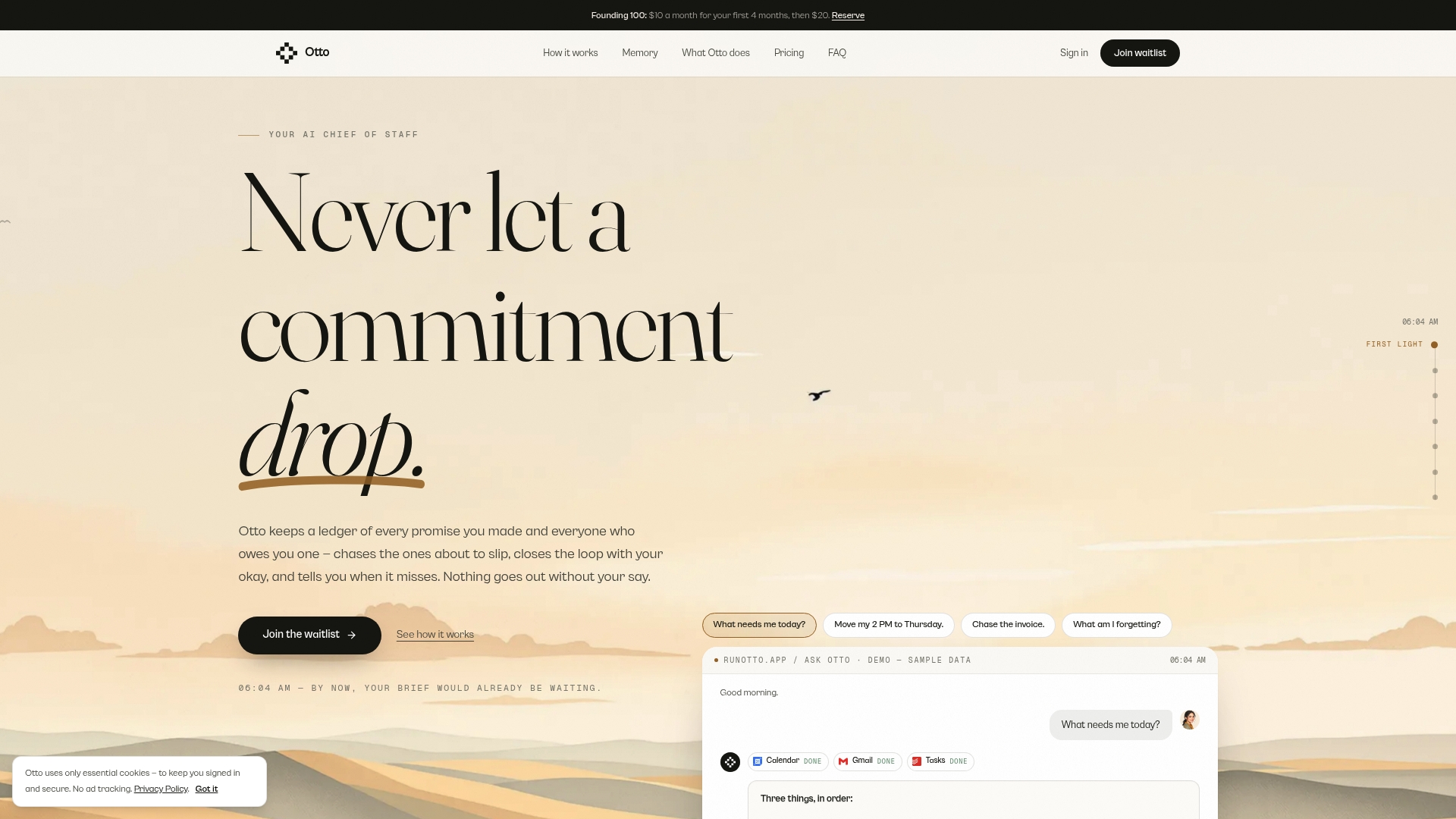
The workflow stays simple: Otto captures what you committed to, prioritizes what actually matters today, and drafts the follow-up. You approve before anything goes out. If your current setup still depends on you remembering what you said out loud in a meeting, it’s worth seeing how Otto’s Free, Upgraded, and Max plans handle that instead. Start on the Free plan and see what shows up in your ledger by the end of the first week.
Sources
Nothing sits in a unified task list because it was typed there directly. Every row is pulled in from somewhere else, and that “somewhere else” is usually one of a handful of sources: an approvals engine, parsed emails, calendar events, a ticketing system, or issues from a code repository. Flows for APEX documents this pattern directly, offering views like flow_task_inbox_vw and flow_apex_my_combined_task_list that merge native APEX approval tasks with tasks pulled from other sources into one combined feed.
Two connector patterns dominate: polling, where the system checks a source on a schedule, and event-driven webhooks, where the source pushes updates the moment something changes. Webhooks scale better but demand more careful permission mapping up front.
- About the unified task list - Oracle APEX documentation
- Task Lists - Flows for APEX
- Architecture lessons from building software for real business workflows
- Audit trail best practices
FAQ
Can you give me an example of a task list?
A common example is an approval inbox showing a specific expense report due tomorrow, submitted by J. Torres. In Oracle APEX, this appears as a row in the My Tasks report context, with claim and approve buttons attached directly to it.
How do I create a list of tasks?
In APEX, you use the Create Page Wizard, select the Unified Task List page type, and pick a report context like My Tasks or Admin Tasks. Outside APEX, the same pattern applies: pull task instances from your source systems, normalize the fields, and render them in one filterable view, which is the approach Otto takes by pulling commitments from email, calendar, and meetings into a single ledger.
Where can I see my tasks?
In an APEX-based system, the My Tasks report context is the default place, showing everything assigned to you or open to your group. In Otto, tasks and commitments surface in your daily priority view, pulled automatically from meetings, email, and calendar rather than requiring manual entry.
What is a task list called in software systems?
It goes by several names depending on the platform: unified task list, task inbox, centralized to-do list, or task dashboard. In Oracle APEX specifically, the term is unified task list, and it’s built around the report-context model covered above.
Does Otto replace a unified task list like the one in APEX?
Otto isn’t a workflow engine like APEX’s approval framework, but it solves a related problem: consolidating commitments scattered across email, calendar, and meetings into one place. Pricing runs from a Free plan up through higher-tier paid plans available on the Otto site.