 Otto
OttoCross App Workflows: Put Idempotency Before AI Agents
Cross App Workflows: Put Idempotency Before AI Agents

A cross app workflow is an automated sequence that moves data or triggers an action between two or more separate software tools without a person copying information by hand. The reliable way to build one is to pair event-driven connectors with strict schema and idempotency discipline, then add AI agents only for the steps that need judgment, not plumbing. Treat retries, deduplication and access controls as part of the design from day one, not an afterthought.
TL;DR:
- Keep rare or sensitive handoffs manual; automate only when they recur weekly, map cleanly, have an owner, and meet security requirements.
- Webhooks respond quickly but need signature checks and duplicate handling; polling is simpler, yet slower and may miss brief state changes.
- Give every event an idempotency key, then protect individual steps and whole runs against retries or duplicate starts; log failures for later inspection.
- Reserve AI agents for interpreting unstructured input, start with one bounded drafting task, and require policy checks or human approval before any external action executes.
Table of Contents
- What counts as a cross app workflow, and when you actually need one
- How cross app workflows actually work: triggers, connectors, and data flow
- How AI agents change the design of cross app workflows
- Operational safety: webhooks, idempotency, and governance controls
- Design patterns and templates for common cross app automations
- Getting started: a checklist for taking a workflow from prototype to production
- What building shared-memory AI systems taught us about cross app workflows
- How Otto removes the cross app context problem entirely
- FAQ
- Sources
What counts as a cross app workflow, and when you actually need one
A cross app workflow exists whenever a trigger in one tool causes an action in another, without a human relaying the information manually. The clearest sign you need one is a repeated, predictable handoff: something happens in App A, and App B always needs to know about it.
A few concrete examples show the shape of the problem:
- An email confirming a meeting should create a calendar event and, once the meeting happens, a CRM record of what was discussed.
- A verbal commitment made on a sales call (“I’ll send that over by Friday”) should become a tracked task with a deadline, not a line buried in a transcript.
- A new lead captured on a web form should trigger both a calendar booking link and a notification in a team chat tool.
- An invoice marked paid in accounting software should update a project management tool so the delivery team knows work can start.
Each case follows the same pattern: a trigger, a data transformation, and an action in a different system. When that pattern repeats more than a few times a week, manual copying becomes the real bottleneck, not the software.
Not every repeated task deserves a cross app workflow, though. Building and maintaining an automation has real costs: someone has to own it, monitor it when it breaks, and update it when either app changes its API. A workflow that touches sensitive data (payroll, health information, legal documents) also adds security exposure every time it moves between systems. If a task happens rarely, if the two apps change their interfaces often, or if the data is sensitive enough that extra copies create real risk, it’s often better to keep the work inside a single tool, even if that means a bit more manual effort.
Use this quick checklist to decide if a flow is worth building:
- The trigger-to-action pattern repeats often enough that manual work has a real cost in hours per week.
- The data involved is structured enough to map cleanly between the two systems.
- Someone is willing to own the workflow long-term, including fixing it when an API changes.
- The security and compliance profile of the data supports moving it between systems.
If all four hold, you have a strong candidate for automation. If two or more fail, keep the task manual or inside one tool until that changes.
How cross app workflows actually work: triggers, connectors, and data flow
Underneath every cross app workflow are four technical primitives: triggers, connectors, data mapping, and operational behavior around retries and monitoring. Getting each one right is what separates a workflow that runs quietly for years from one that silently drops data.
Triggers start the workflow, and the type you choose has real trade-offs:
- Webhook triggers fire the moment an event happens in the source app, giving near-instant response but requiring you to handle delivery failures and duplicate deliveries correctly.
- Polling triggers check a source app on a schedule, which is simpler to build but adds latency and can miss short-lived state changes between polls.
- Scheduled triggers run at fixed times regardless of events, useful for batch jobs like daily digests or nightly reconciliation.
- Agent-invoked triggers let an AI agent decide, based on context, that a workflow should start, which is powerful but needs the same guardrails as any other trigger source.
Connectors are what let a workflow actually talk to each app’s API, and this is where authentication lives. OAuth scopes should be as narrow as the task requires: a workflow that only needs to read calendar events should never hold write access to email. Rate limits also vary wildly between providers, so a workflow that fans out to dozens of records at once needs backoff logic built in, not bolted on after the first outage.
Data mapping is the quiet source of most workflow bugs. Two apps rarely use the same field names, date formats, or required fields, so every connection needs an explicit schema mapping rather than an assumed one. Idempotency keys, a unique identifier attached to each event or action, let a workflow recognize “I’ve already processed this” and skip duplicate work instead of creating a second calendar event or a duplicate invoice. Idempotency guidance from workflow runtime documentation recommends handling this at two levels: step idempotency for safe retries inside a single run, and run idempotency, often implemented with hook tokens, to stop duplicate start requests from spawning parallel runs of the same workflow.
Operational behavior covers what happens when things go wrong. Microsoft’s documentation on its Workflows experience in Copilot Studio describes triggers, connectors, AI-driven actions, and node-level testing as the building blocks practitioners use to construct and validate these automations before they go live, including human-in-the-loop checkpoints for steps that carry risk.
Pro Tip: Build a dead-letter log for every workflow before you launch it: a simple place where failed or duplicate events land so you can inspect them later instead of losing them silently.
How AI agents change the design of cross app workflows
AI agents earn their place in a cross app workflow when a step requires judgment, not when a deterministic API call would do the job just as well. The clearest dividing line: if a human could write a fixed rule for the step (“if status equals paid, update project field”), use a deterministic action. If the step requires interpreting unstructured language, summarizing intent, or deciding priority among competing signals, an agent adds real value.
Two patterns show up repeatedly in agent-involved workflows:
- Agent-as-orchestrator: the agent decides which tools to call and in what order, based on the current state of a task or conversation.
- Agent-as-worker: the agent performs one bounded task, such as drafting a follow-up email, inside a workflow that a deterministic system still controls end to end.
Agent-as-worker is the safer starting pattern for most teams, because it limits the agent’s blast radius to a single, reviewable step rather than an entire chain of decisions.
The practical risk with agents in cross app workflows is that they now operate interfaces, call tools, and coordinate actions across multiple systems at once, which means a mistake in one step can propagate into another app before anyone notices. Research on agent governance frames this as a reason to insert an explicit action-commit boundary: a point where every agent-proposed action is normalized into a common event format and checked against policy before it actually executes. Research on system-wide safety boundaries for AI agent fleets describes this as a Policy Enforcement Point placed after an agent plans an action but before that action runs, which improves both governance and the ability to audit what an agent actually did versus what it intended to do.
An agent-proposed action should always be treated as a draft until it clears that checkpoint, not as something already in motion. This is the single most important design decision in agent-involved cross app workflows, because it’s the difference between an agent that suggests and an agent that acts unsupervised.
Where this plays out most visibly is in reducing manual context copying. An agent that can read a meeting transcript, cross-reference it against an existing CRM contact, and draft a follow-up task removes a step that used to require a person reading notes, opening a separate app, and typing a summary by hand. Our guide to human-in-the-loop AI design covers how to structure the approval step so the agent still drafts freely while a person retains the final call on anything that leaves the system.
One in three organizations deploying AI agents report they need stronger monitoring and audit mechanisms before expanding agent autonomy further, according to research on securing multi-agent systems, which points to transactional execution and information-flow labeling as concrete ways to close that gap.
Operational safety: webhooks, idempotency, and governance controls
Reliability in a cross app workflow comes down to a handful of concrete engineering decisions, most of which have already been standardized by people who have hit the same failures you’re about to hit.
Start with webhook handling, since it’s the most common source of silent data loss. The Standard Webhooks specification proposes a consistent contract for webhook payloads: signature verification so you know a payload genuinely came from the sender, schema hints so consumers can validate structure before processing, and idempotency guidance so a redelivered event doesn’t trigger a duplicate action. Adopting a standard contract instead of a bespoke one for every integration cuts down on the repeated reinvention that causes most webhook bugs in the first place.
A related draft on event and webhook delivery semantics lays out exactly where ambiguity tends to creep in: retry behavior, acknowledgment semantics, and how intermediaries should behave when a delivery fails partway through. Pinning down these behaviors in writing, even informally, before you build a workflow saves hours of debugging later.
For idempotency specifically, design at two levels:
- Step idempotency: each individual step inside a workflow run can be retried safely without creating duplicate side effects.
- Run idempotency: duplicate start requests for the same logical workflow, often coordinated with a hook token, resolve to the same run instead of spawning a parallel one.
Attaching confidentiality and integrity labels to data, then propagating those labels through every step an agent takes, allows policy checks that are deterministic rather than improvised on a case-by-case basis.
Research on information-flow control for AI agents
This labeling approach, often called information-flow control (IFC), matters most in workflows where sensitive data crosses from one app into another. A shared Policy Enforcement Point, the same action-commit boundary discussed for agent orchestration, becomes the natural place to check those labels before anything executes. Research on transactional, safety-focused agent protocols shows that information-flow control combined with transactional execution and concurrency-safe scheduling produces measurable reliability gains in systems where multiple agents act on shared state at once.
Before any workflow goes live, run through a short testing and observability checklist:
- Verify webhook signatures on every incoming event, not just the ones that look suspicious.
- Send duplicate and out-of-order test events to confirm idempotency keys actually prevent double processing.
- Log every action-commit decision, approved or blocked, so you have an audit trail if something needs review later.
- Set up alerting on retry spikes and deduplication misses, since both are early warning signs of an upstream API change.
Design patterns and templates for common cross app automations
A handful of patterns cover the large majority of cross app workflows worth building, and starting from one of them is faster than designing from scratch.
Event fan-out with compensating actions. When one trigger needs to update several downstream apps, treat each downstream update as its own idempotent step with its own key, and define a compensating action for each one in case a later step fails. If a calendar event is created but the CRM update fails, the compensating action might be a retry queue rather than leaving the two systems out of sync.

Canonical ledger as single source of truth. Rather than letting each app hold its own partial view of a commitment or task, maintain one ledger that every workflow reads from and writes to, with a reconciliation step that checks the ledger against each connected app periodically. This avoids the classic failure mode where a task is marked done in one tool but still open in another.
Human approval at the action-commit boundary. Every workflow that sends something externally, an email, an invoice, a calendar invite to an outside party, should pass through an explicit approval gate before that action fires, even if the gate is a one-click confirmation rather than a full review.
Three templates to adapt directly:
- Meeting follow-up pipeline: a meeting transcription trigger extracts commitments, writes them to a canonical task ledger, and queues a draft follow-up email for approval before sending. Our breakdown of turning meeting transcripts into tracked action items covers the extraction step in more detail, and our follow-up template library has ready-to-adapt copy for the email step.
- Lead routing and calendar booking: a new lead webhook triggers lookup against existing contacts, routes the lead to the right owner based on territory or deal size, and offers a booking link pulled from live calendar availability, with scheduling conflicts handled through the patterns in our guide to automating scheduling emails.
- Invoice to delivery pipeline: a payment confirmation webhook from accounting software updates a project management tool’s status field and notifies the delivery team, with a reconciliation job each night confirming the two systems still agree.
For teams syncing tasks specifically into tools like Notion, our post on choosing between manual sync and an AI assistant walks through the mapping decisions that matter most when the destination app has its own rigid schema.
If your workflows center heavily on inbound and outbound email at scale, a mailbox API built for agent-driven sending and receiving, covered in this piece on streamlining team inbox workflows, is worth a look for the connector layer specifically, since generic email APIs weren’t built with agent-initiated sends and structured parsing in mind.
Getting started: a checklist for taking a workflow from prototype to production
Moving a cross app workflow from a quick prototype to something you trust in production comes down to four stages.
Inventory and mapping. List every app involved, the specific endpoints you’ll call, the data fields that need to move between them, and who owns each app’s account and API credentials. A workflow with no clear owner on either side is a workflow that breaks quietly.
Security steps. Request the narrowest OAuth scopes the workflow actually needs, verify webhook signatures on every inbound event, and label sensitive fields so later policy checks can treat them differently from routine data. If your team is implementing this inside Microsoft’s ecosystem, structured Copilot-focused training can shorten the learning curve on scopes and connector permissions specifically.
Testing and rollout. Run the workflow against sandbox accounts first, then synthetic events that mimic real ones, before rolling it out to a small slice of real traffic. Keep a short runbook describing what to do when a step fails, so the response doesn’t depend on whoever happens to be online.
- Confirm every trigger fires correctly with both normal and malformed test payloads.
- Verify idempotency keys prevent duplicate actions when the same event is sent twice.
- Check that approval gates actually block execution until a human responds, not just log that approval was requested.
Monitoring. Set up health checks on each connector, track retry counts over time, and alert on anything that looks like a deduplication failure, since that’s usually the first sign an upstream API changed its event format without warning.
Pro Tip: Run your first production workflow for a week with notifications on every single execution, successful or not, before quieting the alerts down to failures only. You’ll learn more about edge cases in that first week than in a month of documentation reading.
What building shared-memory AI systems taught us about cross app workflows
Building systems where email, calendar, and meeting data live in one shared memory rather than scattered across separate tools exposed a pattern we hadn’t expected going in: most workflow failures weren’t technical, they were ownership failures. A workflow would quietly stop firing for weeks because the person who understood why it existed had moved to a different project.
The operational lesson that mattered most was treating every commitment, whether it came from an email, a calendar invite, or something said out loud in a meeting, as the same kind of object from the start. Teams that kept commitments split across three different tools spent more time reconciling which tool had the current truth than they spent on the actual follow-up work.
The pitfall we saw most often: teams built the trigger and the action first, then bolted on idempotency and approval gates after something had already gone wrong. Building those controls in from the first draft, even for a workflow that feels too small to need them, costs very little and saves a debugging session later.
— Eddie
How Otto removes the cross app context problem entirely
Everything in this guide assumes you’re wiring separate apps together and accepting the maintenance cost that comes with it. We built a shared memory system that holds email, calendar, meetings and commitments in one place, so nothing ever needs to be re-explained from one tool to another.
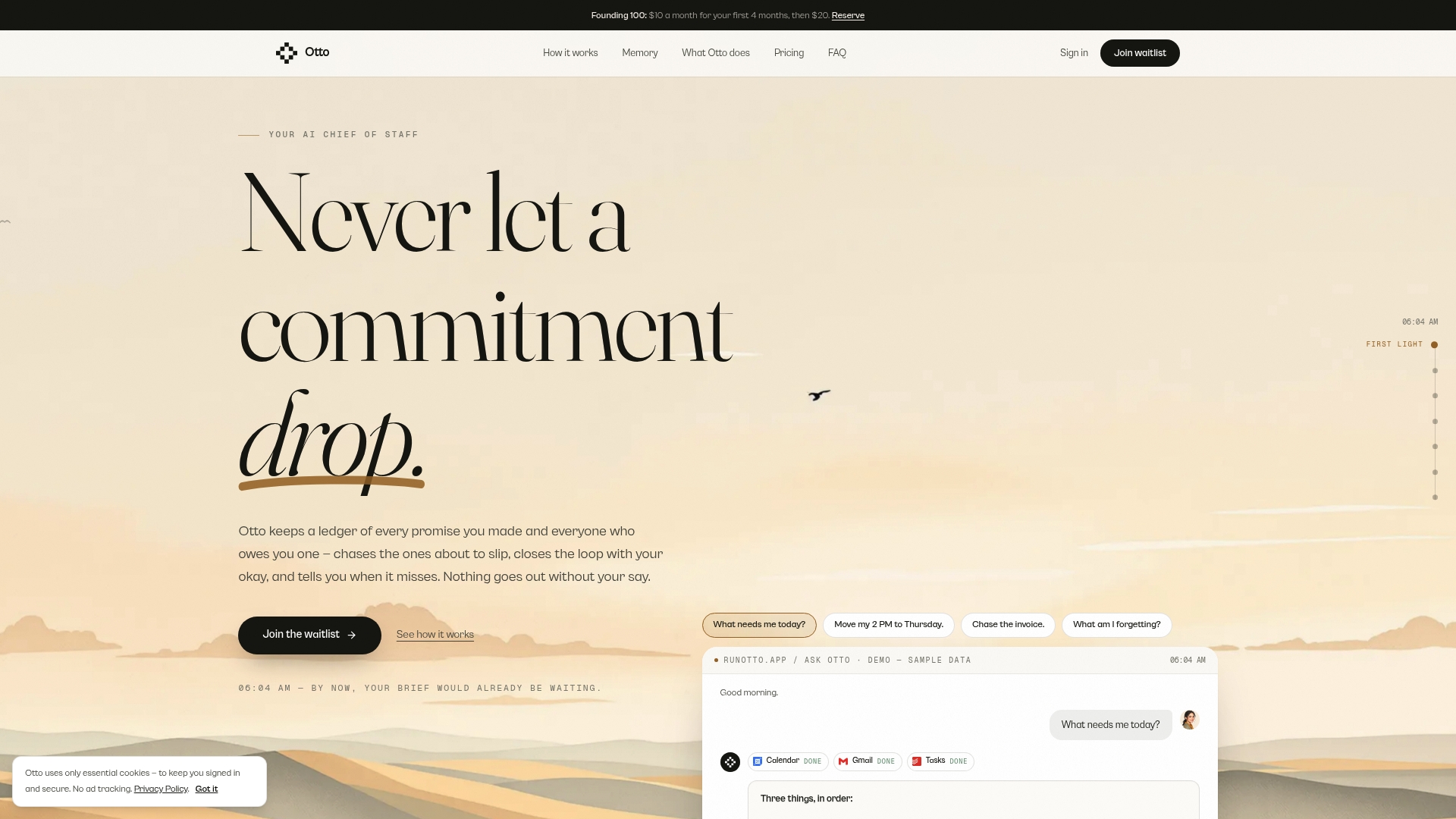
The gap we kept running into, and the reason Otto exists, is that an email assistant has never seen your calendar, a meeting notetaker has never seen your inbox, and a CRM knows your contacts but not what you promised them out loud on a call. The system listens in meetings, reads email and calendar, and captures every promise made across any of them into one ledger it tracks until it’s closed. Nothing is ever sent or finalized without explicit user approval: it drafts, you decide.
Using Otto instead of a hand-built cross app workflow, you can expect:
- Fewer missed follow-ups, since every commitment lands in one ledger instead of three separate tools.
- A single place to see what needs your attention today, instead of checking inbox, calendar and notes separately.
- Automated follow-up drafts that wait for your approval before anything goes out.
If the patterns in this guide sound like more plumbing than you want to own, see Otto’s plans and pricing and find the option that fits how scattered your week already is.
FAQ
What is the difference between a cross app workflow and a plain integration?
A plain integration usually means two apps share data in one fixed direction, like a contact form feeding a CRM. A cross app workflow is broader: it includes triggers, conditional logic, and often multiple downstream actions chained together across more than two systems.
Do I need an AI agent for every cross app workflow?
No. Use a deterministic API call whenever a fixed rule would do the job, and reserve an agent for steps that require interpreting unstructured input, like summarizing a transcript or deciding which of several possible actions fits the situation.
How do I prevent duplicate actions when a webhook fires twice?
Attach an idempotency key to each event and check it before processing, so a duplicate delivery gets recognized and skipped rather than triggering the action a second time. Workflow idempotency documentation recommends handling this at both the individual step level and the overall run level for full coverage.
What’s the biggest risk with letting AI agents trigger actions across apps?
The main risk is an agent committing an action, like sending an email or updating a record, before anyone reviews it. Placing an explicit approval or policy check between an agent’s plan and its execution, sometimes called an action-commit boundary, closes that gap.
Can Otto replace a custom-built cross app workflow?
Otto is built specifically for email, calendar, meetings and commitment tracking, unifying them in one shared memory rather than requiring you to connect and maintain separate tools yourself. For that core set of tasks, it removes the integration work this guide describes; for highly specialized data flows outside that scope, a custom workflow may still be the right tool.
Sources
- OpenAgentFlow: Enabling System-Wide Safety Boundaries for Heterogeneous AI Agent Fleets
- standard-webhooks/standard-webhooks
- Workflows experience (Microsoft Copilot Studio)
- Idempotency (Workflow SDK docs)