 Otto
OttoMeeting Recap Email: Copy a Template, Verify Actions, Send Today
Meeting Recap Email: Copy a Template, Verify Actions, Send Today

A meeting recap email turns discussion into action: open with one line naming the meeting, date and attendees, then list decisions, then actions that each carry an owner and a due date. Send it the same day, while context is fresh, ideally within two hours for high-stakes meetings. Everything below helps you do that quickly.
TL;DR:
- Keep the recap under 300 words, ideally under 200; link the full minutes when detail would crowd decisions and action items.
- Use Recap, the meeting or project name, and the date in the subject; put the most urgent deadline in preview text.
- Assign one named person to each action, with a due date and deliverable; propose a deadline if none was set, and add it to the calendar.
- Choose a format by meeting type: use a quick recap for check ins, detailed minutes for projects, escalation notes for blocked work, and an explicit no decision recap for exploratory talks.
Table of Contents
- What should a meeting recap include?
- How do you write and send a recap the same day?
- How should you write the subject line and preview text?
- Which meeting recap email template should you use?
- What do finished recap emails look like?
- What are the best practices and common mistakes?
- Who should receive the recap, and where should you file it?
- Why do we insist on an action-first format?
- How can Otto draft your recaps and track every commitment?
- FAQ
- Sources
What should a meeting recap include?
A good recap is concise and can be forwarded to someone who missed the call. Rocketly recommends writing recaps to be forwardable and listing actions as owner, date and output. Build yours from these parts:
- Context line: meeting title, date and attendees in one sentence. Add the time zone when people are spread out.
- Decisions: final outcomes only, each written as a definitive sentence (“We approved the Q3 budget”).
- Action items: an explicit task, one named owner, a due date and the expected deliverable.
- Open questions and assumptions: label each as Provisional or Open, and propose an owner if it helps.
- Next meeting and attachments: the next check-in date, plus links to notes, slides or the full minutes.
Keep each bullet to one line. Bold the owners and dates so a scanning reader finds their name fast. BusinessWriting suggests keeping a recap under 300 words, and under 200 when you can. If a recap runs long, link the full minutes instead of pasting them in.
How do you write and send a recap the same day?
The fastest path is a fixed routine. GoTranscript recommends sending within 24 hours, and the same day for fast-moving work. Here is the checklist:
- Capture commitments during the meeting, using minutes or a transcript, and pull out decisions and actions right away.
- Draft the recap promptly, using one of the templates below.
- Check every action for an owner, a due date and a deliverable.
- Verify any disputed or sensitive wording against the transcript, or mark it “pending confirmation.”
- Add a closing line: “Reply with any corrections or questions by [time and date].”
- Do one last owner and date check, then send.
Pro Tip: Write the action items first, then the decisions. Actions are where recaps fail, so getting them right early keeps you from rushing them at the end.
HBR also advises recording task due dates in your calendar, so each deadline lives somewhere besides the email. If you want to see how automation can shorten this routine, our guide to post-meeting follow-ups with templates and AI walks through it.
How should you write the subject line and preview text?
Your subject line is the label that will matter in six months, when someone searches their inbox for what was decided. Facilitation First says to include the document type (“Recap”), the project or meeting topic, and the date. Rocketly adds the company or project name for long-term findability.
A reliable pattern: Recap: [Meeting name] | [Date] | [key outcome or number of actions]
- Strong: “Recap: Acme Onboarding Kickoff | Oct 14 | 4 actions, launch date set”
- Weak: “Notes from today” or “Following up”
- Put the most important keyword first (Recap, Sync or Decision) and keep the whole line concise so it is easy to scan on a phone.
- Use preview text to surface the single most urgent next step or deadline, such as “Pricing sign-off needed from Dana by Friday.”
- Treat the mobile notification as your real headline: if the first few words do not say what happened, rewrite them.
The date is what makes a recap searchable later: a generic title with no date is the one that gets lost.
Which meeting recap email template should you use?
Pick the template that matches the meeting, paste it in and edit. All four share the same skeleton, so you can switch between them without rethinking your layout.
- Quick recap: a short subject, a one-line context, the decisions, and two or three action bullets. Use it for standups and check-ins.
- Detailed minutes-based recap: sections for decisions, action items (owner, task, due date), open questions, next meeting and attachments. Use it for project meetings.
- Escalation-friendly recap: flags at-risk deadlines and blocked items, and enforces a “reply by” time. Use it when something is slipping.
- No-decision recap: states plainly that nothing was decided, lists the open items and who owns each, so nobody mistakes discussion for agreement.
| Template | Best for | Must-have line |
|---|---|---|
| Quick | Short syncs | One-line context plus a few actions |
| Detailed | Project meetings | Action table: owner, task, due date |
| Escalation | Blocked or late work | “Reply by [time]” and at-risk dates |
| No-decision | Exploratory talks | “No decision reached” plus open items |
Here is the detailed template in plain text:
Subject: Recap: [Meeting name] | [Date] | [# actions] Hi all, thanks for joining [meeting] on [date]. Here is where we landed. Decisions: [one definitive sentence each] Actions: [Owner] to [task] by [date], deliverable: [what] Open questions: [Open or Provisional] [question], owner: [name] Next meeting: [date]. Notes: [link] Please reply with corrections or questions by [time and date].
For more ready-made wording, see our follow-up templates and AI workflow.
What do finished recap emails look like?
Seeing a complete recap helps more than any rule. Here are two.
Short executive recap
Subject: Recap: Leadership Sync | [Date] | actions
- Context: Leadership sync on [date] with Priya, Marcus and Elena.
- Decision: We are moving the launch to November.
- Decision: Hiring for the support role stays open.
- Decision: The pricing page keeps its current layout.
- Action: Marcus to confirm the new launch date with sales by [date].
- Action: Elena to post the support role by [date].
- Next meeting: [date].
Detailed client-onboarding recap
Subject: Recap: Acme Onboarding Kickoff | Oct 14 | 4 actions
Decisions: go-live is set for [date], and Acme’s IT team owns single sign-on setup.
Attachments: kickoff deck and the full minutes. Note: pricing terms were verified against the transcript before sending.
Both work for the same reasons. Decisions come first, every action has one person’s name and a date, and the reader never has to guess what happens next.

What are the best practices and common mistakes?
Most failed recaps share a handful of causes. Fix these and yours will land.
- Do keep it concise and give each action exactly one owner.
- Do propose a deadline when none was set, so the action does not float.
- Do bold names and dates, and end with one clear call to action.
- Don’t send the recap days later. Context fades fast.
- Don’t bury decisions inside long paragraphs.
- Don’t name a department as an owner. Assign a person.
- Don’t blur decisions with assumptions. Lab Manager suggests marking status explicitly, such as “Decision: Approved X” versus “Provisional: Awaiting Y,” to prevent false certainty.
Check the wording against the transcript when needed, and send the recap to the appropriate recipients. The “reply with corrections by [date]” line gives people a window to speak up, which makes the recap a shared record instead of one person’s version.
Pro Tip: Follow-through needs a keeper. HBR suggests assigning someone to follow up between meetings and tracking completed items, so decide who that is before you hit send.
Who should receive the recap, and where should you file it?
A recap only helps if the right people see it and you can find it later.
- Send it to every attendee and to invited-but-absent stakeholders who need to know, a practice Indeed also recommends.
- Keep “FYI” recipients to a minimum. Post to a team channel or a CRM record for broader visibility.
- Archive the recap under a searchable title (Recap + project + date) and link the archive inside the email.
- For confidential or sensitive meetings, restrict the recipient list and verify the wording against the transcript first.
- If you send recaps from shared or automated mailboxes, Sendmux’s overview of mailboxes for scheduling agents explains how automated sending can be set up.
Filing matters more than people expect. When the recap lives in a shared folder or customer record, it becomes project memory instead of a message buried in one person’s sent items.
Why do we insist on an action-first format?
I have seen the same pattern many times: a meeting ends with real energy, and a week later nobody can say who agreed to what. Writing decisions and owners in this strict structure is the cheapest fix there is. It can be a quick way to help keep tasks visible.
What I find most underrated is where the context lives. Promises are made on calls, confirmed in email and scheduled on a calendar, and the person in the middle ends up holding all of it in their head. Gathering it into one ledger removes that burden. If you would rather not do it by hand, consider a tool that captures commitments for you.
— Eddie
How can Otto draft your recaps and track every commitment?
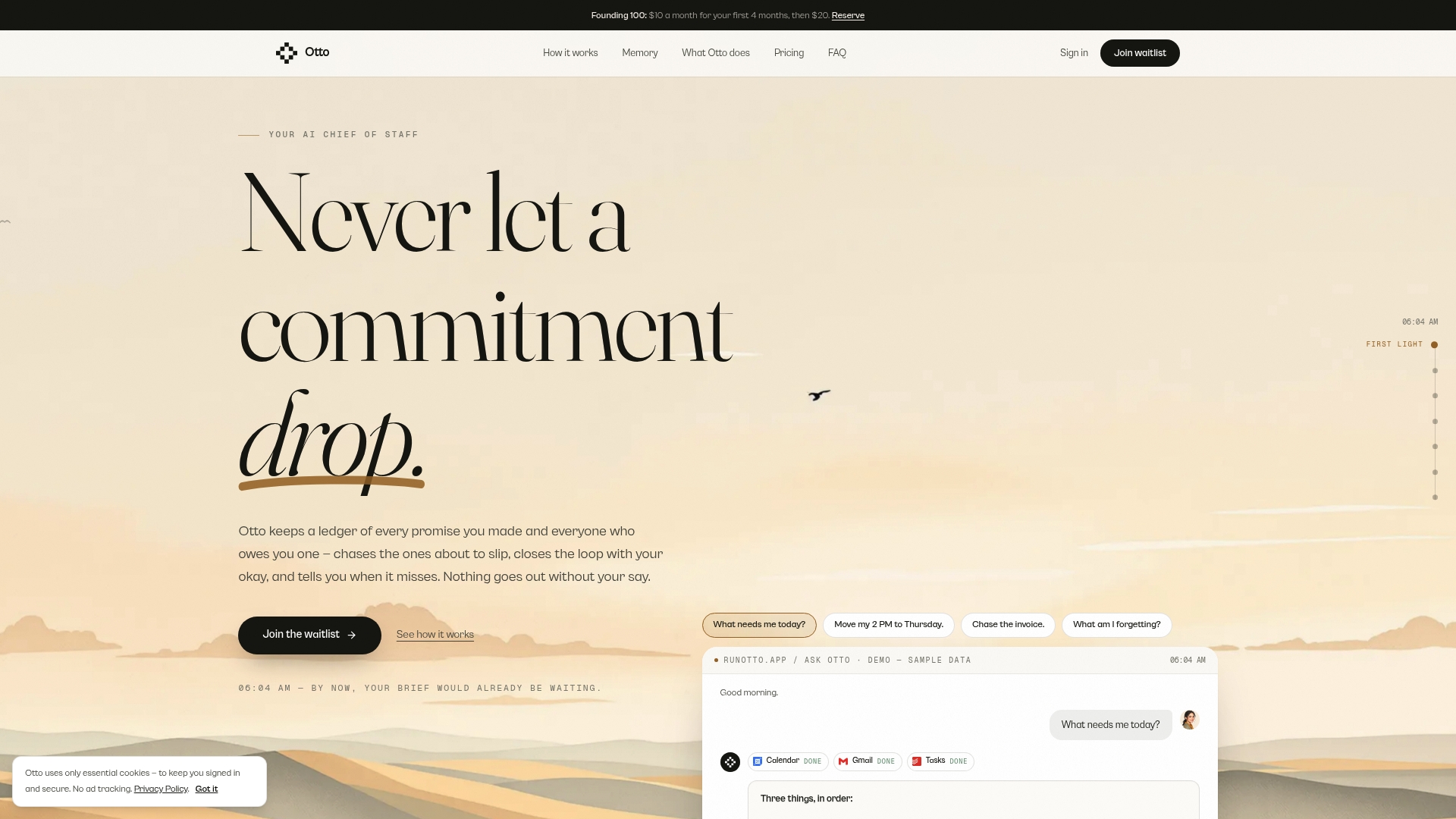
We built Otto as an AI chief of staff that keeps email, calendar, meetings and commitments in one shared memory, so nothing has to be re-explained. It can help capture meeting commitments and draft follow-ups. Review drafts before sending or finalizing them.
You can start on our Free plan, or look at the Upgraded and Max plans, on the Otto product page.
FAQ
How do I start off a recap email?
Open with a one-line context: the meeting name, the date and who attended. Then go straight to decisions. A thank-you is fine, but keep it to a few words so the outcomes stay visible.
What should I write when sending meeting minutes?
Paste the decisions, action items, owners and deadlines directly into the email body, then link the full minutes instead of attaching a long document. GoTranscript recommends this approach so the key points get read.
How do I send a Teams meeting recap?
Take the decisions and actions from your Teams notes or transcript, and drop them into the same email format described above. Check sensitive wording against the transcript first, and send the recap to attendees and any absent stakeholders.
How do I write an email informing people about a meeting?
State the purpose, date, time with time zone and who should attend, then list any decisions you need made. That way attendees arrive prepared, and your recap afterward has a clear agenda to follow.
Sources
- Make Your Meeting More Effective by Following Up
- Internal Meeting Recap Email Templates (Minutes-Based Follow-Ups That Get Action) | GoTranscript
- Meeting recap email: how to write one that works | Rocketly
- How to write a meeting recap email people actually read
- Facilitationfirst