 Otto
Chief of Staff vs Executive Assistant: Leaders, Think Days or Months
Chief of Staff vs Executive Assistant: Leaders, Think Days or Months

An executive assistant protects your time and runs the tactical work around it, while a chief of staff extends your reach across the organization and carries strategic work on your behalf. If your calendar and inbox are the bottleneck, hire an executive assistant. If alignment and cross-functional programs are stalling, hire a chief of staff, who averages just over 12 years of experience, or look at software like Otto for follow-up.
TL;DR:
- Chiefs of staff average just over 12 years’ experience; governance roles may suit five to ten years, while proxy roles call for ten to twenty.
- Many organizations use one to three year rotations for junior chiefs of staff, so define the exit plan, tenure, and decision rights before hiring.
- If both problems exist, hire an assistant first to reclaim leadership time, then add a chief of staff when team alignment becomes routine work.
- For dropped promises and unclosed loops, software can track commitments across email, calendars, and meetings, but human judgment and proxy authority still require people.
Table of Contents
- What does each role actually do day to day?
- How do their responsibilities compare in practice?
- How senior is each role, and where does it lead?
- When should you hire each role?
- How do an assistant and a chief of staff work well together?
- Pick by the problem, not the title
- Where software fits alongside both roles
- FAQ
- Sources
What does each role actually do day to day?
The two roles are easy to confuse because both sit close to a senior leader and both speak on that leader’s behalf. They differ in what they own. Harvard practitioner guidance frames it simply: assistants enable personal effectiveness now, while chiefs of staff enable organizational effectiveness for the future.
An executive assistant typically owns the tactical layer:
- Calendar management and meeting scheduling, including constant reshuffling
- Travel, logistics and vendor coordination
- Inbox triage and drafting replies for the leader’s review
- Meeting prep and an executive daily briefing so the leader walks in informed
A chief of staff typically owns the strategic layer:
- Cross-functional projects that no single department owns
- Framing decisions and preparing the leader to make them
- Monitoring KPIs and flagging drift early
- Representing the leader in rooms the leader cannot attend
- Running off-cycle initiatives such as board prep or a reorganization
BCG describes the chief of staff as a “utility player” who bridges the C-suite and the wider organization. Cornell’s career office puts it more plainly: an execution partner who connects the dots across functions.
Overlap is real. Both brief the executive, both manage communications, and both carry the leader’s voice. The split comes from time horizon and authority.
How do their responsibilities compare in practice?
Think in timeframes. An executive assistant works in hours and days: today’s schedule, this week’s travel, the emails that cannot wait. A chief of staff works in weeks and months: the strategic initiative that needs a steering group, the quarterly planning cycle, the stakeholder alignment that makes a launch land.
Decision rights are the sharper divider. An assistant acts within rules the leader sets, such as which meetings to accept or which vendors to book. A chief of staff sometimes acts as a proxy, making calls or setting direction when the leader is unavailable. That only works when the leader has defined the limits clearly in advance.
Here is how typical work splits:
- Executive assistant: daily calendar triage, travel booking, vendor logistics, meeting prep packets, inbox sorting, expense and document handling
- Chief of staff: board prep, strategic initiative tracking, cross-functional program management, leadership team agendas, communications that align teams around a decision
- Shared ground: briefing the leader, protecting focus time, relaying context between the leader and the organization
Cross-functional alignment is where chiefs of staff earn their keep, and it often depends on clear messaging. A practical look at internal communications challenges shows why that work rarely fits inside an assistant’s remit.
Pro Tip: Write down the last ten things you wished someone else had handled. If most are scheduling, logistics or inbox items, you need an assistant. If most are “someone should have followed up across three teams,” you need a chief of staff.
How senior is each role, and where does it lead?
Seniority is the clearest hiring signal. Chiefs of staff tend to arrive with substantial experience, usually after a career in operations, strategy, consulting or line management.
McKinsey reports the average chief of staff has just over 12 years of work experience, with two common entry points: five to ten years for governance-heavy roles and ten to twenty years for leadership and proxy roles.
That range matters when you write the job description. A five-to-ten-year hire will run the machinery of your leadership team. A ten-to-twenty-year hire can stand in for you.
Tenure also differs. Cornell’s CAHRS working group notes that many organizations use rotational models of one to three years for junior chiefs of staff, and stresses defining exit strategies and decision rights up front. For the occupant, the role often works as a launchpad into senior leadership.
Executive assistants follow a different arc. Many build deep, durable expertise in one executive’s world and stay for years, which is a strength: institutional memory and trust compound. BCG notes that the relationship between a leader and a support team member takes a year or two to become productive, so continuity has real value.

When should you hire each role?
Match the hire to the problem, not the title. Use this sequence as a starting point:
- Hire an executive assistant when operations are eating your week. Signs include a calendar you rebuild daily, a growing email backlog, missed meeting prep, and travel or logistics you still handle yourself.
- Hire a chief of staff when execution stalls between teams. Signs include strategic initiatives with no clear owner, leaders interpreting your priorities differently, and decisions that wait for you because nobody else is trusted to make them.
- Hire both when you have both problems. Most leaders need the assistant first, because it frees the time that makes a chief of staff effective. BCG’s CEO research notes support teams often include one or two assistants and a chief of staff, and that the team must master the basics before playing a strategic role.
- Consider a rotational chief of staff for a defined push, such as a turnaround or integration, where a one-to-three-year horizon fits the work.
- Add software for follow-up at scale. If your real pain is dropped promises and unclosed loops, a tool can track commitments across email, calendar and meetings before you add headcount.
Internal promotion is also worth weighing. McKinsey notes that many chiefs of staff are appointed from within, because insiders bring institutional knowledge and networks that help them start fast.
How do an assistant and a chief of staff work well together?
Duplication and confusion about ownership are the usual failure points. A few rules prevent both:
- Hold a short weekly sync. The assistant brings the schedule, travel and upcoming prep needs. The chief of staff brings initiative status, open decisions and stakeholder issues.
- Split handoffs cleanly. The assistant owns meeting prep and logistics. The chief of staff owns follow-up on cross-functional commitments and nudges stakeholders.
- Agree on cadence for senior meetings. Two shared meeting rhythms, like those in this guide to booking C-suite meetings, keep calendar strategy consistent.
Pro Tip: Write down decision rights and confidentiality rules for both roles in one page. Ambiguity about who can decide, and what can be shared, erodes trust faster than any mistake.
Pick by the problem, not the title
Here is my view after weighing the evidence: titles mislead, problems do not. Leaders who hire a chief of staff to fix a calendar problem end up with an expensive assistant, and leaders who hire an assistant to fix strategic drift end up frustrated. In a startup, begin with an assistant or software and add a chief of staff once cross-team alignment becomes your job. In a scaling company, hire a chief of staff early, with decision rights and tenure expectations agreed on in advance. In a large enterprise, expect both roles and design their handoffs deliberately.
— Eddie
Where software fits alongside both roles
We built Otto as an AI chief of staff that unifies your email, calendar, meetings and commitments in one shared memory, then chases every promise until it closes. It drafts follow-ups and meeting notes, and nothing goes out without your approval. It complements human judgment rather than replacing it.
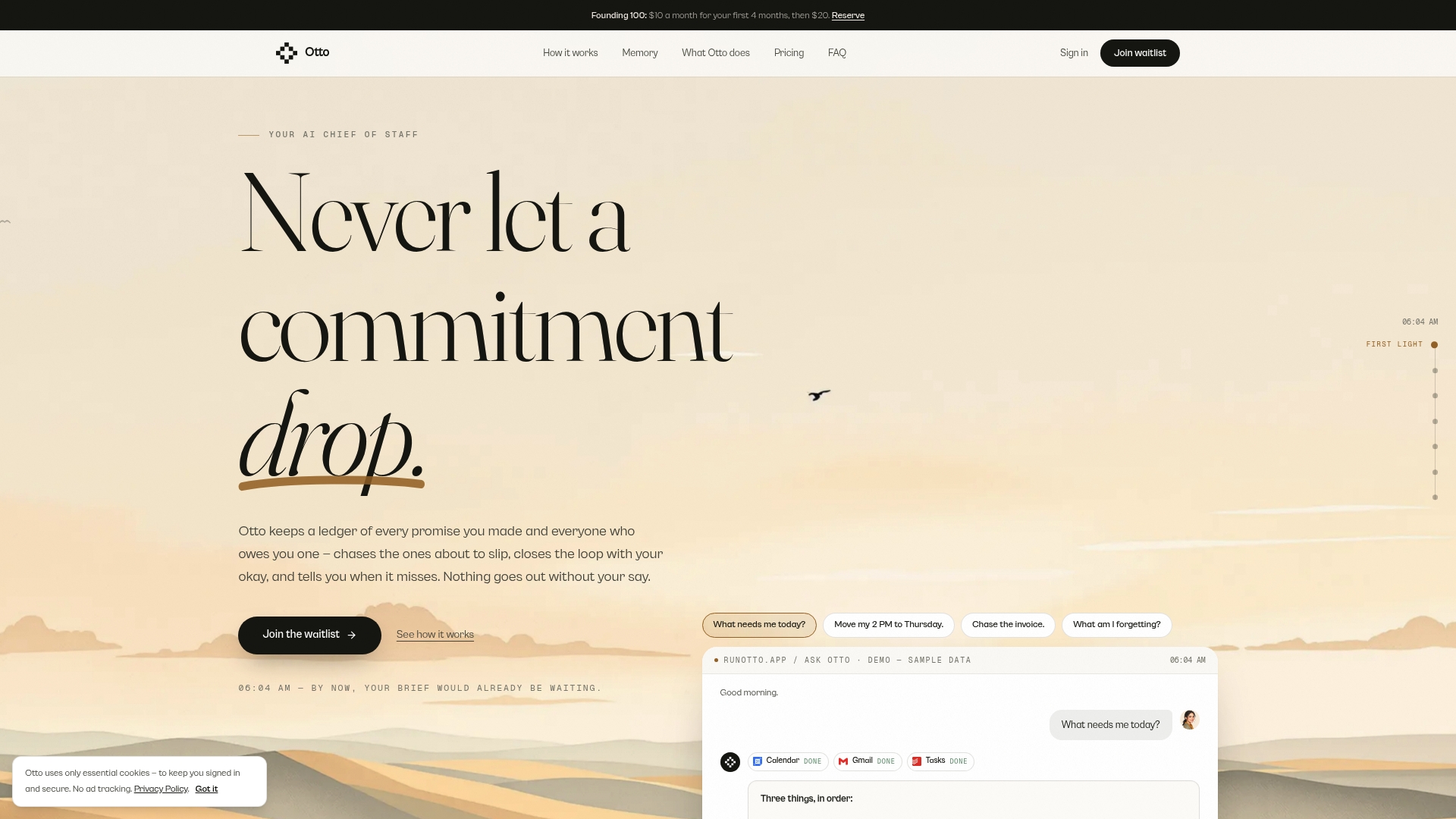
If dropped follow-ups are your real bottleneck, see how Otto works and pick a plan.
FAQ
Is a chief of staff just a glorified executive assistant?
No. The roles solve different problems. An executive assistant manages the leader’s time and logistics, while a chief of staff drives organizational priorities and often acts as a proxy. Harvard guidance describes them as distinct but complementary.
Is a chief of staff higher than an executive assistant?
Usually yes in seniority and scope, particularly in larger organizations, where chiefs of staff more often hold VP-level seniority. Executive assistants can be very senior in expertise and trust, but the two roles are not on a single ladder.
Is chief of staff a high position?
It depends on the company. In many organizations it is a senior role close to the top, often supporting the CEO, and it frequently leads to broader leadership positions. In others, particularly rotational programs, it is a developmental role for rising talent.
Can software replace either role?
Software can absorb a lot of follow-up, note-taking and calendar and task syncing, but it does not replace judgment, trust or proxy authority. The best setups pair human roles with tools that ask for approval before acting.
Sources
- The chief of staff role in eight charts | McKinsey
- Why Chiefs of Staff Are Indispensable to Presidents, CEOs, and Pro-Golfers
- Chief of Staff: What It Is, Responsibilities, and Career Path Overview – Central Career Services | Cornell University
- CAHRS Working Group The Role of the Chief of Staff