 Otto
OttoAI Email Mistakes: Five Checks Before You Hit Send
AI Email Mistakes: Five Checks Before You Hit Send

Prevent AI email mistakes by doing three things every time: constrain your prompt with ground-truth facts, run a short human checklist before sending, and confirm your authentication and deliverability settings. These three habits catch the errors that matter most: hallucinated facts, awkward tone, altered commitments, and messages that land in spam instead of the inbox.
TL;DR:
- Supply exact names, dates, figures, and links; mark commitments or prices as protected, specify tone and format, and reuse tested templates.
- Before sending, verify facts and commitments, remove stock phrasing, align From and Reply To addresses, test promotional links and unsubscribe flows, and scan headers for high stakes messages.
- Bulk senders need aligned SPF, DKIM, and DMARC, unsubscribe headers, prompt handling of opt out requests, and complaint monitoring; personal inboxes may not suit growing outreach.
- Keep a person in control: ground drafts in meeting notes and email history, require explicit approval before sending, and correct consequential errors by phone too.
Table of Contents
- The Common AI Email Mistakes to Watch For
- Human Review Checklist: The Exact Pre-Send Steps to Run in Under Five Minutes
- Prompting and Constraint Patterns That Reduce Hallucinations and Unwanted Rewrites
- Deliverability Basics: Quick Technical Checks to Stop AI Drafts From Going to Spam
- Human + AI Workflows That Stop Mistakes
- Strategies for Training or Fine-Tuning AI Models to Reduce Email Errors
- Handling and Correcting AI Email Mistakes After Sending
- Why Supervising AI Saves More Time Than Abandoning It
- How Otto Helps Prevent AI Email Mistakes
- FAQ
- Sources
The Common AI Email Mistakes to Watch For
AI drafting tools are fast, but speed introduces predictable failure patterns. Recognizing them is the first step to catching them before a reader does.
Hallucinations, or what the NIST AI Risk Management Framework calls confabulation, happen when a model invents plausible but false details. A tool might generate a meeting time that was never confirmed or cite a contract clause that does not exist. NIST recommends verification and human oversight as the primary mitigation, which means every fact in a draft needs a source you can point to.
Beyond facts, several other patterns show up again and again:
- Stock AI phrasing (“I hope this email finds you well,” “I wanted to circle back”) that reads as generic rather than personal.
- Unwanted edits that soften a firm commitment into a vague one, or change a number without flagging it.
- Spam-triggering content, including excessive links, urgent subject lines, or mismatched sender headers.
- Privacy exposure, where a careless prompt pastes in a client’s phone number or internal pricing that should stay out of a draft.
Each of these is avoidable, but only if you know to look for it before you send.
Human Review Checklist: The Exact Pre-Send Steps to Run in Under Five Minutes
A consistent checklist catches most AI drafting errors without slowing you down. Run these five steps in order every time you send an AI-assisted email that matters.
- Verify facts first. Cross-check every name, date, number, and claim against your source material, not against what sounds right.
- Check tone and commitments. Remove generic AI phrasing and confirm that any promise, deadline, or figure matches exactly what you intended to say.
- Confirm header alignment. Make sure your From and Reply-To addresses match and that nothing in the message headers looks inconsistent with your domain.
- Test links and unsubscribe flows. Click every link in promotional or bulk messages, and confirm the unsubscribe option actually works.
- Run a header or spam-score check. For bulk or high-stakes sends, pass the message through a header analysis tool before it goes out.
Pro Tip: Keep this checklist pinned next to your inbox. Five minutes of review prevents the kind of mistake that takes an hour of apology email to fix.
Microsoft’s Copilot documentation makes the same point from the vendor side: outputs are grounded in your data but are not guaranteed to be fully accurate, so review before sending stays a recommended step even with well-configured tools.
Prompting and Constraint Patterns That Reduce Hallucinations and Unwanted Rewrites
The prompt you write determines how much editing you do afterward. A few constraint patterns consistently produce cleaner, more predictable drafts.
- Include ground-truth fields directly in the prompt: exact names, dates, dollar figures, and links, so the model has no reason to guess.
- Mark protected text explicitly, telling the model what not to change, such as a quoted price or a commitment you already made out loud.
- Request output in a strict format, like a bulleted list of fields or a short table, which limits how much the model can improvise around your facts.
- Give short, specific tone instructions (“direct, no greetings filler, under 120 words”) instead of vague ones like “make it professional.”
- Save proven prompt templates for recurring message types, such as follow-ups or scheduling confirmations, so you are not rebuilding constraints from scratch each time.
Practitioner guidance consistently points to the same pattern: deterministic formats and explicit “do not invent” instructions cut down on confabulated details far more reliably than general reminders to “be accurate.”
Deliverability Basics: Quick Technical Checks to Stop AI Drafts From Going to Spam
A well-written AI draft can still land in spam if the technical side of your email setup is off. These checks matter more than wording polish for inbox placement.
- Set up SPF, DKIM, and DMARC alignment, since Gmail flags unauthenticated mail regardless of how good the copy reads.
- Add List-Unsubscribe headers to promotional mail and honor every unsubscribe request immediately.
- Monitor your spam-complaint rate through tools like Google Postmaster Tools, especially once you send in volume.
- Avoid deceptive headers, hidden text, and link patterns that look like redirect chains, all of which filters flag on their own.
- Bring in a delivery specialist or switch to a dedicated email service provider once your outreach scales past what a personal inbox can handle cleanly.
For a deeper check on authentication records before a send, a free email header analyzer can confirm your SPF, DKIM, and DMARC alignment in seconds. Clean list hygiene matters just as much. Verification practices that reduce bounces keep your sender reputation intact even as your sending volume grows.
Human + AI Workflows That Stop Mistakes
The most reliable pattern is an approval-first workflow: draft, checklist review, explicit approval, then send. No message moves to “send-ready” until a person has signed off, which keeps the AI useful without putting it in charge.
What makes this workflow actually catch errors is shared context. When a draft tool can see your meeting notes, calendar, and inbox history together, it is far less likely to mistakenly edit a commitment you made verbally or drop a detail from an earlier thread. Grounding a draft in real conversation history, rather than a single prompt, is what keeps tone and facts consistent.
A promised follow-up (“I’ll send the updated proposal by Friday with the revised number we discussed”) stays intact in both wording and figure, because the draft pulls from the actual meeting record instead of reconstructing it from a vague prompt.
Our team at Otto writes about these workflows in practice, including when an assistant should ask before acting rather than guessing.
Strategies for Training or Fine-Tuning AI Models to Reduce Email Errors
For teams relying heavily on AI drafting, fine-tuning or structured prompt libraries reduce error rates over time more than one-off prompt tweaks.
Start by collecting examples of your own edited drafts, specifically the corrections you make most often: tone changes, factual fixes, or commitment wording. These edits are the clearest signal of where a general-purpose model drifts from your actual voice and standards.
Feed that pattern back into your system through two practical paths. The first is a prompt library approach, where you save the exact constraints that worked (protected fields, tone instructions, format requirements) and reuse them as templates rather than rewriting them each time. The second, for teams with the technical capacity, is lightweight fine-tuning on a corpus of approved, corrected emails, which teaches the model your actual phrasing patterns instead of generic ones.

Either path works best paired with grounding. Microsoft’s Copilot guidance describes a defense-in-depth approach, combining grounding in organizational data, content filters, and human review rather than relying on any single safeguard. The same layered logic applies whether you are fine-tuning a model or simply refining your prompt templates: no single fix replaces the others, but stacked together they meaningfully cut down on repeat mistakes.
Track what you correct for a few weeks and you will likely find the same two or three error types recurring. Fix those at the template or training level and your checklist time drops accordingly.
Handling and Correcting AI Email Mistakes After Sending
Despite a solid checklist, a mistake will eventually get through. How you handle it afterward matters as much as preventing it in the first place.
Send a correction promptly once you notice an error, and keep it short: state what was wrong, give the accurate information, and avoid over-explaining the cause. A brief, direct follow-up (“Correction: the deadline is Thursday the 18th, not the 15th as I wrote earlier”) reads as competent. A long apology draws more attention to the mistake than the mistake itself did.
For factual errors that could affect a decision, such as a wrong price or date, follow up with a phone call or a direct message in addition to the email correction, especially if the recipient may have already acted on the wrong information.
Log the mistake somewhere you will actually review it. If it traces back to a prompt that lacked a ground-truth field, fix that prompt template immediately so the same error does not repeat on the next similar email. Treating each correction as a prompt-improvement opportunity is what turns occasional mistakes into a shrinking list over time, rather than a recurring one.

Why Supervising AI Saves More Time Than Abandoning It
The instinct after a bad AI-drafted email is to stop using AI altogether. That overcorrects. A five-minute checklist run consistently catches far more errors than abandoning the tool and writing everything from scratch, and it builds real trust in what the model gets right. Adopt the checklist, keep your prompt defaults conservative, and let AI handle the first draft while you handle the judgment.
— Eddie
How Otto Helps Prevent AI Email Mistakes
The workflow described above, shared context plus approval before send, is easier to run when one system holds your email, calendar, and meeting history together instead of three separate tools. That is the gap we built Otto to close: a shared memory across your inbox, calendar, and meetings means a drafted follow-up pulls from what was actually said, not a guess reconstructed from a short prompt.
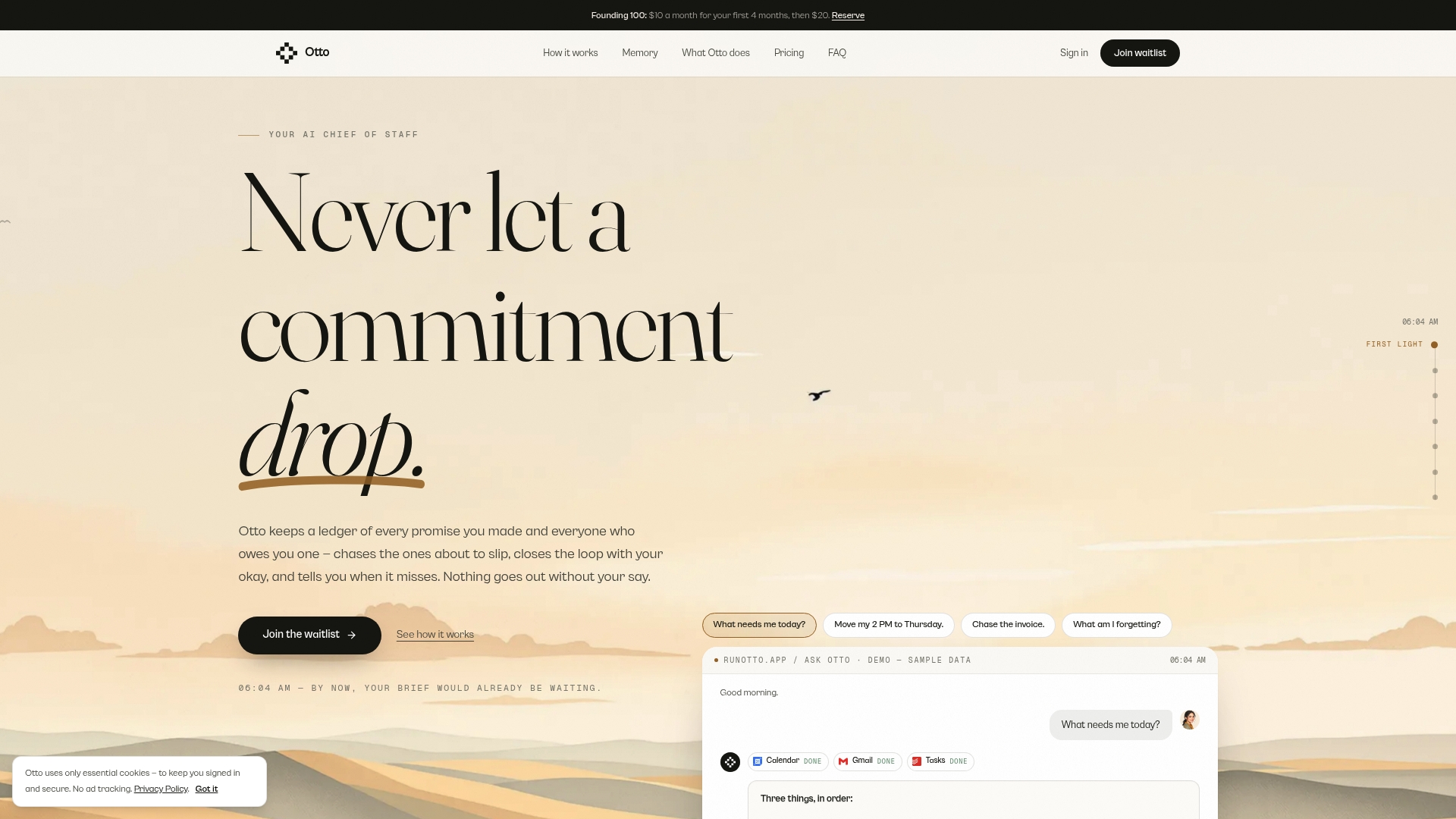
- Draft replies and follow-ups grounded in your actual meeting notes and email history.
- Nothing sends without your explicit approval: drafts are prepared, and you decide.
- Our AI email drafting workflows and follow-up templates show the pattern in practice.
See the Free, Upgraded, and Max plans and find the one that fits how much of your inbox you want handled this way.
FAQ
What causes AI to hallucinate facts in emails?
AI models generate text based on probability, not verified records, so they can produce a plausible-sounding date, name, or figure that was never confirmed. The NIST AI Risk Management Framework identifies this as confabulation and recommends verification and human review as the primary mitigation.
How do I stop AI from sounding robotic in emails?
Give the model short, specific tone instructions instead of vague ones, and remove stock phrases like “I hope this finds you well” during review. Grounding the draft in your actual prior messages or meeting notes also helps the output match how you naturally write.
Why do AI-drafted emails end up in spam?
Spam placement is usually a technical issue, not a wording issue: missing or misaligned SPF, DKIM, or DMARC records are common triggers regardless of how the message is written. Bulk senders also need List-Unsubscribe headers and a spam-complaint rate kept low to maintain reliable inbox placement.
What should I check before sending an AI-written email?
Verify every fact against your source material, confirm the tone and commitments match your intent, and check that your sender headers are aligned. For bulk or high-stakes sends, running a header or spam-score check adds one more layer of protection.
How do I correct a mistake after an AI-drafted email is sent?
Send a short, direct correction stating what was wrong and the accurate information, without over-explaining. For errors that could affect a decision, follow up with a call or direct message in addition to the email correction.
Sources
For deeper technical and policy detail, the NIST Generative AI Profile covers confabulation risk and mitigation steps, while Microsoft’s Copilot documentation explains grounding and safeguards for AI-generated content. Gmail’s own sender guidelines cover authentication and deliverability rules directly.
- Artificial Intelligence Risk Management Framework: Generative Artificial Intelligence Profile
- Data, Privacy, and Security for Microsoft Copilot | Microsoft Learn