 Otto
Otto30 Minute Setup to Track Waiting on Emails for Busy Leaders
30 Minute Setup to Track Waiting on Emails for Busy Leaders

The simplest reliable way to track emails you’re waiting on is to capture every open promise in one place, attach a visible, time-based signal like a snooze or a due date, and review that list on a set cadence. Tools like Otto automate this pattern end to end, but you can build it with free, native features too. Done right, you get fewer missed follow-ups and exactly one place to check each morning.
TL;DR:
- Below ten open threads, use one inbox label or list; above that, choose a task manager, while teams need a shared board.
- Gmail snooze suits replies expected by a known date; use a dedicated label for uncertain waits, while Outlook flags can carry start and due dates.
- Set a fixed weekly review, add due dates to urgent threads, and check the list daily when volume is high; one system prevents conflicting records.
- Keep the first reminder brief; if silence continues, name the blocked deadline or cost, update affected stakeholders, and set a date to escalate.
Table of Contents
- 7 practical ways to track waiting-on emails right now
- How to use Gmail and Outlook’s built-in follow-up tools
- Building a system that scales past single-email tricks
- Repeatable templates for the follow-ups you run every week
- How to choose the right tracking method for you
- A 30-minute setup checklist for your first “waiting on” system
- How to communicate status updates and escalate delays
- Why capture, signal, and review beats memory every time
- If you want it automated: how Otto handles the whole loop
- FAQ
- Sources
7 practical ways to track waiting-on emails right now
You don’t need a new system to start tracking what you’re owed. Pick one of these and you’ll have something working in the next ten minutes.
- Waiting-on list: keep a dedicated doc or note with links to each open thread, who owes you a reply, and the date you sent it.
- Label plus snooze: tag the message “Waiting” and snooze it to resurface on the date you expect a response.
- Flag and reminder: in Outlook, flag the message and set a start or due date so it lands on your to-do list.
- Task manager entry: add a task in Todoist, Microsoft To Do, or Apple Reminders with a direct link back to the email thread.
- Board or Kanban column: for multi-step deals, give “Waiting on Reply” its own column in Trello or Notion.
- Send-later draft: write the follow-up now, schedule it to send in a few days, and cancel it if the reply arrives first.
- Shared tracker inbox: forward time-sensitive threads to a team tracker address so more than one person sees what’s pending.
None of these require new software. They require picking one and sticking with it for a week before judging whether it works.
Pro Tip: Don’t run two systems at once. If you label in Gmail and also keep a side spreadsheet, you’ll stop trusting both of them within a week.
How to use Gmail and Outlook’s built-in follow-up tools
Both major email platforms already have features built for this exact problem. You just have to use them consistently.
- In Gmail, open a message, click the clock icon, and choose Snooze. The email disappears from your inbox and reappears at the date and time you pick, which is the core mechanism behind Gmail’s snooze feature.
- Use snooze for “wait and see” emails where you expect a reply by a certain date. Use a label like “Waiting” for emails you’re tracking over a longer, less predictable window.
- Gmail’s nudges may occasionally surface old sent messages that might need a follow-up, but nudges are inconsistent and shouldn’t be your only safety net.
- In Outlook, right-click a message and choose Follow Up to flag it for yourself, or flag it for the recipient so they get a reminder too. You can set specific start and due dates, and later find every flagged item through the To-Do Bar or InfoBar, according to Microsoft’s support documentation.
Exposure to interruptions that don’t match your current task raises subjective workload and can hurt performance, according to research published in MIS Quarterly. That’s the research-backed case for not relying on inbox visibility alone: if your only tracking method is “I’ll notice it in my inbox,” you’re depending on a channel that’s also full of unrelated noise competing for your attention.
Building a system that scales past single-email tricks
Snooze and flags work fine until you’re tracking 30 open threads at once. At that point you need to pick an architecture, not just a feature.
There are three common setups, each suited to a different kind of workload:
- Inbox-centric: labels and snooze live inside your email client; best for low volume and simple, short-cycle follow-ups.
- Task-centric: every waiting email becomes a task in Todoist, To Do, or a similar app; best when follow-ups compete with other work for your attention and you want one master list.
- Board-centric: a Kanban board in Trello or Notion gives each deal or project its own column; best for multi-step processes with several people involved.
Wiring email into any of these is usually a matter of forwarding or a simple integration: most task managers accept an email address that turns a forwarded message straight into a task, and board tools offer similar email-to-card features. If you’re coordinating follow-ups across a team, rather than just for yourself, a shared tracker or a lightweight CRM becomes worth the setup cost since it gives everyone visibility into who’s waiting on what, without someone having to ask in a side channel.
Repeatable templates for the follow-ups you run every week
A tracking system is only half the job. The other half is having a follow-up you can send without composing it from scratch every time.
- Gmail follow-up workflow: label every open thread “Waiting,” create one task per thread with a due date, and protect a weekly slot to review the whole label at once. Otto’s Gmail follow-up guide walks through setting this up end to end.
- Busy leader workflow: capture promises made out loud in meetings, not just the ones in writing, and turn them into follow-up tasks automatically rather than trying to remember them after the call ends. Otto listens across meetings, email, and calendar and drafts the follow-up for your approval before anything goes out.
- Freelancer payment reminder sequence: send a friendly nudge a few days past the due date, a firmer reminder a week later, and a final notice with a clear next step if payment still hasn’t arrived. Otto’s freelance reminder templates lay out the timing for each step, and theNeedle’s guide to tracking high-impact follow-ups offers useful heuristics for deciding which overdue threads to chase first.
Each template works best with a short checklist: label it, set the due date, and schedule the review on your calendar to ensure it happens.
Pro Tip: Automate the drafting, not the sending. A template that writes the follow-up for you still needs a human glance before it goes out.
How to choose the right tracking method for you
The right system depends less on which tool looks impressive and more on your actual volume and habits.
- Volume: under ten open threads, a simple label or list works; above that, you need a task manager or board.
- Frequency: daily back-and-forth needs a tighter review cadence than monthly check-ins.
- Collaboration: solo tracking can live in your inbox; team tracking needs a shared tool.
- Automation appetite: if you’re willing to set up integrations, task-centric or AI-assisted systems pay off faster.
- Review time available: a system you won’t actually check daily or weekly isn’t worth building.
A quick rubric: if your waiting list fits in your head, stay inbox-centric. If it’s spilling into other tools, go task-centric. If multiple people need to see the same list, go board-centric. Watch for red flags like a dozen overlapping labels, no fixed review time, or running two tracking systems that quietly drift out of sync.
A 30-minute setup checklist for your first “waiting on” system
You can have a working system before lunch.
- Create one label, folder, or project called “Waiting On.”
- Add your five oldest open threads to it right now.
- Set a reminder or due date on your top three most urgent ones.
- Block 15 minutes on your calendar, once a week, to review the full list.
- Save a search query for “sent emails with no reply” so future migrations are fast.
After one week, check two numbers: how many items you closed and how many you almost missed. If the miss count isn’t near zero, your review cadence needs to move, not your tool.
How to communicate status updates and escalate delays
Tracking a pending reply is only useful if you also have a plan for what to do when the silence drags on. The first follow-up is typically short and assumes good faith: a one-line nudge referencing the original ask often helps jog someone’s memory without sounding like a complaint.
If a second follow-up goes unanswered, shift from reminding to informing. Tell the other person what the delay is costing, concretely: a deadline that’s now at risk, a decision that’s blocked, or a next step that can’t start. This reframes the message from “did you forget” to “here’s what’s actually at stake,” which tends to get a faster response.
When a delay affects other people, loop in whoever needs to know before it becomes a surprise. A short status update, “still waiting on X, expect resolution by Y,” keeps stakeholders calm even when the answer is “I don’t know yet.” For anything with a hard deadline, set your own internal trigger point, a date by which you escalate to a manager, a different contact, or an alternative plan, rather than waiting indefinitely. The goal isn’t to chase harder every time. It’s to match the tone and urgency of your message to how much the delay now actually matters.

Why capture, signal, and review beats memory every time

Most people’s real failure isn’t forgetting to send a follow-up. It’s never writing the promise down in the first place, so there’s nothing to forget. A single ledger, checked on a fixed cadence, removes the mental tax of holding every open thread in your head at once.
Research on email interruptions backs this up loosely: batching can raise perceived productivity for people handling high email volumes, though its effect on stress is less consistent. A fixed review slot is a form of batching applied to follow-ups specifically.
— Eddie
If you want it automated: how Otto handles the whole loop
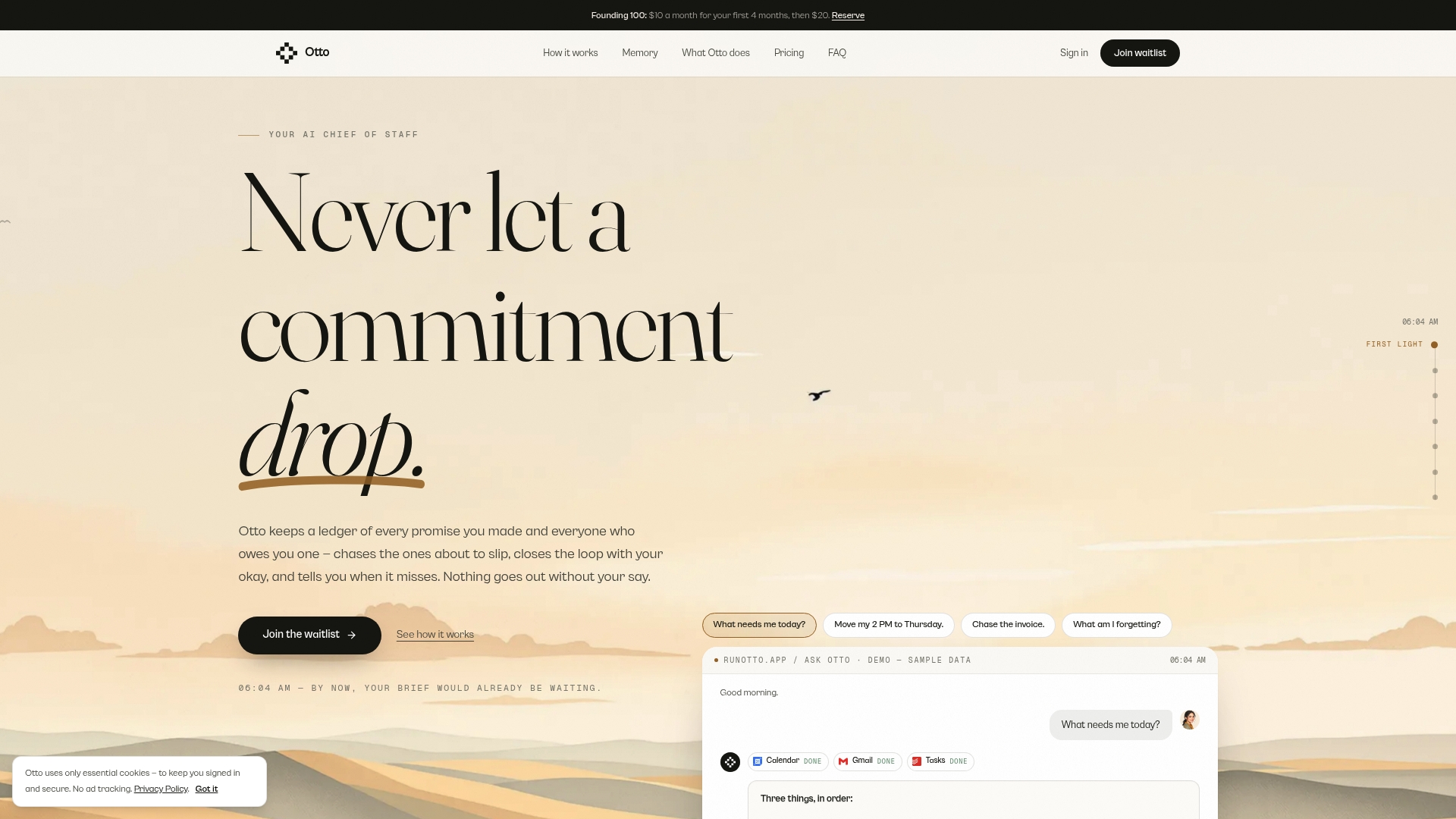
We built Otto to capture every promise made across your email, calendar, and meetings into one ledger it chases automatically, drafting every follow-up for your approval before anything sends.
- Works for founders, operators, and chiefs of staff juggling commitments across a dozen tools.
- Plans start Free, with paid upgrades available as your volume grows.
FAQ
What’s the fastest way to start tracking emails I’m waiting on?
Create one label or folder called “Waiting On,” add your current open threads, and set a reminder on the three most urgent ones. A fixed weekly review slot matters more than which tool you pick.
Does Gmail have a built-in way to track emails I’m waiting on?
Gmail’s snooze feature hides a message until a chosen date and time, which works well for threads with a clear expected reply date. For longer or less predictable waits, a dedicated label tends to hold up better than snooze alone.
How does Outlook’s follow-up flag work?
Outlook lets you flag a message for yourself or for the recipient, set a start and due date, and later find every flagged item through the To-Do Bar. It’s a solid native option if you don’t want a separate task manager.
Can Otto automatically track emails I’m waiting on?
Otto captures promises and open threads from your email, calendar, and meetings into a single ledger and drafts follow-ups for your approval, so you don’t have to manually re-check your inbox. Plans start Free, with Upgraded at $20 per month and Max at $50 per month.
How often should I review my “waiting on” list?
A weekly review works for most people, with a quick daily scan if your volume is high. The research on email batching suggests a fixed cadence can raise perceived productivity for heavy email users, though its effect on stress is mixed.
Sources
- Snooze email or reminders until later - Google Workspace Learning Center
- Flag email messages for follow up | Microsoft Support
- E-mail interruptions and individual performance: Is there a silver lining? — MIS Quarterly (Addas & Pinsonneault)
- Email duration, batching and self-interruption: Patterns of email use on productivity and stress — CHI 2016